
Lagos Revives Iconic Eyo Festival After Eight-Year Hiatus with Presidential Participation
For the first time in eight years, the streets of Lagos Island fell quiet, then filled with the measured steps of white-robed figures carrying long staffs. The Eyo Festival — known to the Yoruba as the Adamu Orisha Play — returned on Saturday, 27 December 2025, in a revival that brought together a sitting president, four honoured ancestors, and thousands of spectators who lined
For the first time in eight years, the streets of Lagos Island fell quiet, then filled with the measured steps of white-robed figures carrying long staffs. The Eyo Festival — known to the Yoruba as the Adamu Orisha Play — returned on Saturday, 27 December 2025, in a revival that brought together a sitting president, four honoured ancestors, and thousands of spectators who lined the streets of Nigeria's commercial capital to witness one of West Africa's most distinctive cultural traditions.
Lagos Revives Iconic Eyo Festival After Eight-Year Hiatus: A Presidential Homecoming for Nigeria's Sacred Masquerade Tradition
Lagos, Nigeria — The Adamu Orisha Play, more commonly known as the Eyo Festival, holds a singular place in Lagos State's cultural identity. Unique to the indigenous people of Isale Eko (Lagos Island), this sacred masquerade tradition dates back to at least 1854 and is performed only on special occasions to honour departed kings, chiefs, and eminent citizens. Its return after nearly a decade marked not merely a celebration but a powerful statement about Lagos's commitment to preserving its ancestral heritage while embracing its role as a global cultural destination.
Four Legends Honoured: A Break with Tradition
The 2025 edition honoured four eminent late Lagosians — Brigadier Mobolaji Johnson, the first military administrator of Lagos State, Alhaji Lateef Kayode Jakande, the first civilian governor, Sir Michael Otedola, another former civilian governor, and Alhaja Abibat Mogaji, the Iyaloja-General of Lagos and mother of President Bola Tinubu.
This choice of four honorees departed from the customary one or three figures typically recognised in the Adamu Orisha Play. The festival traditionally serves as a funeral rite and celebration for distinguished community members whose contributions shaped Isale Eko.
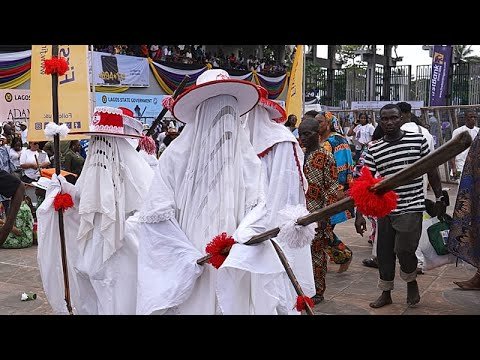
Each Eyo masquerade group represents different wards and families of Lagos Island. The five Eyo groups in order of seniority are Adimu with broad-brimmed black hats as the most senior, followed by Laba in red, Oniko in yellow, Ologede in green, and Agere in purple appearing last.
The hierarchy determines who leads the procession through the streets of Lagos Island. Adimu always takes the foremost position when the groups move together toward Tafawa Balewa Square.
The festival began with preparatory rites including the Ijade Opa, the procession of the staff, on 23 December when the Eyo Oniko group was received at Lagos House in Ikeja by state officials. This step formally opened the eight-year hiatus revival.
The Oba of Lagos, His Royal Majesty Oba Riliwan Babatunde Osuolale Aremu Akiolu I, declared the occasion, confirming that the Adamu Orisha Play remains an occasion-based event rather than an annual fixture.
A President in White: Tinubu's Historic Participation
President Bola Tinubu attended the grand finale at Tafawa Balewa Square dressed in a flowing white agbada with a damask sash, a star-emblazoned hat, and carrying the ceremonial opambata staff. This marked the first time a sitting president actively participated in the masquerade procession.
The President emphasised that the festival underscores Nigeria's tourism potential and positions Lagos as a destination where ancestral rites meet contemporary global interest. His presence drew attention from across West Africa.
Governor Babajide Sanwo-Olu served as host and chairman of the event, describing it as a historic homecoming and an affirmation of Lagos's indigenous heritage rooted in Isale Eko traditions.
Other dignitaries included Governor Hope Uzodimma of Imo State, Femi Gbajabiamila the President's Chief of Staff, traditional rulers, diplomats, and cultural leaders who gathered at the square for the closing rites.
Special prayers were offered for the President and the nation during the ceremony, linking the spiritual elements of the Eyo with national aspirations for unity and prosperity.
The event was timed during Detty December, Lagos's peak tourist season, to maximise international visibility and connect the Adamu Orisha Play with the city's growing reputation for cultural festivals.
The White Spirits: Understanding the Eyo Masquerade Tradition
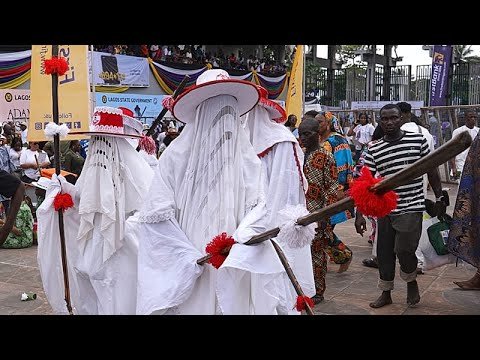
The Eyo masquerades are tall figures entirely draped in white robes, their faces covered, moving in a dignified gliding motion meant to represent ancestral spirits returning to bless the living. They carry the opambata, a long ceremonial staff, and do not speak throughout the procession.
The white symbolises purity and the spiritual realm, a visual code understood across Yoruba communities from Lagos Island to neighbouring states. Attendants walk beside each masquerade to enforce strict protocols.
Strict protocols govern behaviour around Eyo masquerades. They can bless onlookers with a touch of the staff, but inappropriate touching or provoking them carries consequences enforced by attendants who manage protocol during the festival period.
The tradition has its roots in Ibefun, present-day Ogun State, and was brought to Lagos during the reign of Oba Ado. This migration story ties the Adamu Orisha Play to broader Yoruba movements across the region.
Eyo is not a fixed annual festival. It is occasion-based, declared by the Oba of Lagos only when deemed necessary, which makes each edition significant for the families and wards of Isale Eko.
Similar spirit-representation rituals exist across West Africa, including Senegal's Kankurang, the Mandinka initiation masquerade, and the Gelede tradition of the Yoruba, showing how communities maintain ancestral presence through masked performance.
Tourism, Identity, and the Detty December Effect
The Eyo Festival's revival was a centrepiece of Lagos's Detty December campaign, which positions the city as a global destination for culture, music, and entertainment during the holiday period.
The Lagos State Government under Governor Sanwo-Olu's administration actively promoted the event to attract international visitors and diaspora Nigerians returning for the festive season.
The festival represents a broader trend across Africa where traditional cultural events are revitalised as tourism and economic drivers. Senegal's revived Dakar Carnival and Ghana's Year of Return and December in GH initiatives follow similar paths.
Benin's Vodun Days also demonstrate how governments and traditional authorities collaborate to present sacred practices to wider audiences while maintaining core protocols.
The Oba of Lagos, His Royal Majesty Oba Riliwan Babatunde Osuolale Aremu Akiolu I, formally declared the festival, underscoring the collaboration between traditional institutions and modern state governance in Lagos.
With Lagos population over 20 million as Africa's largest city, the return of the Adamu Orisha Play after eight years offered residents and visitors a rare pause to witness heritage in motion.
Controversy and Conversation: The Eyo Incident
The festival was not without controversy. Viral videos circulated showing Eyo masquerades repeatedly striking a man with their staves during the procession, while separate footage showed residents throwing chairs and objects at a group of masquerades.
These incidents sparked debate on social media about tradition, crowd control, and the selective sharing of negative footage from the 27 December 2025 event at Tafawa Balewa Square.
The Eyo attendants enforce strict protocols. The masquerades are considered sacred and inviolable during the festival period, a seriousness rooted in Yoruba understandings of ancestral presence.
Understanding these incidents requires context about the spiritual seriousness with which Yoruba masquerade traditions are treated across Lagos Island communities.
The discussions echoed broader conversations about cultural preservation versus modern sensitivities, similar to debates around bullfighting in Spain or the San Fermín festival.
Most coverage and attendee accounts focused on the celebration's positive aspects, cultural pride, intergenerational transmission, and the rare spectacle of Lagos Island slowing down for ancestral heritage.
Preserving Tradition in a Modern Lagos
A documentary titled The Sacred White of Lagos was referenced in connection with the festival, suggesting growing interest in documenting Nigeria's intangible cultural heritage for future generations.
The Eyo statues and exhibits remain on display year-round at venues like the J. Randle Museum in Lagos, allowing residents to engage with the tradition outside festival dates.
The festival's return after eight years raises questions about how often such events can and should occur in a city of over 20 million people.
Proponents argue that occasion-based scheduling preserves the sacredness of the Adamu Orisha Play, while others advocate for annual editions to sustain tourism momentum.
As Lagos continues its rapid transformation, the balance between modernity and tradition becomes ever more delicate for the indigenous families of Isale Eko.
The five Eyo groups continue to represent different wards, ensuring that the hierarchy of Adimu, Laba, Oniko, Ologede, and Agere remains intact for future declarations by the Oba of Lagos.
What to Watch For
As of July 2026, no announcements have been made about a 2026 edition, consistent with Eyo's nature as an occasion-based rather than annual festival.
The success of the 2025 revival may influence future scheduling decisions by the Oba of Lagos and the traditional Eyo families.
Lagos State continues to promote other cultural festivals, including the Epe Kayo-Kayo Festival in July 2026 and the annual Lagos Carnival, to maintain year-round cultural visibility.
The preservation of Eyo as a living tradition, not just a tourist spectacle, depends on continued support from the Oba of Lagos, the traditional Eyo families, and the Lagos State Government.
For African readers, the festival serves as a reminder that the continent's most powerful cultural assets are often its oldest ones: traditions that have survived colonisation, urbanisation, and globalisation.
The Adamu Orisha Play connects Lagos to wider West African practices such as Senegal's Kankurang, showing shared commitments to honouring ancestors through masked performance.
By Amara Diop, Staff Writer
This article was produced with AI-assisted research and editorial support. Reporting is based on sources cited in the article.
What's Your Reaction?
 Like
0
Like
0
 Dislike
0
Dislike
0
 Love
0
Love
0
 Funny
0
Funny
0
 Wow
0
Wow
0
 Sad
0
Sad
0
 Angry
0
Angry
0

West Africa/Sahel Correspondent at Global1.News. Dakar-based journalist covering politics, security, climate, and development across Francophone and Anglophone West Africa. Tells the stories of a region undergoing profound transformation.












Comments (0)