
JEE Advanced 2026 Results Declared: Over 56,000 Qualify as JoSAA Counselling Begins Tomorrow
JEE Advanced 2026 Results Declared: Over 56,000 Qualify as JoSAA Counselling Begins Tomorrow IIT Roorkee released the JEE Advanced 2026 results today, with more than 56,000 candidates qualifying for admission into the 23 Indian Institutes of Technology across the country. The announcement, made early this morning on the official JEE Advanced portal, marks the culmination of one
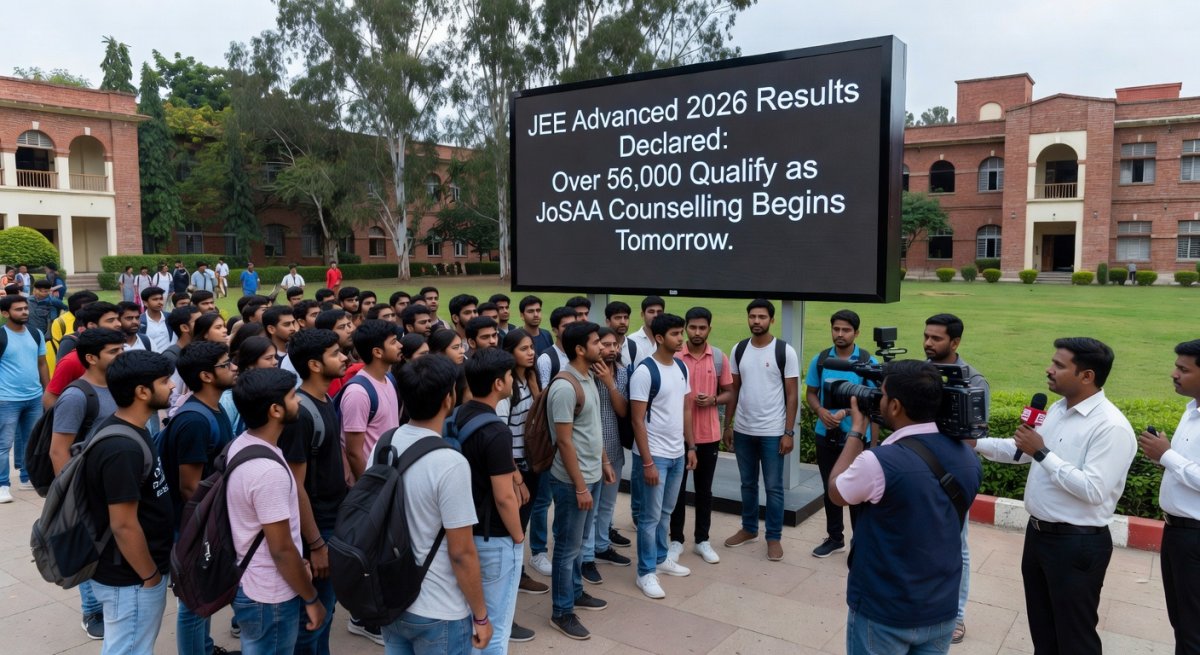
JEE Advanced 2026 Results Declared: Over 56,000 Qualify as JoSAA Counselling Begins Tomorrow
IIT Roorkee released the JEE Advanced 2026 results today, with more than 56,000 candidates qualifying for admission into the 23 Indian Institutes of Technology across the country. The announcement, made early this morning on the official JEE Advanced portal, marks the culmination of one of the world's most competitive engineering entrance examinations.
Candidates who appeared for the exam can now download their scorecards from the official website — jeeadv.ac.in — using their registration number and date of birth. The Joint Seat Allocation Authority (JoSAA) counselling process is set to begin tomorrow, June 2, 2026.
Key Numbers Behind the Results
According to the Indian Institute of Technology Roorkee, which convened the examination this year, over 1.8 lakh candidates registered for JEE Advanced 2026, and approximately 1.6 lakh actually appeared across the two shifts. The qualification rate of roughly 31% — with over 56,000 candidates making the cut — remains consistent with previous years' trends, reflecting the exam's stringent standards.
The IIT Joint Admission Board sets the qualifying criteria each year based on category-wise percentile thresholds. General category candidates typically need to score in the top 20-25 percentile of total registered test-takers to qualify, while reserved categories benefit from relaxed cutoffs as per government norms.
Subject-Wise Performance Trends
Preliminary data from IIT Roorkee indicates that Physics proved to be the most challenging section this year, with the average score across all test-takers dropping approximately 8% compared to the 2025 cycle. Chemistry remained relatively stable, while Mathematics saw a marginal increase in high-scorers — a trend that coaching institutes across Kota, Delhi, and Hyderabad had predicted based on the exam pattern shift announced last November.
The exam featured a redesigned question pattern for the first time since 2023, with increased emphasis on application-based numerical problems rather than pure theoretical recall. This shift appears to have favored students from CBSE and ICSE curricula that emphasize problem-solving over those from state board backgrounds, according to initial analysis by educational researchers.
JoSAA Counselling: What Students Need to Know
The JoSAA counselling process kicks off tomorrow, June 2, at 10:00 AM IST. Qualified candidates must register online at josaa.nic.in and fill in their preferred choices of institute and branch. The process involves six rounds of seat allocation, running through July 2026.
For the first time, JoSAA has integrated a real-time vacancy dashboard that updates after each round, allowing candidates to make informed decisions about upgrading their choices. This digital overhaul follows recommendations from the National Education Policy 2023 implementation committee, which pushed for greater transparency in the engineering admission process.
Key counselling dates to keep in mind: the first round of seat allocation results will be announced next week, while the final round concludes in mid-July. Candidates who secure seats must report to their allotted institutes within the stipulated window to confirm admission.
IIT Intake Capacity and Seat Distribution
The 23 IITs collectively offer approximately 17,000 undergraduate seats across disciplines including Computer Science, Mechanical Engineering, Electrical Engineering, Civil Engineering, and newer interdisciplinary programs like Data Science and Artificial Intelligence, Quantum Engineering, and Climate Science.
Computer Science and AI-related branches continue to command the highest cutoffs, with general category students needing top 500-1,000 ranks for a seat at the older IITs in Delhi, Bombay, Madras, Kanpur, Kharagpur, and Roorkee. Newer IITs in Jammu, Palakkad, Goa, and Dharwad offer more accessible entry points for candidates with mid-range ranks.
What This Means for Indian Education
The release of JEE Advanced results comes amid a broader transformation of India's engineering education landscape. The National Education Policy 2020's phased implementation has introduced greater flexibility in undergraduate curricula, with IITs now offering multiple exit points, interdisciplinary majors, and credit-based course selection that was unimaginable a decade ago.
Education policy analysts have noted that the rising number of JEE Advanced qualifiers reflects both India's demographic dividend and the growing premium placed on STEM education in the country's technology-driven economy. The Times of India has reported on a structural shift where engineering education is no longer just about campus placements — it is about research output, startup incubation, and global employability.
The Road Ahead for the Class of 2026
For the over 56,000 candidates who have qualified today, the journey is far from over. The JoSAA counselling process will demand careful strategy, especially for mid-ranked candidates navigating the complex web of branch preferences and category reservations. For those who did not make the cut, the Indian Institutes of Science Education and Research (IISERs), National Institutes of Technology (NITs), and other centrally funded institutions offer alternative pathways through their own admission processes.
The Class of 2026 enters the IIT system at a moment of significant transformation — with increased focus on research output, international collaborations, and industry-linked curricula. The Union Ministry of Education has allocated ₹3,200 crore for IIT infrastructure upgrades in the current fiscal year, including new research centres in semiconductor design, green hydrogen, and computational biology.
As the JoSAA portal opens tomorrow morning, tens of thousands of Indian families will begin the anxious wait for seat allocations — a ritual that has defined the aspirations of India's middle class for over six decades.
By Dr. Raj Patel, Staff Writer
This article was produced with AI-assisted research and editorial support. Reporting is based on sources cited in the article.
What's Your Reaction?
 Like
0
Like
0
 Dislike
0
Dislike
0
 Love
0
Love
0
 Funny
0
Funny
0
 Wow
0
Wow
0
 Sad
0
Sad
0
 Angry
0
Angry
0

India/South Asia Correspondent at Global1.News. Analytical voice with a background in science and health journalism. Based in New Delhi, covering Indian politics, education, healthcare, technology, and policy. Breaks down complex data into clear, actionable reporting.














Comments (0)