
Syria's First Post-Assad Parliament Convenes as Damascus Charts a New Course
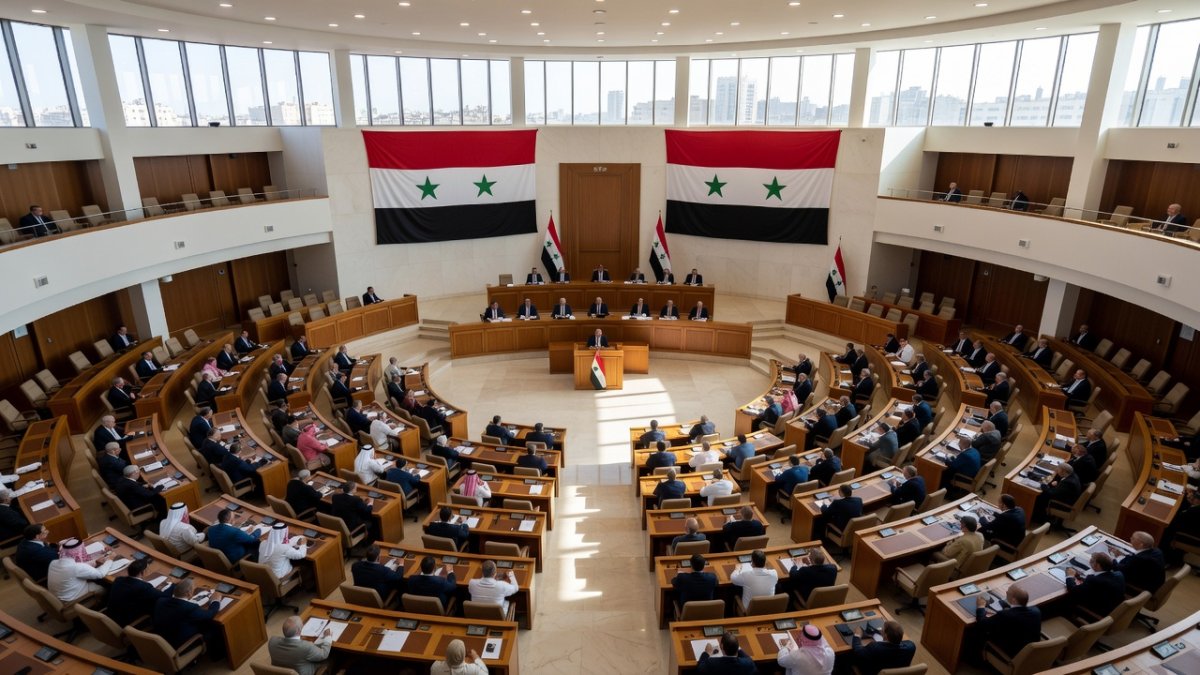
Historic Convening in Damascus The newly elected 210-member People's Assembly convened its first session on Sunday, July 12, 2026, in Damascus, marking the initial parliamentary gathering since opposition forces led by President Ahmed al-Sharaa toppled Bashar al-Assad on December 8, 2024. This event occurred 19 months after the regime change, signaling a deliberate effort to re
Historic Convening in Damascus
The newly elected 210-member People's Assembly convened its first session on Sunday, July 12, 2026, in Damascus, marking the initial parliamentary gathering since opposition forces led by President Ahmed al-Sharaa toppled Bashar al-Assad on December 8, 2024. This event occurred 19 months after the regime change, signaling a deliberate effort to rebuild state institutions following more than five decades of Assad family rule that began with Hafez al-Assad in 1970 and continued under Bashar from 2000 until 2024. Of the 210 members, 206 attended the session, with three absences from Suwayda province attributed to ongoing security challenges.
The composition reflects a hybrid structure: 140 members elected through electoral colleges and 70 appointed directly by al-Sharaa. This setup contrasts sharply with the Baathist-controlled rubber-stamp parliaments of the Assad era, which lacked genuine legislative independence. Supplementary appointees ensured continued representation from Suwayda despite the absences linked to militia violations by Druze leader Hikmat al-Hijri's forces. The session briefly adjourned before reconvening, underscoring procedural formality in the transition process. Analysts view this convening as a foundational step in post-Assad Syria's institutional reconstruction, where attendance figures and provincial accommodations highlight both progress and persistent regional frictions.
Al-Sharaa's Address and Institutional Vision
President Ahmed al-Sharaa addressed the inaugural session, framing the parliament as "a new chapter in Syria's history" and "a platform for truth and justice." He stated, "After liberating our homeland and regaining our freedom, we are all moving toward consolidating the state," while urging lawmakers to transform the body into "a model of responsibility and competence." These remarks positioned the 30-month parliamentary term as a bridge toward future elections, with explicit priorities centered on economic recovery, public services restoration, and the drafting of new laws.
In contrast to the Assad family's 54-year authoritarian grip, where parliaments served merely as extensions of Baathist control without independent authority, al-Sharaa's vision emphasizes accountability and competence. Several Cabinet ministers and officials attended, reinforcing executive-legislative coordination. This address connects to broader regional dynamics, including the decline of Iranian influence and the potential for Gulf reconstruction investments, as lawmakers prepare frameworks that could attract Turkish normalization and sanctions relief. The emphasis on justice and consolidation signals an intent to move beyond pre-Assad parliamentary traditions of limited pluralism toward a more functional institution capable of addressing immediate governance gaps.
Speaker Election and Political Transition
Abdul Hamid al-Awak was elected Speaker of the People's Assembly after three candidates competed: al-Awak, Moayad Hayel al-Qablawi, and Mohammad Ramez Koraj. A former Justice Ministry judge for a decade from Hassakeh province, al-Awak defected from the Assad government early in the uprising and relocated to Turkey, bringing experience that aligns with the transitional emphasis on legal reform. The election process, conducted among 206 attending members, demonstrated the hybrid electoral model's functionality during this interim phase.
The Suwayda situation, where three members were absent due to security issues tied to Hikmat al-Hijri's militia violations, tested the assembly's inclusivity. Supplementary appointees by al-Sharaa maintained provincial balance, illustrating pragmatic adjustments in the political transition. This outcome reflects wider Kurdish dynamics and Arab League reintegration efforts, as the speaker's background from a northern province may facilitate negotiations across ethnic lines. The 30-month term provides space for such adjustments while preparing for eventual direct elections, distinguishing the process from the rubber-stamp mechanisms of prior Baathist parliaments.
Gulf and Turkish Strategic Calculus
The parliament's convening opens pathways for Gulf reconstruction investment and Turkish normalization, as the 210-member body begins addressing economic recovery priorities outlined by al-Sharaa. With sanctions relief potentially tied to institutional stability, lawmakers' focus on public services and new legislation could create conditions attractive to Gulf states seeking post-conflict opportunities in Syria. Turkish engagement, already evident through al-Awak's prior relocation, may accelerate through cross-border economic ties and security coordination.
Analysis indicates that successful consolidation under this assembly could unlock substantial reconstruction funds, contrasting with the isolation that characterized Assad-era governance. The hybrid election and appointment system allows for calibrated representation that appeals to regional actors wary of instability. Israeli security concerns factor into this calculus, as normalized Turkish-Syrian relations might influence border dynamics, while Gulf investors prioritize predictable legislative frameworks over the previous Baathist model of centralized control.
Iranian, Russian, and Great Power Dynamics
The session underscores the decline of Iranian influence in Syria following the December 2024 regime change, as the new parliament operates without the external alignments that defined Assad governance. Russian leverage, once anchored in military and diplomatic support for the former regime, faces similar contraction amid shifting institutional priorities toward economic recovery and law-making. Western powers may gain indirect leverage through engagement with the 30-month transitional body, particularly if it demonstrates competence in public services and sanctions-related reforms.
Great power competition intensifies around these developments, with the assembly's speaker election and attendance patterns signaling reduced space for prior patrons. Al-Sharaa's call for state consolidation positions the parliament as a vehicle for rebalancing external relations, where Iranian and Russian roles diminish relative to emerging Gulf and Turkish interests. This dynamic creates openings for Western actors to support institutional rebuilding without the constraints of the Assad family's 54-year legacy of aligned authoritarianism.
Kurdish Autonomy and Arab League Reintegration
Delicate negotiations over Kurdish autonomy intersect with the parliament's operations, as the Hassakeh-origin speaker and northern representation offer potential bridges in ongoing talks. The assembly's hybrid structure, combining elected and appointed members, provides a forum for addressing autonomy questions within the broader framework of Arab League reintegration. Regional forums could utilize this 30-month term to advance coordinated positions on security and economic issues affecting Kurdish areas.
Analysis of the Suwayda absences highlights parallel challenges in maintaining national cohesion, where militia-related frictions test the body's ability to project unified authority. Reintegration into Arab League structures depends on demonstrating legislative functionality beyond the rubber-stamp parliaments of the Baathist period. Success here could stabilize Kurdish dynamics by embedding them in national law-making processes, fostering regional cooperation that contrasts with the isolation of the Assad era.
Outlook for State Consolidation
Success in state consolidation hinges on the parliament's ability to deliver on al-Sharaa's priorities of economic recovery, public services, and new legislation during its 30-month term. The high attendance rate and speaker election reflect initial momentum, yet persistent security issues in provinces like Suwayda illustrate risks of fragmentation if representation gaps widen. Failure could stall Gulf investments, Turkish normalization, and sanctions relief, while inviting renewed external interference from declining Iranian and Russian channels.
Ultimately, the assembly's performance will determine whether Syria advances beyond the Assad family's authoritarian model toward functional institutions capable of managing Kurdish dynamics, Arab League ties, and great power competition. Sustained competence in these areas offers the clearest path to durable stability, whereas shortcomings risk prolonging transitional uncertainties across the region.
By Malik Hassan, Staff WriterThis article was produced with AI-assisted research and editorial support. Reporting is based on sources cited in the article.
What's Your Reaction?
 Like
0
Like
0
 Dislike
0
Dislike
0
 Love
0
Love
0
 Funny
0
Funny
0
 Wow
0
Wow
0
 Sad
0
Sad
0
 Angry
0
Angry
0
Middle East Correspondent at Global1.News. Based in Beirut, covering politics, conflict, energy, and society across the Middle East. Brings context and depth to a region often reduced to headlines.









Comments (0)