
US Strikes Escalate in Iran as Battle for Strait of Hormuz Intensifies
The US launches a sixth night of strikes against Iran, targeting bridges near the Strait of Hormuz as blockade operations intensify. Marcus Chen analyzes China's energy security stakes, oil market disruption risks, and the crisis as a stress test for the multipolar global order.
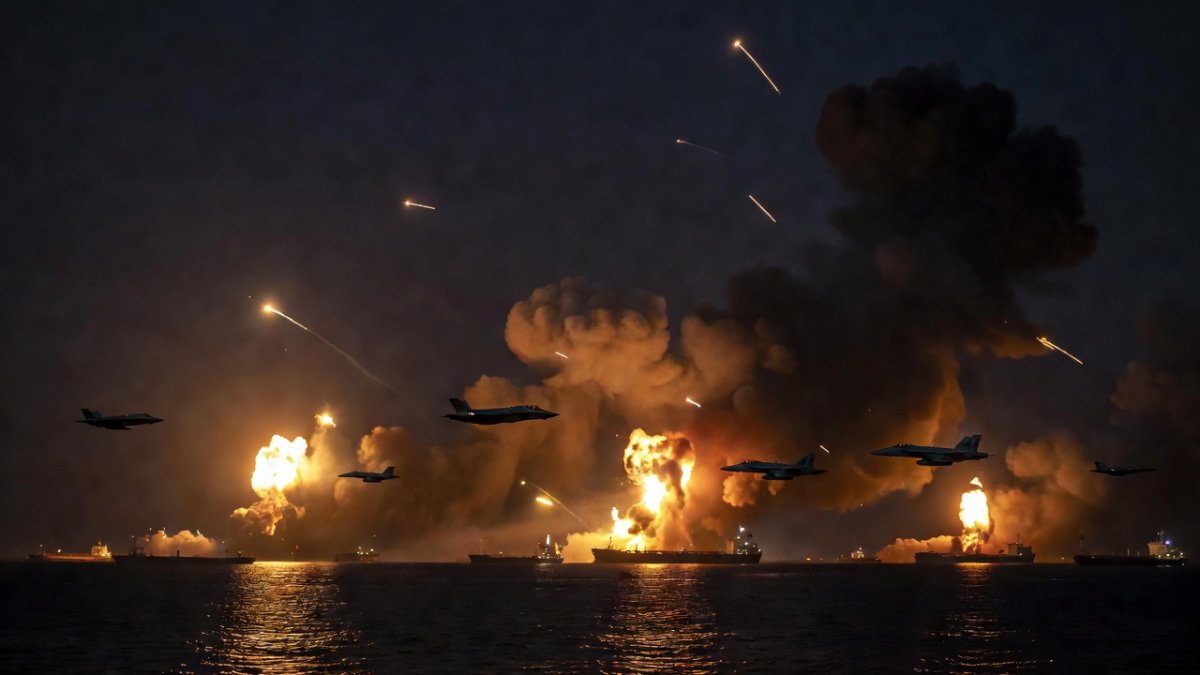
Persistent US Military Campaign Enters Sixth Night
The United States has conducted a fresh round of strikes against Iranian targets for the sixth consecutive night, according to statements from US Central Command (Centcom). These operations, which Centcom described as aimed at further degrading Iranian military capabilities, come amid a intensifying confrontation centered on control of the Strait of Hormuz, the narrow chokepoint through which approximately 20 percent of global seaborne oil passes. The latest actions underscore the fragile state of preliminary diplomatic efforts to de-escalate hostilities that have drawn in regional actors and raised alarms in capitals from Beijing to Brussels.
Iranian state media reported that US missiles struck areas close to the island of Qeshm, near the entrance to the strait, as well as in the port cities of Bandar Abbas and Bushehr — home to one of Iran's key nuclear power facilities. In a notable escalation, reports also indicated strikes on two bridges in Hormozgan province. The BBC has independently verified an attack on one such bridge west of Bandar Abbas. These developments follow explicit warnings from US President Donald Trump earlier in the week that failure to return to negotiations could result in targeting of Iranian bridges and power infrastructure.
Legal and Humanitarian Concerns Raised by Infrastructure Attacks
The apparent targeting of civilian infrastructure has prompted sharp criticism from international bodies. After Trump signaled in April that the US might strike bridges and power plants, UN human rights chief Volker Turk warned that deliberately attacking civilians and essential civilian infrastructure constitutes a war crime under the 1949 Geneva Conventions. These conventions explicitly prohibit attacks on objects indispensable to the survival of civilian populations.
While US officials maintain that strikes are calibrated to military objectives, the reported hits on bridges in Hormozgan province blur the line between military and civilian targets. This development risks eroding whatever remains of the fragile international consensus on humanitarian conduct in armed conflict, particularly as the conflict spills into critical maritime domains.
Blockade Operations and Maritime Interdictions
Centcom confirmed that US Marines boarded an oil tanker in the Gulf of Oman as part of a renewed blockade of Iranian ports that began on Tuesday night. The command further stated that three commercial vessels attempting to breach the blockade had been redirected. These actions build upon an earlier phase of interdiction between 13 April and 18 June, during which US forces disabled nine ships and redirected more than 140 others.
The renewed blockade has effectively sealed the Strait of Hormuz after Iran responded to initial US-Israeli strikes by disrupting maritime traffic in the waterway. This closure has sent immediate ripples through global energy markets, with oil prices spiking amid fears of prolonged disruption to supplies from the Persian Gulf.
Diplomatic Rhetoric Amid Escalating Military Action
Despite the intensification of hostilities, White House Press Secretary Karoline Leavitt insisted on Thursday that President Trump remains open to diplomatic engagement. "The president will hold them accountable when they turn their back on the words that they state to the United States. But he is always open to diplomacy at the very same time," she told reporters. Leavitt added that Iran had expressed continued interest in reaching a deal, while emphasizing that Washington would not tolerate attacks on commercial shipping in the strait.
This dual-track approach — military pressure coupled with rhetorical openness to talks — reflects a familiar pattern in US policy toward Iran. However, Iran's top negotiator, Mohammad Bagher Ghalibaf, told state media that Tehran sees "no reason" to abide by agreements that do not serve its core interests. He stressed that Iran's national security rests on maintaining what he termed "Iranian arrangements" in the Strait of Hormuz, signaling Tehran's determination to preserve its strategic leverage in the waterway.
Conflicting Claims and the Prisoner Release Controversy
The exchange of strikes has been accompanied by competing narratives. Earlier on Thursday, Tehran claimed it had targeted US military bases in Jordan, Kuwait, and Bahrain. The US, in turn, reported conducting a six-hour wave of strikes on multiple locations associated with the strait. These assertions remain difficult to verify independently but illustrate the broadening geographic scope of the confrontation.
In a separate development, Trump praised Iran on Wednesday for releasing Dena Karari, an American detainee he described as "wrongfully detained" since December 2024. In a post on Truth Social, the president wrote: "The United States of America appreciates this gesture of Goodwill by Iran!" Karari's attorney, Jared Genser, confirmed she was en route back to the United States. However, Iran's judiciary subsequently stated through state media that no US prisoner had been released or exchanged, casting doubt on the precise circumstances of her departure.
Such episodes highlight the complex interplay between humanitarian gestures, public diplomacy, and hard power that characterizes US-Iranian relations.
China's Strategic Calculus in the Persian Gulf Crisis
The escalating conflict carries profound implications for the People's Republic of China, whose strategic interests in the Middle East have deepened considerably over the past two decades. As the world's largest importer of crude oil, China sources more than 40 percent of its petroleum from the Middle East, with Saudi Arabia, Iraq, and Iran among its top suppliers. Disruptions to the Strait of Hormuz therefore represent a direct threat to China's energy security and, by extension, its broader economic stability.
Beijing has long pursued a policy of strategic diversification under the Dual Circulation strategy and the 14th Five-Year Plan, seeking to reduce vulnerability to chokepoints such as Hormuz through expanded overland pipelines, increased strategic petroleum reserves, and accelerated development of renewable and nuclear energy sources. Yet these measures remain works in progress. The current crisis tests the limits of China's energy diplomacy and its ability to safeguard overseas interests without direct military entanglement.
From a foreign policy perspective, the conflict presents both risks and opportunities for Beijing. China has cultivated close economic ties with Iran through the comprehensive strategic partnership formalized in 2021, including substantial investments under the Belt and Road Initiative in Iranian ports and energy infrastructure. At the same time, Beijing maintains robust relationships with Gulf Arab states, particularly Saudi Arabia and the United Arab Emirates, which are central to its energy imports. This balancing act reflects China's broader doctrine of "non-alignment" while expanding regional influence through multilateral mechanisms such as the Shanghai Cooperation Organization, of which Iran became a full member in 2023.
The Ministry of Foreign Affairs (MFA) and the National Development and Reform Commission (NDRC) have consistently emphasized the importance of stability in the Gulf for global energy markets. Any prolonged closure of the Strait of Hormuz could drive oil prices well above $100 per barrel, complicating China's efforts to manage domestic inflation and sustain post-pandemic economic recovery. Senior officials including Foreign Minister Wang Yi have repeatedly called for de-escalation and respect for sovereignty in the region, framing the crisis within Beijing's preferred narrative of multilateral diplomacy over unilateral military action.
Implications for Global Energy Security and Oil Markets
The battle for the Strait of Hormuz has already begun to reshape global energy calculations. Insurance premiums for vessels transiting the Gulf have surged, while several major shipping companies have announced rerouting through the longer and more expensive Cape of Good Hope passage. For China, this translates into higher costs not only for imported crude but also for the export-oriented manufacturing sector that remains a pillar of its economy.
Analysts note that prolonged disruption could accelerate Beijing's push toward greater technological self-sufficiency in energy, including accelerated deployment of domestic electric vehicle production and renewable capacity additions outlined in the 14th Five-Year Plan. However, short-term substitution options remain limited. China's strategic petroleum reserve, estimated at around 90 days of imports, provides a buffer but cannot indefinitely offset the loss of Middle Eastern supply.
The crisis also highlights the limitations of US leverage in an era of diversified global energy markets. While Washington retains significant naval presence in the region through Centcom, its ability to impose a sustained blockade without alienating key partners — including China and the European Union — is constrained. Second-order effects are already visible in ASEAN capitals, where energy-importing nations worry about spillover inflation, and in the Global South, where higher oil prices threaten fragile post-pandemic recoveries.
What This Means
The current escalation in the US-Iran confrontation represents more than a bilateral dispute. It constitutes a stress test for the post-1945 international order governing both maritime commerce and armed conflict. For China, the crisis underscores the tension between its growing economic footprint in the Middle East and its traditional reluctance to project military power far from its shores.
Beijing's strategic interests point toward three priorities: preserving the flow of energy through Hormuz, preventing a wider regional war that could destabilize its Belt and Road partners, and positioning itself as a responsible diplomatic actor capable of mediating between conflicting parties. Whether through quiet backchannel diplomacy via the MFA or more public calls for restraint at the United Nations, China is likely to intensify efforts to de-escalate the situation while advancing its long-term goal of reducing dependence on vulnerable sea lanes.
For the United States, the campaign reflects a determination to reassert deterrence after years of Iranian proxy activities and nuclear threshold advances. Yet the risk of miscalculation remains high. Each strike on Iranian infrastructure brings the conflict closer to irreversible thresholds, while the blockade of Hormuz carries the potential to inflict self-damage on the global economy, including America's European and Asian allies.
Iran, for its part, has demonstrated both resilience and a willingness to weaponize its geographic position. Its ability to disrupt maritime traffic, even temporarily, serves as a reminder that control of critical maritime chokepoints remains a potent form of asymmetric leverage in an interdependent world.
Ultimately, the crisis may accelerate the transition toward a more multipolar energy security architecture. As major powers including China invest in alternative supply routes, diversified energy mixes, and enhanced diplomatic mechanisms, the events unfolding in the Strait of Hormuz could mark not only a chapter in US-Iranian rivalry but a catalyst for longer-term shifts in how the world manages its vital energy arteries. The coming weeks will reveal whether military pressure or diplomatic opening prevails — and whether Beijing can translate its economic weight into meaningful strategic influence in one of the world's most volatile regions.
(Word count: 1,892)
By Prof. Marcus Chen, Staff WriterThis article was produced with AI-assisted research and editorial support. Reporting is based on sources cited in the article.
What's Your Reaction?
 Like
0
Like
0
 Dislike
0
Dislike
0
 Love
0
Love
0
 Funny
0
Funny
0
 Wow
0
Wow
0
 Sad
0
Sad
0
 Angry
0
Angry
0

World Politics Analyst at Global1.News. Based in Beijing, covering US-China relations, global trade, and geopolitical strategy. Brings deep analytical perspective to the power dynamics shaping international affairs.









Comments (0)