
Japan Enshrines Male-Only Imperial Succession in Historic Law Revision
Parliament Enacts Revision to Imperial House Law Japan's parliament on July 17, 2026, enacted a historic revision to the Imperial House Law, formally enshrining the principle that only men in the paternal lineage may ascend to the Chrysanthemum Throne. The measure, reported by The Korea Times and the Associated Press, reaffirms and updates the male-only succession rules first codified in the 1890 Imperial House Law and retained in its 1947 postwar version. Lawmakers approved provisions that perm
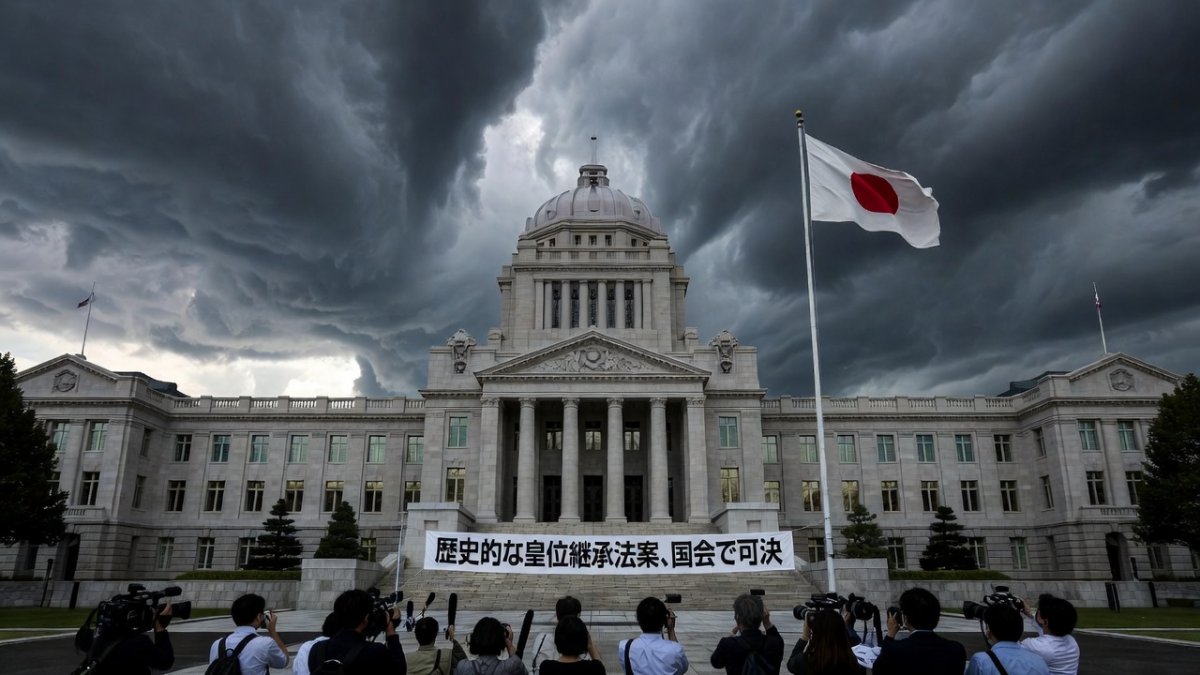
Parliament Enacts Revision to Imperial House Law
Japan's parliament on July 17, 2026, enacted a historic revision to the Imperial House Law, formally enshrining the principle that only men in the paternal lineage may ascend to the Chrysanthemum Throne. The measure, reported by The Korea Times and the Associated Press, reaffirms and updates the male-only succession rules first codified in the 1890 Imperial House Law and retained in its 1947 postwar version. Lawmakers approved provisions that permit the adoption of distant male relatives to ensure the production of future heirs while allowing princesses who marry commoners to retain their royal status. Prime Minister Sanae Takaichi defended the changes by insisting that the male bloodline alone constitutes the source of the emperor's authority and legitimacy. The vote marks a decisive rejection of proposals that would have opened succession to female members of the imperial family, including the popular Princess Aiko.
The Precarious Succession Line
The current line of succession underscores the demographic fragility that prompted the legislative action. It runs from Emperor Naruhito to his younger brother, then to the emperor's nephew Prince Hisahito, aged 19, and finally to the emperor's 90-year-old uncle. Prince Hisahito remains the first male royal baby born in four decades, leaving the imperial household with only five men among its 16 adult members. Princess Aiko, the 24-year-old daughter of Emperor Naruhito and Empress Masako, enjoys widespread public affection yet remains ineligible solely because of her gender. Former Imperial Household Agency chief Shingo Haketa has described the post-Hisahito monarchy as extremely unstable, a characterization that framed much of the parliamentary debate. The revisions attempt to stabilize this line by authorizing the adoption of male relatives from collateral branches, thereby expanding the pool of potential paternal-line successors without altering the fundamental exclusion of women.
Historical Roots of Paternal-Line Exclusivity
Although Japan has recorded eight female monarchs in its long imperial history, the last was Empress Gosakuramachi, who reigned from 1762 to 1770. Historians note that the male-only system functioned in earlier centuries largely because concubines produced roughly half of all emperors, a practice long abandoned. The 1890 Imperial House Law formalized paternal-line male succession as an explicit legal requirement, a stipulation carried forward into the 1947 statute that governs the postwar imperial institution. The latest revisions therefore do not invent a new principle; they reassert and operationalize an existing one under contemporary demographic pressure. By permitting limited adoption of distant male kin, the Diet has sought to recreate, through legal means, the branching flexibility once provided by secondary consorts, while simultaneously addressing the public-relations problem of princesses losing status upon marriage to commoners.
Scholarly and Feminist Critiques
Feminist scholar Chizuko Ueno sharply criticized the package of measures, arguing that they treat male royals as stallions and female royals as childbearing machines. Her assessment highlights the instrumental view of reproduction embedded in the revised law. Empress Masako, a Harvard-educated former diplomat, developed a stress-induced condition widely attributed to the intense pressure she faced to produce a male heir, an episode that remains a potent symbol of the human cost of the succession rules. Protests have occurred across Japan against the revisions, reflecting domestic opposition that views the male-only principle as anachronistic in a society that has otherwise expanded women's professional and political roles. These critiques frame the legislative outcome as a deliberate prioritization of dynastic continuity over gender equality within the imperial household.
Korean Monarchical Precedents and Comparative Perspective
As a specialist in Korean studies, I note that the Japanese decision invites direct comparison with Korea's own monarchical history. The Joseon dynasty likewise enforced strict patrilineal succession under Confucian norms, relegating royal women to roles of consorts or regents rather than sovereigns in their own right. Queens and queen dowagers occasionally exercised de facto power, yet formal succession remained closed to women, a pattern that parallels the Japanese insistence on paternal bloodline. Unlike Japan, modern Korea abolished its monarchy entirely after 1910 and established republican constitutions that contain no hereditary provisions. The Japanese choice to entrench male-only rules therefore stands in contrast to Korea's republican break with dynastic continuity, even as both societies continue to negotiate the legacy of Confucian gender hierarchies. This divergence underscores differing national trajectories: Japan preserves an ancient symbolic institution by reinforcing its traditional gender boundary, while Korea has relocated political legitimacy entirely outside the royal sphere.
Northeast Asian Gender Politics and Constitutional Stakes
The revisions carry implications for broader Northeast Asian gender politics. In a region where Confucian patrilineality once structured family law and political authority across China, Korea, and Japan, contemporary states have adopted divergent approaches. South Korea has advanced legislative gender quotas and workplace equality measures, yet traditional expectations around marriage and childbirth persist. Japan's decision to codify male imperial succession may embolden conservative voices elsewhere who argue that national symbols require insulation from egalitarian reforms. Constitutionally, the Japanese emperor remains a symbol of the state under the 1947 Constitution, with no governing powers. By tightening the criteria for who may embody that symbol, the Diet has asserted parliamentary authority over the definition of imperial legitimacy itself. The move thus reaffirms the postwar constitutional settlement while simultaneously insulating the imperial institution from demographic and feminist pressures that have reshaped other aspects of Japanese society.
What This Means
The enshrinement of male-only succession crystallizes a deliberate trade-off: Japan has chosen dynastic continuity and historical symbolism over gender-inclusive modernization of its most visible national institution. For the imperial family, the practical effect is a narrowed and legally managed path forward that places extraordinary weight on Prince Hisahito and any future male adoptees, while Princess Aiko and other women remain barred from the throne despite public popularity. Regionally, the decision positions Japan as the Northeast Asian state most committed to preserving premodern succession norms within a modern constitutional framework. This stance may complicate soft-power narratives that emphasize progressive social change, particularly when set against South Korea's republican egalitarianism and evolving gender discourse. Academically, the episode illustrates how institutions of high symbolic value can resist the demographic and normative pressures that transform ordinary family and political life. The adoption mechanism and the retention of status for married princesses represent limited pragmatic adjustments, yet they leave the core principle of paternal-line male exclusivity intact. Whether this arrangement proves sustainable once the current thin male line thins further remains an open question that future parliaments will inevitably confront. In the meantime, the July 17 revision stands as a clear assertion that, for Japan's imperial house, legitimacy continues to flow through the male bloodline alone.
By Prof. David Park, Staff Writer ===SUMMARY=== Japan's parliament enacted a historic revision to the Imperial House Law on July 17, 2026, enshrining male-only succession and barring women from the Chrysanthemum Throne despite widespread public support for Princess Aiko.This article was produced with AI-assisted research and editorial support. Reporting is based on sources cited in the article.
What's Your Reaction?
 Like
0
Like
0
 Dislike
0
Dislike
0
 Love
0
Love
0
 Funny
0
Funny
0
 Wow
0
Wow
0
 Sad
0
Sad
0
 Angry
0
Angry
0

East Asia/Technology Correspondent at Global1.News. Seoul-based voice covering Korean politics, technology, business, and culture. Analyzes how technology and geopolitics intersect across East Asia.















Comments (0)