
NASA races to save Swift telescope from falling back to Earth with daring rescue mission
Washington, D.C. — June 29, 2026 — She's been watching the cosmos for nearly 22 years, capturing gamma-ray bursts from black holes and neutron stars across the universe. But now, NASA's Swift Observatory is facing a countdown of its own — and the agency is launching a daring, first-of-its-kind robotic rescue mission to save her before she falls back to Earth. Folks, this is not
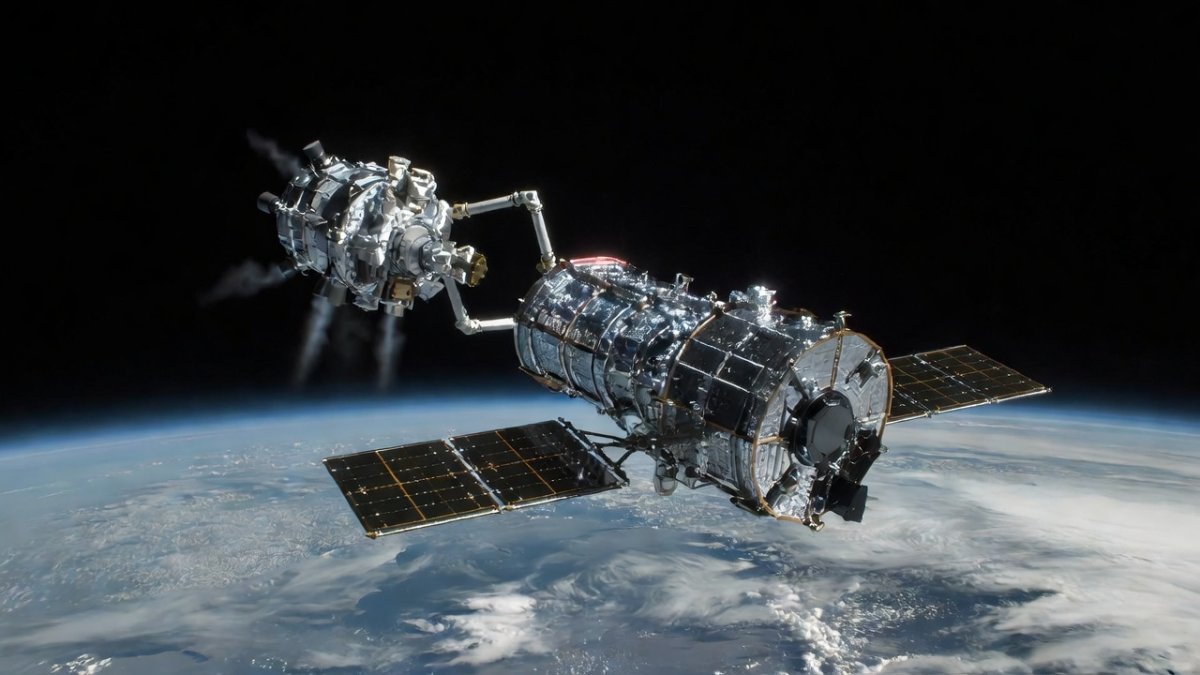
Washington, D.C. — June 29, 2026 — She's been watching the cosmos for nearly 22 years, capturing gamma-ray bursts from black holes and neutron stars across the universe. But now, NASA's Swift Observatory is facing a countdown of its own — and the agency is launching a daring, first-of-its-kind robotic rescue mission to save her before she falls back to Earth.
Folks, this is not science fiction. This is happening. This week.
NASA has greenlit a $30 million mission dubbed LINK — short for "Last In-space Notification for Kennedy" — a bold plan to send a robotic spacecraft to rendezvous with the aging Swift telescope, latch on, and boost it back to a stable orbit. If it works, it'll be the first time NASA has ever attempted an orbital rescue of a science satellite that wasn't designed to be serviced in space.
And if it doesn't? Swift burns up in the atmosphere. End of mission.
The Clock Is Ticking on Swift
Swift launched in November 2004 with an original design life of just two years. Twenty-one years later, she's still doing science — detecting gamma-ray bursts, tracking black holes, and providing critical data on cosmic explosions that reshape our understanding of the universe.
But gravity doesn't care about good intentions. Swift's orbit has been slowly decaying, dropping from its original 600-kilometer altitude to dangerously low levels. According to NASA engineers, the telescope is now losing altitude at an accelerating rate. Without intervention, Swift would re-enter Earth's atmosphere within the next 12 to 18 months.
"We're racing against physics," one NASA mission director told the LA Times. "Every day the orbit drops a little more. We either go now, or we lose her forever."
How the LINK Rescue Mission Works
Here's where it gets incredible. The LINK mission involves launching a custom-built robotic spacecraft that will autonomously navigate to Swift's orbit, match its trajectory, and physically dock with the telescope.
Once attached, LINK's onboard thrusters will fire to raise Swift's orbit by roughly 50 to 80 kilometers — enough to extend the telescope's operational life by another three to five years. The whole operation takes place hundreds of miles above Earth, with both vehicles traveling at roughly 17,500 miles per hour.
"No one thought it was going to be possible," a lead engineer told Space magazine. "Docking with a satellite that was never designed to be docked with? That's a whole new level of difficulty."
The spacecraft has already passed key testing milestones, including a full docking simulation at NASA's Goddard Space Flight Center in May. Engineers replicated Swift's docking ring — which was never intended for capture — and tested LINK's grappling mechanism in zero-g simulators. It worked.
A $500 Million Asset at Risk
Swift isn't just sentimental — it's expensive. The telescope cost $500 million to build and launch, and its scientific output has been enormous. Since 2004, Swift has detected over 1,500 gamma-ray bursts, mapped black holes across the universe, and helped scientists understand the earliest moments after a supernova.
In an era of billion-dollar space telescopes like the James Webb Space Telescope, $30 million for a rescue mission is a bargain. Compared to building and launching a replacement Swift — which would cost billions and take a decade — the LINK mission is a cost-effective gamble.
"The science Swift produces is irreplaceable," an astrophysicist at NASA told USA Today. "There's nothing else in orbit right now that does exactly what Swift does. Losing it would leave a gaping hole in our ability to detect and study gamma-ray bursts in real time."
This Week's Launch Window
NASA has confirmed that the LINK mission is targeting a launch window this week from Cape Canaveral, Florida. A SpaceX Falcon 9 rocket will carry the robotic rescue vehicle into orbit.
The timeline is tight: LINK needs to reach Swift before its orbit decays too far for a safe rendezvous. After launch, the robotic spacecraft will spend several days maneuvering into position before attempting the critical docking sequence.
The entire operation — from launch to docking — will be monitored in real time by NASA's mission control at the Goddard Space Flight Center. If the docking fails, engineers have contingency plans for a second attempt.
What This Means for Space Science
This mission is about more than just one telescope. If LINK succeeds, it opens the door to a whole new era of satellite servicing. Future missions could refuel aging satellites, repair broken instruments, or even attach new scientific payloads to existing spacecraft.
Think of it as roadside assistance for space. Instead of abandoning expensive satellites when their orbits decay, we could send robotic mechanics to give them a boost.
NASA's successful OSIRIS-REx sample return and the ongoing work on the Mars Sample Return campaign have proven that complex robotic operations in space are achievable. LINK takes that one step further — it's not just grabbing a rock or collecting samples. It's grabbing a tumbling, uncontrolled spacecraft and saving its life.
The Bottom Line
This mission matters. Swift has fundamentally changed how we understand the most violent events in the universe — the births of black holes, the deaths of stars, the collisions of neutron stars. Every gamma-ray burst Swift detects is a window into processes so extreme they can't be recreated in any laboratory on Earth.
And right now, that window is closing. The LINK mission is humanity's best shot at keeping it open.
As one NASA engineer put it: "We designed Swift to explore the universe. Now we're going to see if we can explore a way to save her."
Liftoff is expected this week. I'll be watching. You should be too.
What You Can Do: Follow NASA's live coverage of the LINK launch at nasa.gov. Share this story to spread the word about this historic mission. And stay tuned to Global 1 News for updates as this story develops.
By Jessica Ali, Global 1 News
This article was produced with AI-assisted research and editorial support. Reporting is based on sources cited in the article.
What's Your Reaction?
 Like
0
Like
0
 Dislike
0
Dislike
0
 Love
0
Love
0
 Funny
0
Funny
0
 Wow
0
Wow
0
 Sad
0
Sad
0
 Angry
0
Angry
0

Editor-in-Chief at Global1.News. Atlanta-based journalist who cuts through the BS and tells it like it is. Lead anchor, host, and the voice you hear when the spin stops and the truth starts.















Comments (0)