
Lee Jae-myung Revives Inter-Korean Hope in Rome Address
President Lee Jae-myung used a solemn setting in Rome to reaffirm South Korea’s commitment to inter-Korean engagement. Speaking on Sunday, June 14, 2026, at the Basilica of Saint Paul Outside the Walls, Lee described the “ember of hope” for dialogue and cooperation as still alive, even as North Korea maintains its posture of hostility and non-responsiveness. The Setting of the
President Lee Jae-myung used a solemn setting in Rome to reaffirm South Korea’s commitment to inter-Korean engagement. Speaking on Sunday, June 14, 2026, at the Basilica of Saint Paul Outside the Walls, Lee described the “ember of hope” for dialogue and cooperation as still alive, even as North Korea maintains its posture of hostility and non-responsiveness.
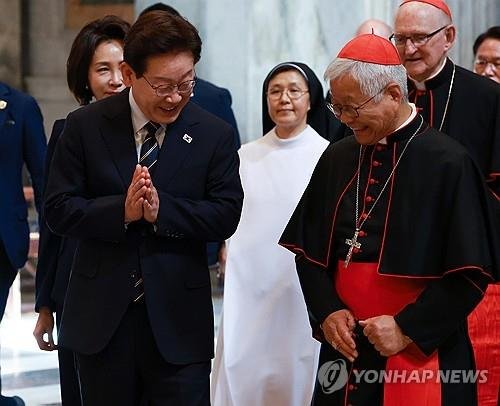
The Setting of the Address
The Mass, celebrated by South Korea-born Cardinal Lazzaro You Heung-sik under the theme of peace and solidarity, provided a distinctive platform for Lee’s remarks. The event occurred during the president’s first European tour since taking office in June 2025, which had already taken him to Belgium for meetings with European Union leaders.
Lee’s choice of venue and audience underscored the administration’s effort to frame inter-Korean policy within a broader international and moral context. By invoking the Vatican’s longstanding support for Seoul’s peace initiatives, the president positioned South Korea’s approach as consistent with global norms of dialogue and reconciliation.
Reference to the 2000 Joint Declaration
Lee explicitly recalled the June 15, 2000 inter-Korean Joint Declaration, describing it as a historic turning point that enabled family reunions, humanitarian cooperation, and people-to-people exchanges. He stated, “I firmly believe the ember of that hope is still alive,” signaling continuity with earlier periods of engagement rather than a rupture.
The 2000 summit between Kim Dae-jung and Kim Jong-il marked the first meeting of the two Korean leaders. Lee’s invocation of that precedent serves both as historical grounding and as a deliberate contrast to the hardline posture of his predecessor, Yoon Suk Yeol.
Policy Commitments Outlined
In the same address, Lee clarified the parameters of his approach. He declared that South Korea would not pursue unification by absorption or unilateral ideological competition. Instead, the administration intends to “do everything we can to overcome the ceasefire and build a peace system.”
Concrete steps already taken include the suspension of propaganda loudspeaker campaigns directed at Pyongyang and renewed efforts to prevent accidental clashes while restoring military confidence-building measures. These actions reflect a systematic attempt to lower tensions and reopen channels that had been closed in recent years.
North Korea’s Continued Stance
Despite these overtures, North Korea has remained unresponsive. Pyongyang continues to characterize inter-Korean relations as those between “two hostile countries” and has sustained missile tests alongside hostile rhetoric. Lee’s remarks therefore acknowledge the reality of limited immediate reciprocity while preserving the possibility of future engagement.
This asymmetry between Seoul’s consistent invitations and Pyongyang’s silence constitutes the central challenge facing the Lee administration’s peace policy. The president’s public expression of hope in Rome can be read as an attempt to keep diplomatic space open without conceding ground on security concerns.
The Vatican Meetings and Papal Invitation
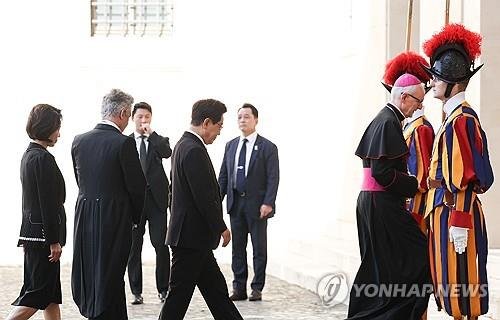
On Monday, June 15, Lee met Pope Leo XIV at the Vatican—the first such encounter between a South Korean president and the pontiff since Moon Jae-in’s meeting with Pope Francis in October 2021. National Security Director Wi Sung-lac announced that Lee had invited Pope Leo XIV to visit South Korea in August 2027 for World Youth Day in Seoul.
Speculation has arisen that any papal visit might extend to North Korea, an unprecedented step given that no pope has ever traveled there. Lee was also scheduled to meet Vatican Secretary of State Cardinal Pietro Parolin, further deepening institutional ties between Seoul and the Holy See.
European Tour and G7 Participation
Following the Vatican engagements, Lee was set to travel to France for the G7 summit in Evian-les-Bains, where South Korea participates as an invited partner country. Discussions were expected to cover the wars in Ukraine and Iran as well as wider global challenges, allowing Lee to place Korean Peninsula issues within a multilateral framework.
The timing of these European engagements illustrates how the Lee administration seeks to leverage international platforms to sustain momentum for inter-Korean dialogue even when direct responses from Pyongyang remain absent.
By Prof. David Park, Staff Writer
This article was produced with AI-assisted research and editorial support. Reporting is based on sources cited in the article.
What's Your Reaction?
 Like
0
Like
0
 Dislike
0
Dislike
0
 Love
0
Love
0
 Funny
0
Funny
0
 Wow
0
Wow
0
 Sad
0
Sad
0
 Angry
0
Angry
0
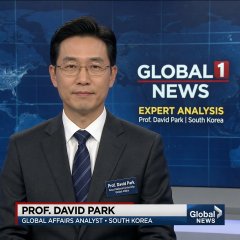
East Asia/Technology Correspondent at Global1.News. Seoul-based voice covering Korean politics, technology, business, and culture. Analyzes how technology and geopolitics intersect across East Asia.











Comments (0)