
Sheshkaris Terminal Halt Disrupts Russian Black Sea Exports
Russia's largest Black Sea oil export facility has abruptly suspended all tanker loadings, sending shockwaves through global energy markets as Ukrainian forces intensify strikes on Moscow's shadow fleet. The Sheshkaris terminal at Novorossiysk, which normally handles 650,000 barrels per day, has seen no activity since Monday amid a targeted campaign that threatens one-fifth of Russia's seaborne crude exports according to the Moscow Times citing Bloomberg data.
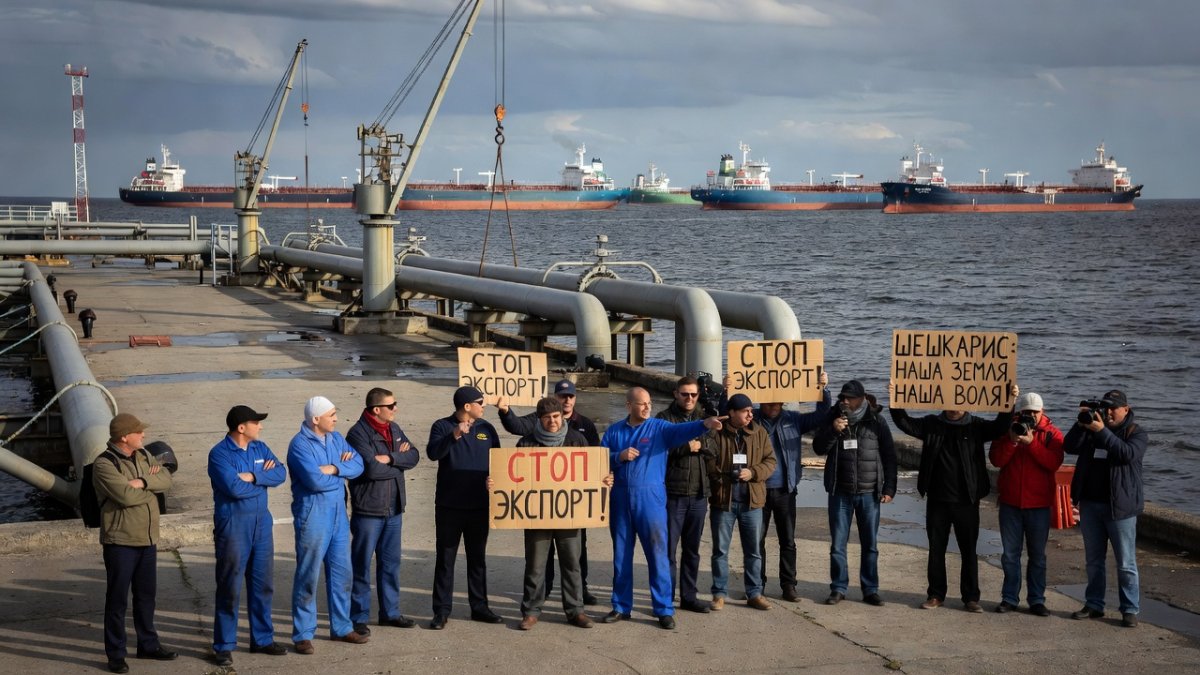
Russia's largest Black Sea oil export facility has abruptly suspended all tanker loadings, sending shockwaves through global energy markets as Ukrainian forces intensify strikes on Moscow's shadow fleet. The Sheshkaris terminal at Novorossiysk, which normally handles 650,000 barrels per day, has seen no activity since Monday amid a targeted campaign that threatens one-fifth of Russia's seaborne crude exports according to the Moscow Times citing Bloomberg data. This halt highlights how maritime chokepoints are becoming decisive battlegrounds in the economic war.
Sheshkaris Terminal Halt Disrupts Russian Black Sea Exports
Moscow, Russia — Article continues...
The Sheshkaris Terminal Halt
Russia's largest Black Sea oil export facility, the Sheshkaris terminal at the Port of Novorossiysk, has suspended all tanker loadings since Monday. The terminal normally handles approximately 650,000 barrels per day, accounting for roughly one-fifth of Russia's seaborne crude exports according to the Moscow Times citing Bloomberg data. Managed by state pipeline monopoly Transneft, the facility processes the majority of Russia's Black Sea crude shipments. Bloomberg and satellite imagery confirm that no tankers have loaded at the site in recent days.
Operation MoLoChKa
Kyiv Independent reported that Ukraine's Unmanned Systems Forces launched Operation MoLoChKa on July 6, an acronym translating to "Moscow will fall because of Crimea." Ukraine's Unmanned Systems Forces claimed the campaign specifically targets Russia's shadow fleet of aging tankers used to evade Western sanctions. Ukraine's Unmanned Systems Forces claimed 159 vessels struck in the first twelve days. The operation has directly disrupted loadings at Novorossiysk, Russia's primary remaining outlet for Black Sea crude after earlier losses in other ports.
In recent days, Ukraine's Unmanned Systems Forces have intensified Operation MoLoChKa, a coordinated campaign that has already claimed strikes on 159 vessels over just 12 days. The operation specifically targets Russia's shadow fleet, a network of aging, uninsured tankers often flagged under obscure registries to bypass the Western oil price cap of $60 per barrel. These vessels, many exceeding 15 years in age and lacking proper insurance, ferry discounted Russian crude through the Black Sea, generating billions in revenue that directly funds Moscow's military operations.
Sea drones and aerial unmanned systems form the core of the strikes, hitting targets both near key ports and while underway. Commander Robert 'Madyar' Brovdi has publicly stated that the goal is to sever Russia's ability to export oil at scale, noting in recent briefings that each disrupted voyage compounds logistical strain across the fleet. Industry analysts from Bloomberg have tracked how these attacks have forced rerouting and delays, directly halting flows at terminals like Sheshkaris and reducing throughput by significant margins in the past week.
The strategic logic centers on choking war financing at its source. By disrupting Black Sea oil logistics, Ukrainian forces aim to create cascading shortages that limit Russia's capacity to sustain prolonged conflict, turning maritime chokepoints into economic battlegrounds where every tanker sidelined represents lost revenue for the Kremlin.
The Broader Drone Campaign
The strikes on energy infrastructure form part of a wider wave that also hit Wildberries warehouses in St. Petersburg, the Leningrad region, and annexed Crimea on Thursday. At least six people were killed in those attacks. Ukrainian forces have expanded strikes beyond maritime targets to include logistics hubs supporting Russia's war effort. These coordinated actions demonstrate an intent to pressure multiple sectors of the Russian economy simultaneously.
Kremlin Response
Russian Foreign Minister Sergei Lavrov described the drone strikes as "terrorism." The Kremlin imposed an unofficial ban on tanker movements at Novorossiysk between midnight and 5 a.m. starting Tuesday, a verbal order confirmed by Reuters. Presidential press secretary Dmitry Peskov has not issued detailed public comments on the terminal closure. Deputy Prime Minister Alexander Novak recently acknowledged fuel shortages in parts of Siberia, indicating existing strain on domestic supply chains before the latest disruptions.
Energy War Context
Russia has relied on a shadow fleet of older, often uninsured vessels to continue oil exports despite Western sanctions. The Black Sea remains a critical artery, with Novorossiysk also handling up to one-third of Russia's grain exports. Prolonged closure of the Sheshkaris terminal would intensify global oil supply pressures already heightened by conflict in the Middle East. Transneft has not publicly detailed alternative routing options for the affected volumes.
Russia has adapted to Western sanctions through elaborate shadow fleet schemes and third-party insurance arrangements that obscure ownership and allow continued sales below the price cap. Oil revenue remains the primary funding mechanism for the war effort, accounting for roughly 30 percent of the federal budget according to recent Russian finance ministry data. This week's halt at Sheshkaris underscores how vulnerable these supply lines have become under sustained pressure.
Reuters reported earlier attacks in 2025, including the November strike on Novorossiysk that temporarily halted all exports from the facility, demonstrated the pattern now expanding into a broader 2026 campaign. The Caspian Pipeline Consortium terminal, also located in the Novorossiysk area, faces similar exposure, with combined disruptions threatening to remove hundreds of thousands of barrels from global markets daily. At current prices, the 650,000 barrels per day affected at Sheshkaris equates to roughly $40-50 million in daily lost revenue, a figure that industry analysts say is already pressuring Moscow's ability to finance imports of critical components.
These developments highlight the Black Sea's role as a critical artery for Russian energy exports, where even temporary halts amplify global supply pressures and force buyers in Asia to seek alternative sources amid tightening availability.
Analysis and Implications
This disruption could indicate growing Ukrainian success in constraining Russia's ability to monetize oil exports, a key revenue source for the war economy. Analysts suggest that sustained pressure on the shadow fleet may force Moscow to divert resources toward port defense and vessel protection, raising operational costs. The combination of export halts and domestic fuel shortages acknowledged by Novak points to compounding vulnerabilities in Russia's energy logistics. Such developments might accelerate the Kremlin's efforts to secure alternative export routes, though capacity constraints limit rapid shifts.
This sustained 2026 campaign marks a clear escalation from the isolated November 2025 Novorossiysk strike, shifting from sporadic disruption to systematic pressure on export infrastructure. The compounding effect is evident in reported fuel shortages across Siberia, where domestic distribution strains combine with export losses to create dual economic pressure on the Russian system. According to energy analysts, these overlapping challenges are forcing refineries to operate below capacity in multiple regions.
Russia's options remain limited. Rerouting via Baltic ports requires extensive rail and pipeline adjustments that cannot absorb the full volume quickly, while temporary storage facilities are already nearing capacity in several terminals. The political calculus for Putin involves weighing acceptance of mounting economic pain against the risks of escalation, including potential retaliation that could draw in additional international actors.
Partner countries such as China, India, and Turkey face indirect consequences through higher spot prices and delivery delays, with some traders already reporting contract renegotiations this week. These ripple effects illustrate how Ukrainian operations are reshaping not only Russian finances but also global energy dynamics tied to the conflict.
Looking Ahead
Further escalation appears likely as Ukraine's Unmanned Systems Forces, led by Commander Robert 'Madyar' Brovdi, continue targeting maritime and logistics assets. A prolonged shutdown at Novorossiysk would likely worsen Russia's fuel distribution problems and add upward pressure on global oil prices. President Vladimir Putin faces mounting economic constraints that could influence decisions on resource allocation and diplomatic positioning. International observers will monitor whether Russia can restore tanker movements without exposing vessels to additional strikes.
By Irina Volkov, Staff WriterThis article was produced with AI-assisted research and editorial support. Reporting is based on sources cited in the article.
What's Your Reaction?
 Like
0
Like
0
 Dislike
0
Dislike
0
 Love
0
Love
0
 Funny
0
Funny
0
 Wow
0
Wow
0
 Sad
0
Sad
0
 Angry
0
Angry
0

Russia/Eastern Europe Correspondent at Global1.News. Covering Russian politics, energy, security, and the shifting dynamics of the post-Soviet space. Provides clear-eyed analysis on one of the world's most opaque regions.













Comments (0)