
Lee Jae-myung Caps First European Tour with G7 Appearance
The Brussels Summit and Institutionalizing EU-Korea Economic Ties President Lee Jae-myung concluded an eight-day European itinerary this week by joining the expanded sessions of the Group of Seven summit in Évian-les-Bains. The journey began in Brussels, where Lee convened the eleventh EU-South Korea summit with European Council President António Costa and European Commission P
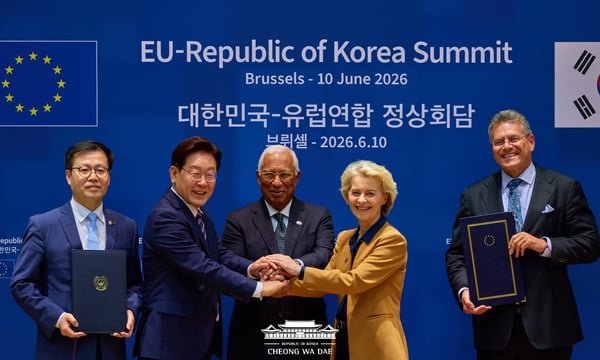
The Brussels Summit and Institutionalizing EU-Korea Economic Ties
President Lee Jae-myung concluded an eight-day European itinerary this week by joining the expanded sessions of the Group of Seven summit in Évian-les-Bains. The journey began in Brussels, where Lee convened the eleventh EU-South Korea summit with European Council President António Costa and European Commission President Ursula von der Leyen. This marked the first such presidential visit to the Belgian capital in eight years and produced a Digital Trade Agreement alongside commitments to launch a High-Level Economic Dialogue and a competitiveness partnership.
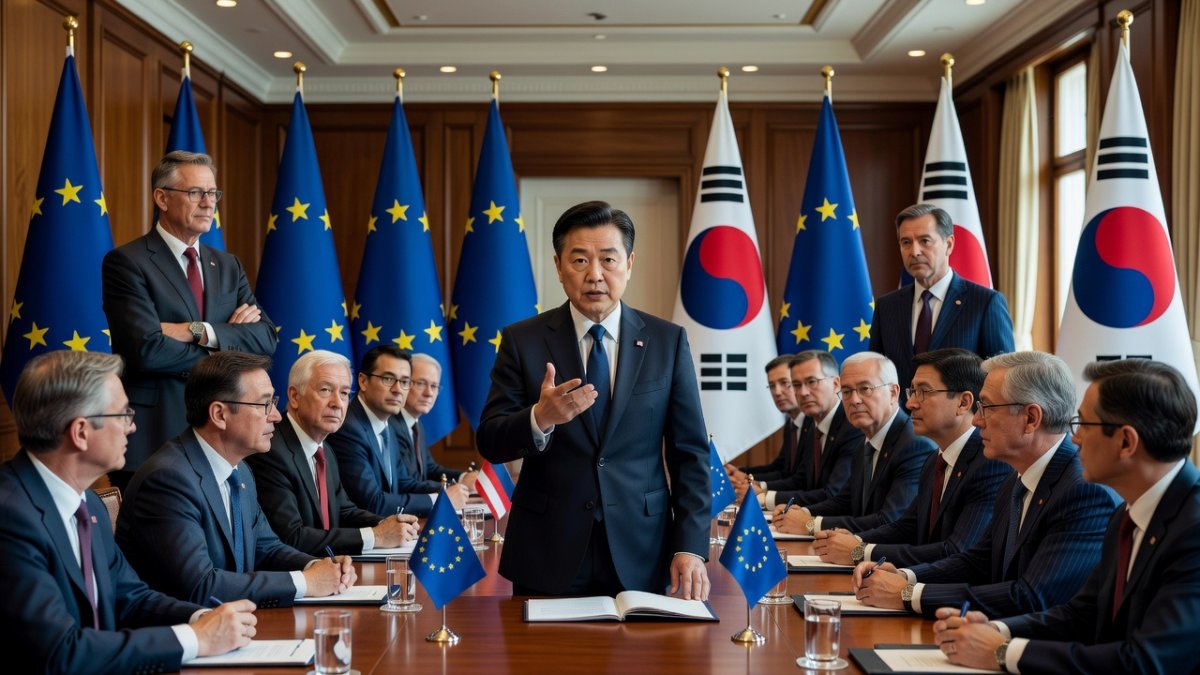
(Global 1 News)
These mechanisms aim to bolster supply-chain resilience at a moment when Korean manufacturers confront simultaneous pressures from U.S. semiconductor export controls and Chinese rare-earth restrictions. The joint statement issued after the summit explicitly condemned third-party support for Russia’s war against Ukraine, naming North Korea’s munitions deliveries as a direct violation of the UN Charter. Such language situates Seoul’s European diplomacy within the broader contest over global norms rather than treating the peninsula as an isolated theater.
Elevating Relations with Italy Through a Special Strategic Partnership
From Brussels, Lee proceeded to Rome for the first state visit by a South Korean president in twenty-six years. Talks with President Sergio Mattarella produced an upgrade of bilateral ties to a special strategic partnership focused on advanced industries, energy security, and supply-chain coordination. A parallel meeting with Prime Minister Giorgia Meloni yielded four memorandums of understanding covering science and technology, African development cooperation, the social economy, and support for small and medium enterprises, together with a five-year action plan extending to 2030.
The target of raising annual people-to-people exchanges to 1.5 million by 2034 reflects a deliberate effort to diversify Korea’s soft-power footprint beyond its traditional Northeast Asian and North American circuits. For Italian policymakers, the partnership offers access to Korean battery and shipbuilding expertise at a time when the EU seeks to reduce dependence on Chinese electric-vehicle components. The reciprocal interest underscores how middle-power diplomacy can generate concrete industrial linkages even when great-power alignments remain fluid.
Vatican Engagement and the Pursuit of Inter-Korean Dialogue
Lee’s schedule included an address at a special Mass for peace at the Basilica of Saint Paul Outside the Walls and a subsequent audience with Pope Leo XIV. In his remarks, the president articulated a vision of reciprocal reinforcement between peninsular peace and global solidarity, explicitly inviting the pontiff to attend World Youth Day 2027 in South Korea. Observers in Seoul have noted that such a visit could create opportunities for papal engagement with North Korean authorities, echoing the precedent set by Pope Francis’s 2014 visit to the South.
Lee’s approach revives elements of the engagement strategy pursued by earlier progressive administrations while adapting them to a more fragmented international environment. The Vatican channel provides a low-risk venue for signaling openness to Pyongyang without immediate security concessions. Whether this produces tangible movement on denuclearization remains uncertain, yet the diplomatic investment itself signals continuity in Seoul’s preference for multilateral rather than purely bilateral approaches to the North Korean question.
Interventions at the G7 and the Trump Exchange
At the G7 gathering, Lee drew attention to the widening gap between development needs in the Global South and stagnating official assistance flows, calling for innovative financing mechanisms. He likewise highlighted unequal access to artificial-intelligence technologies, arguing that innovation must not exacerbate existing economic divides. On the sidelines, Lee held a brief exchange with U.S. President Donald Trump during the group photo session, in which Trump inquired about the state of inter-Korean relations and Lee urged American leadership in pursuing a peaceful resolution.
Lee also met German Chancellor Friedrich Merz to discuss cooperation in AI, energy, and defense. These encounters illustrate the dual-track character of contemporary Korean diplomacy: participation in elite Western forums alongside persistent outreach to Pyongyang. The willingness of a U.S. president to engage directly on North Korea during a multilateral setting suggests that Lee’s European tour may have helped reframe the peninsula issue within a wider transatlantic conversation rather than leaving it confined to U.S.-China bilateral dynamics.
Strategic Implications for Northeast Asian Geopolitics
Lee’s itinerary must be read against the backdrop of intensifying great-power competition in Northeast Asia. By securing explicit EU condemnation of North Korean arms transfers to Russia, Seoul has embedded its security concerns within European normative frameworks at a moment when NATO’s Indo-Pacific partnerships are expanding. The emphasis on supply-chain resilience and digital trade standards simultaneously positions Korea as a rule-shaper in emerging technology governance, an arena where both Washington and Brussels seek partners capable of resisting Chinese dominance.
At the same time, the renewed emphasis on dialogue with Pyongyang risks friction with conservative domestic constituencies and with Tokyo, whose own North Korea policy remains more cautious. Historical precedent shows that progressive Korean administrations have often faced coordination challenges with the United States precisely when engagement initiatives accelerate. Lee’s European tour therefore serves not only to diversify diplomatic options but also to generate external validation that may cushion potential bilateral tensions.
Assessing the Durability of Lee’s European Pivot
The eight-day tour produced tangible institutional outputs: a Digital Trade Agreement, an upgraded Italian partnership, and high-level Vatican access. These achievements reflect a calculated effort to embed Korean interests within European economic and normative structures. Yet the ultimate test lies in whether these new mechanisms translate into measurable influence over North Korean behavior or into concrete gains in technology standards and development financing.
Scholars of Korean foreign policy will watch closely how the High-Level Economic Dialogue and the competitiveness partnership evolve, and whether the anticipated papal visit materializes with any parallel diplomatic opening. In the interim, Lee’s European engagement demonstrates that middle-power diplomacy retains utility even amid polarized great-power relations, provided it is pursued with institutional precision and a clear linkage to peninsular objectives.
By Prof. David Park, Staff WriterThis article was produced with AI-assisted research and editorial support. Reporting is based on sources cited in the article.
What's Your Reaction?
 Like
0
Like
0
 Dislike
0
Dislike
0
 Love
0
Love
0
 Funny
0
Funny
0
 Wow
0
Wow
0
 Sad
0
Sad
0
 Angry
0
Angry
0
East Asia/Technology Correspondent at Global1.News. Seoul-based voice covering Korean politics, technology, business, and culture. Analyzes how technology and geopolitics intersect across East Asia.










Comments (0)