
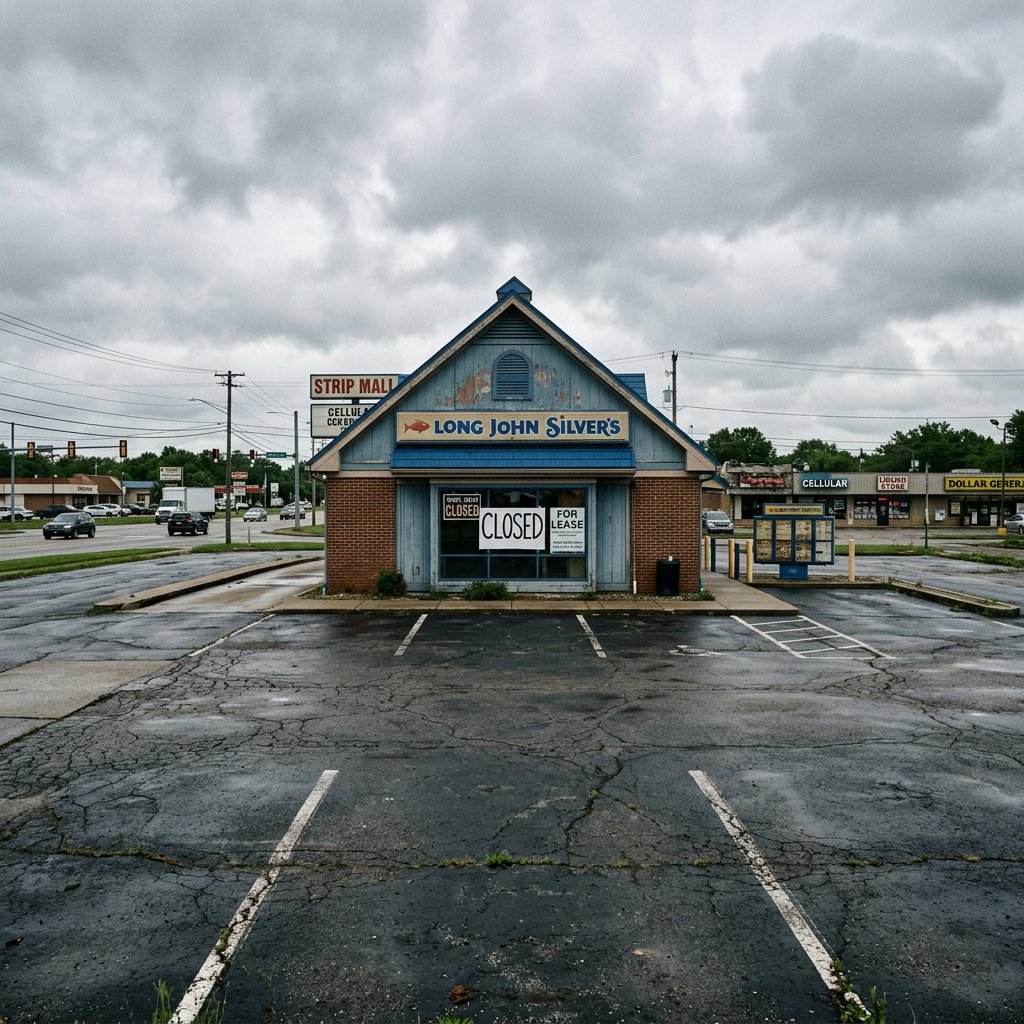
THE BELL TOLLS FOR LONG JOHN SILVER'S: 30 RESTAURANTS SHUTTERED, 18 STATES HIT — AND THIS IS ONLY THE BEGINNING
Long John Silver's closed 30 restaurants across 18 states, dropping from 1,200+ locations at peak to 375 today. The chain is not dead but is restructuring under private equity ownership. Competition, changing consumer habits, and rising costs are blamed. The real story is systematic failure by owners who extracted value instead of investing. Workers are the casualties. Survival is possible but requires a complete change in ownership philosophy.
THE BELL TOLLS FOR LONG JOHN SILVER'S: 30 RESTAURANTS SHUTTERED, 18 STATES HIT — AND THIS IS ONLY THE BEGINNING
By Jessica Ali, Lead Anchor — Global 1 News
Let me be blunt right out of the gate: Long John Silver's is not dead. But it's on life support, and the ventilator is wheezing. The iconic fast-food seafood chain — the one that promised you a "shrimp shack" experience in a paper basket — just closed 30 restaurants across 18 states. That's not a minor trim. That's a chainsaw massacre of a once-mighty brand. And if you think this is the end of the story, you haven't been paying attention.
From a peak of more than 1,200 locations to a skeletal 375 today, this is a brand that has been gutted by private equity, ambushed by changing consumer habits, and outflanked by competitors who actually understand what people want to eat in 2025. The closures are part of what the company calls a "restructuring" — not a full shutdown, they insist. But let's call this what it is: a desperate attempt to stop the bleeding before the patient flatlines.
THE HARD NUMBERS: WHAT ACTUALLY HAPPENED
These 30 closures weren't scattered randomly. They hit 18 states, meaning the average state lost nearly two locations. That's not a "strategic consolidation" — that's a retreat. LJS Partners LLC, the private equity firm that owns the chain, is trying to frame this as a necessary pivot. "We're focusing on our strongest-performing locations," they said in a statement that reads like every other corporate obituary for a brand that's been stripped for parts.
Let me be clear: I am not rooting for failure. I want every worker to keep their job. I want every small-town franchisee to thrive. But when a private equity firm owns the brand — when the people making decisions are not restaurateurs but spreadsheet-wielding financiers — the outcome is almost always the same: squeeze, trim, extract, and exit. The workers are the ones left holding the empty batter bowl.
THE HISTORY: FROM LEXINGTON LEGEND TO PRIVATE EQUITY PUNCHING BAG
Long John Silver's was born in 1969 in Lexington, Kentucky. Think about that. This was the era of fast food's golden age — when chains were built on personality, not quarterly earnings calls. The original concept was genius: a quick-service seafood restaurant that didn't feel like a greasy spoon. It was clean, it was fast, and it was seafood — something that, at the time, was either fancy or fish-fry casual. Long John Silver's split the difference perfectly.
The brand grew rapidly throughout the 1970s and 1980s, becoming a staple of American strip malls and highway exits. By the 1990s, it was a cultural icon. The "Famous Batter-Dipped Fish" was a genuine innovation — crispy, light, and somehow not completely terrible for you. The hushpuppies were a carb-lover's dream. The chicken planks were a solid backup. And the malt vinegar? Pure genius. You didn't just eat at Long John Silver's — you experienced it.
Then came the slow bleed. The chain was sold multiple times, each new owner taking a different approach. Yum! Brands owned it for a while but never seemed to know what to do with it. Then came the private equity vultures. LJS Partners LLC took over, and the decline accelerated. The menu shrank. The quality dipped. The brand identity — once so clear — became muddled. Were they fast food? Fast-casual? A seafood shack? Nobody knew, least of all the customers.
THE ANALYSIS: THREE REASONS LONG JOHN SILVER'S IS SINKING
1. Competition ate their lunch. Let's be real: the fast-food seafood space is not exactly crowded. But the competition that does exist is better. Popeyes has a fish sandwich that is aggressively marketed and actually good. McDonald's Filet-O-Fish is a perennial favorite. Even grocery stores are selling better frozen seafood options. Long John Silver's didn't just lose to other chains — they lost to the entire food industry's ability to offer better, fresher, more interesting seafood at comparable prices.
2. Consumer habits changed. People are eating less fried food. They're demanding transparency about ingredients. They want sustainability — and let's be honest, a fast-food chain selling battered fish from unknown sources is not exactly winning the eco-conscious consumer. Meanwhile, younger generations are flocking to chains like Chipotle, Sweetgreen, and CAVA — places that feel healthier, even if the calorie counts are similar. Long John Silver's is stuck in a 1980s time capsule, and nobody's buying the ticket.
3. Rising costs killed the margins. Seafood is expensive. Battered, fried seafood is even more expensive when you factor in labor, oil, and waste. The fast-food model works best with cheap ingredients — chicken, beef, potatoes. Seafood is inherently volatile. When supply chain shocks hit, Long John Silver's can't absorb the costs the way a McDonald's or a Chick-fil-A can. The result? Higher prices for customers, lower quality to compensate, and a death spiral that ends with "30 restaurants closed across 18 states."
THE WORKER IMPACT: REAL PEOPLE, REAL PAIN
Let's talk about the human cost, because the corporate press releases won't. When 30 restaurants close, that's not just a statistic — that's hundreds of workers who just lost their jobs. Shift managers who were counting on that paycheck to pay rent. Fry cooks who were supporting families. Teenagers working their first jobs. Long-term employees who have dedicated years, sometimes decades, to a brand that just threw them overboard.
And here's what makes me furious: the private equity owners will walk away with their fees. The executives will get their bonuses. The restructuring consultants will get paid. But the workers? They'll get a notice, maybe a severance if they're lucky, and a "we appreciate your service" email that reads like it was written by a chatbot.
I am not saying that every business that closes is a tragedy. Markets change. Brands fail. But when a chain goes from 1,200 locations to 375, and the owners are a private equity firm, the pattern is clear: this is not a natural market correction. This is a systematic extraction of value from a once-thriving enterprise, and the workers are the ones who pay the price.
THE FUTURE OUTLOOK: CAN LONG JOHN SILVER'S SURVIVE?
The company says they're not going out of business. They're restructuring. They're focusing on their strongest locations. They're exploring new formats. They're — and I'm paraphrasing here — "committed to the brand's future."
I've heard this song before. It's the same tune that played before every other private-equity-owned chain went under. The script is almost identical: close underperforming stores, cut costs, squeeze suppliers, reduce labor, and then — when the brand is a hollow shell of its former self — sell the remaining pieces to someone else, or just liquidate.
But here's the thing: I actually think Long John Silver's could survive. Not as a 1,200-location behemoth, but as a leaner, smarter, more focused brand. The demand for quick-service seafood is real. The nostalgia factor is powerful. If they can reinvent themselves — smaller footprint, better ingredients, digital-first ordering, a clear identity — they might have a shot.
But that would require the private equity owners to invest, not extract. It would require them to care about the product, not just the margin. It would require them to see the brand as something worth saving, not just something worth milking. And based on the track record of LJS Partners LLC, I'm not holding my breath.
JESSICA'S TAKE: THIS IS A WARNING SHOT FOR EVERY ICONIC BRAND
Long John Silver's is not just a restaurant chain. It's a symbol of something bigger — the systematic destruction of beloved American brands by financial engineering that values short-term profit over long-term viability. This is happening to Sears. It's happening to Toys "R" Us. It's happening to RadioShack. And now it's happening to a fast-food seafood chain that once defined a category.
If you're a fan of Long John Silver's — and I know you exist, because I am one of you — you should be angry. Not at the competition, not at changing tastes, but at the people who bought this brand and ran it into the ground. The 30 closures are not an accident. They are the result of years of neglect, underinvestment, and a complete failure to adapt to a changing world.
But here's the good news: the brand is not dead yet. 375 locations is not nothing. There is still a loyal customer base. There is still a recognizable name. There is still a chance — a slim one, but a chance — to turn this around. But it will require a fundamental shift in ownership philosophy. It will require someone who actually cares about seafood, not just spreadsheets. And it will require a willingness to take risks, to invest in quality, and to listen to what customers actually want.
Until then, pour one out for the 30 restaurants that just closed. And keep an eye on the remaining 375. Because if this restructuring doesn't work, the next headline won't be about 30 closures. It will be about the end of an era.
WHAT YOU CAN DO
If you want to save Long John Silver's, vote with your wallet. Go to a location and order the fish — not the chicken, not the shrimp, the fish. Bring your friends. Post about it on social media. Make it clear that there is demand for this brand. And if you happen to work at a location that's closing, know that your labor was not wasted — it was stolen by people who never deserved to own your company.
This is Jessica Ali, and I'm not going to apologize for being angry. Because when 30 restaurants close and hundreds of workers lose their jobs, anger is the only appropriate response. The question is: who are you angry at? I'm angry at the private equity owners who let this happen. And I'm going to keep saying it until someone listens.
By Jessica Ali, Staff Writer
This article was produced with AI-assisted research and editorial support. Reporting is based on sources cited in the article.
What's Your Reaction?
 Like
0
Like
0
 Dislike
0
Dislike
0
 Love
0
Love
0
 Funny
0
Funny
0
 Wow
0
Wow
0
 Sad
0
Sad
0
 Angry
0
Angry
0

Editor-in-Chief at Global1.News. Atlanta-based journalist who cuts through the BS and tells it like it is. Lead anchor, host, and the voice you hear when the spin stops and the truth starts.












Comments (0)