
Japan Coffee Cultivation Advances with Smart Agriculture
Japan ranks as the world's fourth-largest coffee consumer, importing nearly all of its roughly 400,000 tons consumed each year. A US research institute forecasts that suitable Arabica growing areas worldwide will be halved by 2050 due to climate change, while global consumption is projected to reach 10.16 million tons in fiscal 2026. These pressures have prompted Japanese compa
Japan ranks as the world's fourth-largest coffee consumer, importing nearly all of its roughly 400,000 tons consumed each year. A US research institute forecasts that suitable Arabica growing areas worldwide will be halved by 2050 due to climate change, while global consumption is projected to reach 10.16 million tons in fiscal 2026. These pressures have prompted Japanese companies and research institutions to test controlled-environment cultivation techniques that align with national Smart Agriculture goals and climate adaptation strategies under Society 5.0.
Japan Coffee Cultivation Advances with Smart Agriculture
Tokyo, Japan – July 8, 2026 — Domestic output remains limited, with an estimated 10 tons produced annually, concentrated in Okinawa's Yanbaru region, the Ogasawara Islands, Kagoshima, and Miyazaki. Approximately 30 farms in Okinawa grow small-batch Arabica varieties such as Yellow Bourbon and Typica. New projects are extending cultivation northward through protected environments that address temperature constraints, supporting broader agricultural technology policy objectives for regional resilience.
Bankoku Coffee and Yamako Farm Initiatives in Yamagata and Okayama
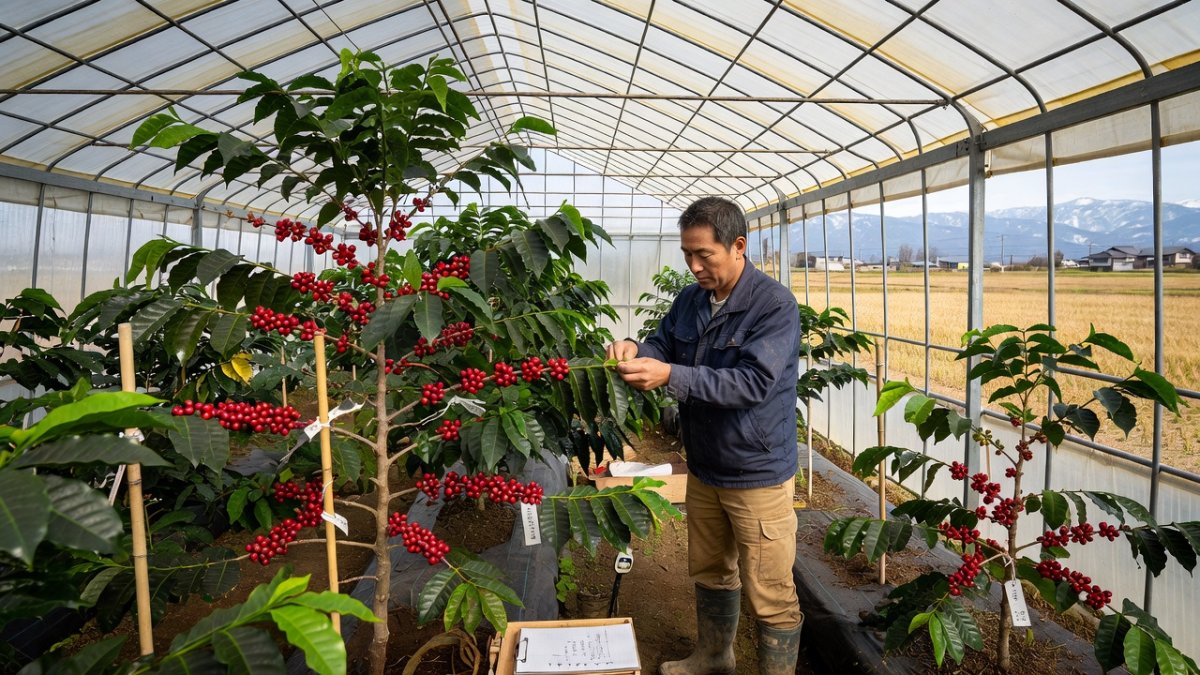
Bankoku Coffee, a food wholesaler in Yamagata Prefecture about 400 km north of Tokyo, began leasing farmland for coffee cultivation in 2020. The operation maintains around 40 coffee trees inside a plastic greenhouse, achieving its first harvest in 2024 under the management of Hiroyuki Akatsuka. Roughly half of the initial 150 trees did not survive early trials. Akatsuka described the resulting beans as having a smooth mouthfeel and well-balanced tangy orange-like acidity, with plans to open an adjacent cafe.
Yamako Farm in Okayama Prefecture has supplied seedlings and technical expertise since 2020. President Kosuke Yamamoto noted rising global demand alongside shrinking suitable cultivation zones by 2050, reporting inquiries extending as far north as Hokkaido and Tohoku. These efforts illustrate practical applications of precision environmental controls promoted through Japan's agricultural technology frameworks.
Nichibei United and Controlled-Environment Systems in Okayama
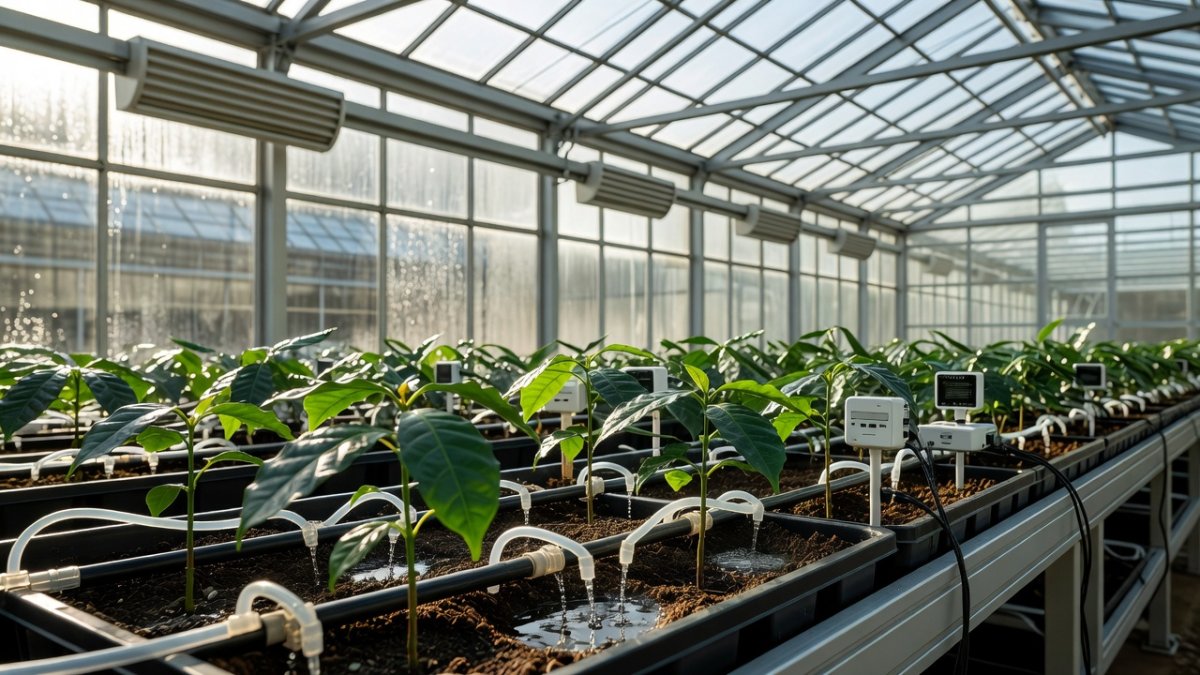
Nichibei United Corp, an Osaka-based energy trading company, planted more than 1,100 Typica coffee trees across eight greenhouses in Soja, Okayama Prefecture beginning in 2024. Project manager Kenji Tsujino oversaw installation of underground drainage after initial flooding and deployment of shade nets during summer plus heaters in winter to sustain the 18-24 C range required by the plants. Such integrated climate-management technologies directly support national Smart Agriculture initiatives aimed at stable production under variable weather conditions.
Yuumu Farm, Hirono Town, and Ishizuka Glass Trials
Yuumu Farm in Shintoku, Hokkaido, collaborates with Hokusei Gakuen University and Rakuno Gakuen University on research using surplus heat from biogas power generation to protect seedlings through winter. Manager Masatoshi Yuasa reported successful growth to one meter in height. In Fukushima Prefecture, the Hirono Town Promotion Corporation has conducted experiments since 2020, with representative Hirofumi Nakatsu emphasizing contributions to post-Great East Japan Earthquake recovery through successful cultivation. Ishizuka Glass Co in Aichi Prefecture launched a three-year trial in spring 2025, testing approximately 10 coffee varieties under greenhouse conditions.
Technological and Policy Implications for Society 5.0
Greenhouse heating costs remain substantial in northern regions, yet the projects demonstrate incremental progress in adapting coffee production through data-driven environmental controls. These align with Japan's agricultural technology policy, which promotes Smart Agriculture tools for climate resilience and regional revitalization. By integrating sensor monitoring, waste-heat recovery, and protected cultivation, the initiatives contribute to Society 5.0 objectives of merging digital innovation with traditional farming to enhance food security. Coffee trees require three to five years to reach full production, underscoring the long-term nature of these technology-supported experiments.
China's coffee consumption, which tripled from 120,000 tons in 2010 to more than 360,000 tons in 2024, further illustrates shifting Asian demand patterns that Japanese producers are positioning themselves to address through domestic technological adaptation.
What to Watch For
The Ministry of Agriculture, Forestry and Fisheries (MAFF) has been monitoring the development of domestic coffee production as part of its broader strategy for agricultural diversification and climate resilience. The coming years will determine whether northern greenhouse coffee cultivation can achieve commercial viability, with Yamagata's Bankoku Coffee aiming to open its farm-to-cafe experience and Okayama's Nichibei United expanding its Typica plantation. Researchers in Hokkaido continue to refine the use of biogas heat for seedling protection, while Fukushima's Hirono Town Promotion Corporation pushes forward as part of regional recovery. As Japan's coffee dependency meets the realities of a warming planet, the intersection of agricultural technology and climate adaptation will shape whether domestic beans become a meaningful supplement to the nation's 400,000-ton annual coffee demand.
By Kenji Tanaka, Staff Writer
This article was produced with AI-assisted research and editorial support. Reporting is based on sources cited in the article.
What's Your Reaction?
 Like
0
Like
0
 Dislike
0
Dislike
0
 Love
0
Love
0
 Funny
0
Funny
0
 Wow
0
Wow
0
 Sad
0
Sad
0
 Angry
0
Angry
0

Japan Correspondent at Global1.News. Tokyo-based voice covering Japanese politics, technology, economy, and culture. Tracks the intersection of tradition and innovation in one of the world's most dynamic societies.















Comments (0)