
JandK Adds 200 E-Buses to Fleet, Free for Women, Connecting Rural Areas
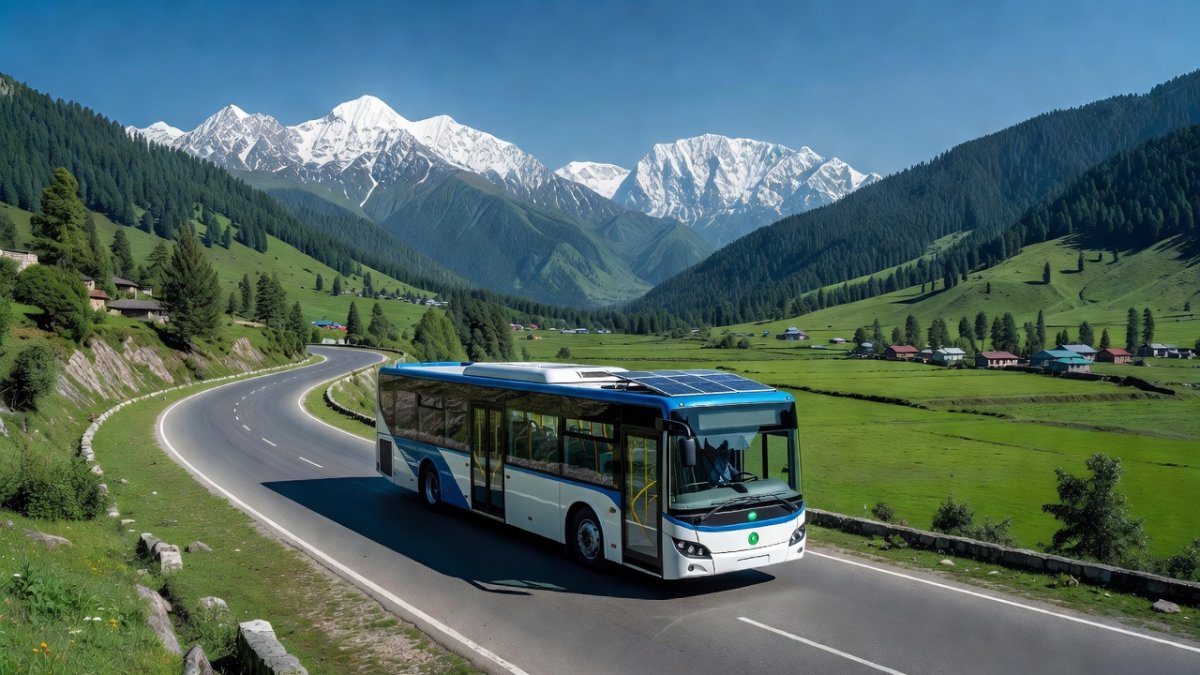
Breaking Down the J&K Electric Bus Expansion The Jammu and Kashmir administration has approved the induction of 200 new electric buses into the state transport fleet, with operations slated to begin by December 2026. These buses will link rural blocks in the Kashmir Valley and Jammu region with key tourist circuits including Gulmarg, Pahalgam, Sonamarg, Vaishno Devi, and Patnit
Breaking Down the J&K Electric Bus Expansion
The Jammu and Kashmir administration has approved the induction of 200 new electric buses into the state transport fleet, with operations slated to begin by December 2026. These buses will link rural blocks in the Kashmir Valley and Jammu region with key tourist circuits including Gulmarg, Pahalgam, Sonamarg, Vaishno Devi, and Patnitop, while extending coverage along the Srinagar-Ladakh highway corridor. The initiative also mandates zero fares for all women passengers, a policy extension of existing schemes in select districts.
This rollout forms part of a larger 1,050-bus modernisation plan approved under the Atal Mission for Rejuvenation and Urban Transformation (AMRUT) 2.0 and the Smart City Mission for Srinagar and Jammu. Of the 200 units, 120 will be 9-metre midi-buses suited for hilly terrain, while 80 will be 12-metre standard buses for inter-district routes. The Jammu and Kashmir State Road Transport Corporation will operate the fleet, with an estimated annual ridership target of 4.8 million passengers once fully deployed.
Policy Context: India's National Electric Bus Push
The J&K announcement aligns directly with the central government’s electric mobility framework. Under the FAME India scheme Phase II, administered by the Ministry of Heavy Industries, 5,095 electric buses have already been sanctioned across 64 cities as of March 2026. Phase III guidelines, currently under finalisation by NITI Aayog and the Bureau of Energy Efficiency, aim to scale this to 50,000 electric buses nationwide by 2030. J&K’s 200-bus order represents the first major deployment in a Union Territory following the 2024 revision of FAME subsidy norms that increased support for hilly states to ₹45 lakh per 9-metre bus.
State transport departments in Delhi, Maharashtra, Karnataka, and Kerala have already operationalised larger fleets. Delhi’s 1,650 electric buses now account for 38 percent of its public transport fleet, while Maharashtra’s 1,200 buses under the Mumbai Metropolitan Region Development Authority have logged 42 million kilometres since 2023. J&K’s smaller but geographically ambitious programme therefore tests the viability of electric mobility in high-altitude, low-density corridors that other states have yet to prioritise.
Environmental and Public Health Impact in the Valley
The Central Pollution Control Board recorded average PM2.5 concentrations of 47 micrograms per cubic metre in Srinagar during winter 2025, exceeding the national safe limit of 40 micrograms. Transport contributes approximately 28 percent of particulate emissions in the Kashmir Valley according to 2024 inventory data from the Jammu and Kashmir Pollution Control Committee. Replacing 200 diesel buses with electric equivalents is projected to eliminate 1,850 tonnes of CO2 and 12.4 tonnes of NOx annually once the fleet reaches 80 percent utilisation.
Health modelling by the Indian Council of Medical Research suggests that sustained reduction of transport-related PM2.5 by even 15 percent could lower annual respiratory disease hospitalisations in Srinagar and Anantnag districts by 2,300 cases. This is particularly relevant for the 1.4 million residents living within 500 metres of the proposed routes, many of whom currently experience elevated rates of childhood asthma linked to diesel exhaust.
Free Travel for Women: A Social Welfare Dimension
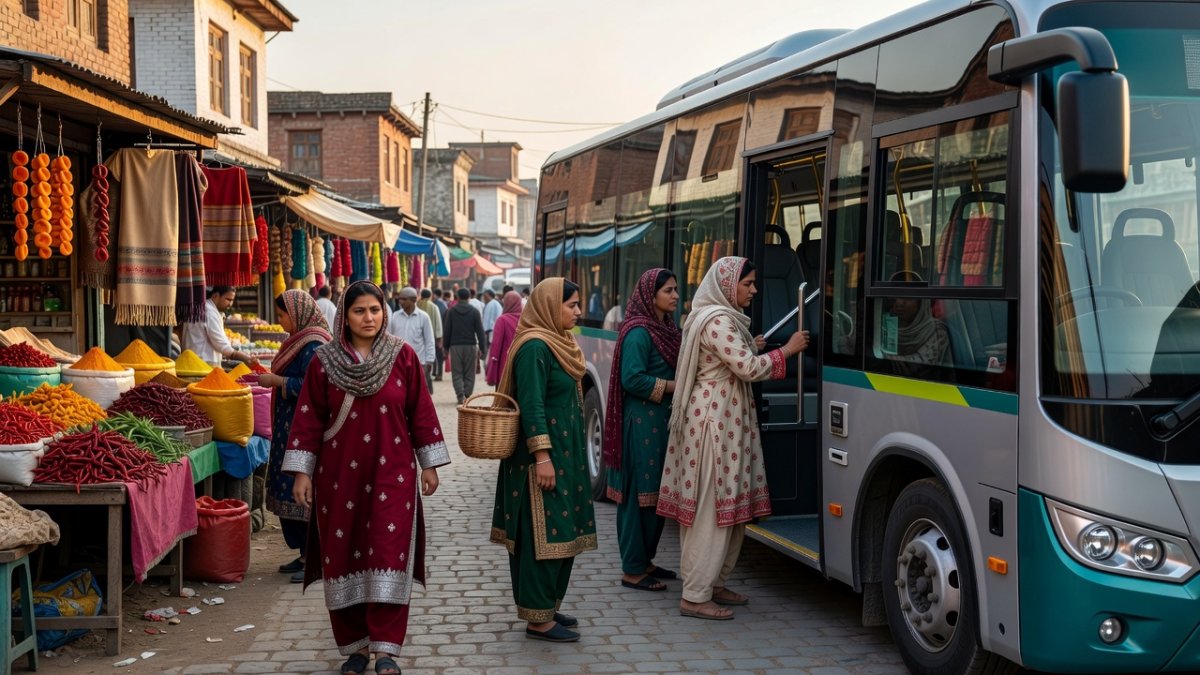
The decision to provide free travel for women builds on successful pilots in Punjab and Tamil Nadu, where zero-fare policies increased female public transport usage by 31 percent within 18 months. In J&K, women currently constitute only 22 percent of bus passengers on rural routes, largely due to safety concerns and cost. Officials estimate the free-travel provision will add 1.1 million additional female trips per year, directly supporting economic mobility for 68,000 women employed in tourism and handicraft sectors across Ganderbal, Baramulla, and Udhampur districts.
The policy also intersects with the Ministry of Housing and Urban Affairs’ gender-responsive urban planning guidelines under AMRUT, which require states to allocate at least 15 percent of transport budgets toward women-specific interventions. J&K has earmarked ₹9.2 crore annually to subsidise the fare waiver, funded through a combination of state revenues and central grants under the Smart City Mission.
Rural Connectivity and Tourism Development
The 200 buses will serve 142 previously unconnected panchayats in the Kashmir Valley and Jammu region, reducing average travel time to the nearest market or health centre by 47 minutes. Tourist circuits stand to benefit significantly: daily service to Gulmarg and Sonamarg will increase from four to 14 departures during peak season, while dedicated electric shuttle services to Vaishno Devi base camp in Katra are expected to handle 8,500 pilgrims daily by 2027.
These improvements align with the Union Territory’s tourism target of 2.5 crore annual visitors by 2028. Electric buses will also reduce noise pollution along the ecologically sensitive Zojila Pass corridor, supporting biodiversity conservation efforts in the vicinity of the proposed Zojila tunnel project.
Challenges and Infrastructure Requirements
Successful deployment hinges on charging infrastructure. The J&K Power Development Department has identified 38 locations for 50 kW fast chargers, yet only 12 sites currently possess adequate grid capacity. The estimated ₹142 crore infrastructure cost will be met through convergence of FAME III funds and the state’s Green Energy Corridor project. Battery performance in sub-zero winter temperatures remains a technical concern; operators plan to deploy buses with 280 kWh packs and thermal management systems rated for minus 15 degrees Celsius.
Driver training programmes, to be conducted by the Automotive Research Association of India, will cover 650 personnel by March 2027. Maintenance protocols must also account for the limited availability of spare parts in remote Ladakh highway depots.
The Bottom Line
Jammu and Kashmir’s 200-bus programme represents a measured yet strategic step in India’s broader transition to electric public transport. By integrating national schemes such as FAME and AMRUT with local priorities of rural connectivity, women’s mobility, and tourism growth, the Union Territory is positioning itself as a test case for electric mobility in challenging geographies. The public health dividend from reduced air pollution, combined with measurable gains in female workforce participation, offers tangible benefits to citizens beyond simple emission reductions. Success will ultimately depend on timely infrastructure delivery and sustained fiscal support, yet the initiative marks a credible contribution toward India’s 2070 net-zero commitment in the transport sector.
Source: NDTV News — "J&K To Add 200 New E-Buses To Fleet, Will Connect Rural And Tourist Areas," June 28, 2026
— By Dr. Raj Patel, Staff Writer
This article was produced with AI-assisted research and editorial support. Reporting is based on sources cited in the article.
What's Your Reaction?
 Like
0
Like
0
 Dislike
0
Dislike
0
 Love
0
Love
0
 Funny
0
Funny
0
 Wow
0
Wow
0
 Sad
0
Sad
0
 Angry
0
Angry
0

India/South Asia Correspondent at Global1.News. Analytical voice with a background in science and health journalism. Based in New Delhi, covering Indian politics, education, healthcare, technology, and policy. Breaks down complex data into clear, actionable reporting.














Comments (0)