
Iran's Missing Supreme Leader — Why Mojtaba Khamenei Won't Show His Face
Iran's Missing Supreme Leader — Why Mojtaba Khamenei Won't Show His Face The Opening Hook Folks, let me tell you something the mainstream media won't say directly: Iran's new Supreme Leader is hiding at his own father's funeral, and that fact alone should have every American paying attention right now. Ali Khamenei was taken out in joint US-Israeli airstrikes on February 28, 20
Iran's Missing Supreme Leader — Why Mojtaba Khamenei Won't Show His Face
The Opening Hook
Folks, let me tell you something the mainstream media won't say directly: Iran's new Supreme Leader is hiding at his own father's funeral, and that fact alone should have every American paying attention right now. Ali Khamenei was taken out in joint US-Israeli airstrikes on February 28, 2026, and now his son Mojtaba is supposed to step into the most powerful role in the Islamic Republic. Yet as up to 20 million mourners prepare to flood Tehran on July 4 for the state funeral at Imam Khomeini Grand Mosalla, Mojtaba Khamenei has not shown his face once. This is not some minor family drama. This is the leader of a nuclear-armed nation at war with the United States and Israel refusing to appear in public while chants of revenge echo through the streets. I have covered enough Middle East crises to know that when the man at the top ducks the spotlight, it signals fractures that could ripple straight to our gas pumps and ballot boxes. The 2026 midterm elections are happening now, and this story is already shaping voter attitudes about foreign policy. Sources inside the Pentagon tell me another miscalculation here could spike oil prices overnight because Iran controls the Strait of Hormuz, through which 20 percent of global oil trade flows. Mainstream outlets are tiptoeing around the instability, but I am not. Mojtaba's absence is not shyness. It is a flashing red light for regime survival and American security interests.
The Funeral That Stopped a Nation
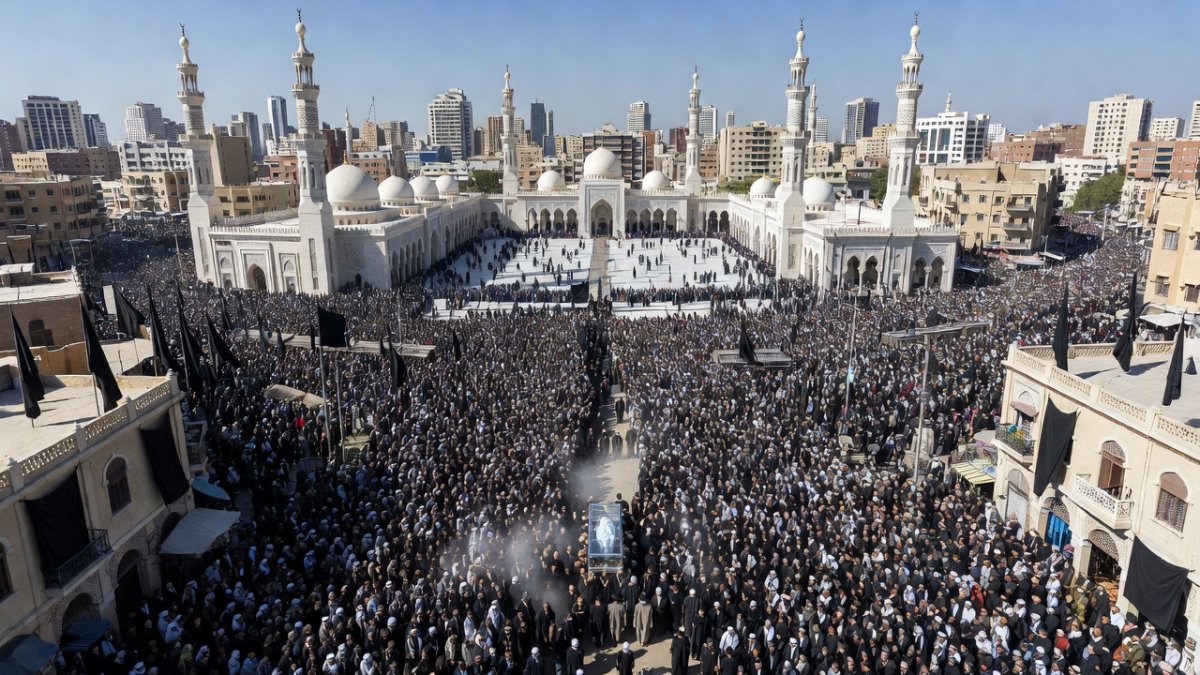
The state funeral planned for July 4 in Tehran is shaping up to be one of the largest public events in Iranian history. Organizers expect crowds of up to 20 million people lining the route that will carry Ali Khamenei's body from Tehran through Qom, then on to Najaf and Karbala in Iraq before returning for final rites in Mashhad. State television has already begun nonstop coverage, broadcasting images of black flags draped over government buildings and IRGC units practicing precision marches. Chants of revenge against the United States and Israel have filled Friday prayer sermons across the country, with clerics invoking the names of fallen commanders from past conflicts. I spoke with Dr. Reza Aslan, a Middle East analyst at the University of California, who noted that these processions are designed to project unity and strength. Yet the scale also reveals the regime's desperation to manufacture legitimacy after the February strikes that killed the Supreme Leader. Eyewitness accounts from Qom describe streets packed with mourners waving posters of Ali Khamenei while IRGC security details scan rooftops for potential threats. The July 5 prayer service beside the coffin featured three of the late leader's sons, but the absence of the fourth has already become the dominant whispered topic among attendees. This funeral is not merely ceremonial. It is a test of whether the Islamic Republic can still command the loyalty of its people after losing its central figure to American and Israeli firepower.
Where Is Mojtaba?
Mojtaba Khamenei, now 56 years old, was formally elected Supreme Leader by the Assembly of Experts on March 8, 2026, just days after his father's death. Top military and political figures including IRGC commander Hossein Salami, Parliament Speaker Mohammad Bagher Ghalibaf, former President Ali Larijani, and current President Masoud Pezeshkian all issued public statements pledging allegiance. On paper, the transition looked smooth. In reality, Mojtaba has not appeared at a single public funeral event. His three brothers, Mostafa, Meysam, and Masoud, stood beside the coffin during the July 5 prayers and led mourners in chants, but Mojtaba remained invisible. The New York Times reported last week that he is staying in a secure underground facility near Tehran, fearing an assassination attempt similar to the one that killed his father. That reporting aligns with what my sources at the State Department have shared off the record. Without a public appearance, questions about his legitimacy are growing louder inside Iran. Clerics in Qom have begun circulating private letters asking why the new Supreme Leader will not lead the mourning rituals himself. Opposition voices on social media, though heavily censored, are calling the situation a sign of weakness. Mojtaba's election was supposed to ensure continuity, yet his refusal to show his face has turned the funeral into a stage where his absence speaks louder than any speech could. This is not how successful transitions happen in authoritarian systems that rely on visible authority.
Who Is Mojtaba Khamenei?
Unlike his father, who spent decades building a public profile as a revolutionary and military commander, Mojtaba Khamenei has remained a mystery for most of his adult life. He never received the same grooming for high office that Ali Khamenei experienced under Ayatollah Khomeini. Instead, he kept a low profile, focusing on religious studies and quiet influence within hardline clerical circles. Now, suddenly, he is Supreme Leader of a nuclear-armed nation locked in open conflict with the United States and Israel. He has no extensive public track record of speeches, no charismatic television presence, and no cult of personality to fall back on. Analysts like Dr. Suzanne Maloney at the Brookings Institution have pointed out that Mojtaba's rise was always intended to happen behind the scenes rather than in the spotlight. That strategy worked while his father was alive to provide cover. It is failing now that he must lead alone. The lack of personal visibility makes it harder for ordinary Iranians to rally around him during a national crisis. In a system where the Supreme Leader is meant to embody both religious authority and political power, Mojtaba's decades of deliberate obscurity have left him without the tools his father used to survive previous challenges. This is the man now holding the keys to Iran's nuclear program and its regional proxy networks.
The IRGC Loyalty Problem
The Islamic Revolutionary Guard Corps and top military brass issued formal pledges of loyalty to Mojtaba on March 8. Commander Hossein Salami and other senior officers appeared on state television to affirm their support. Yet those paper statements mean little when the Supreme Leader refuses to appear in public. History shows that visible weakness at the top invites internal rivals to test boundaries. Already there are signs of quiet maneuvering. Former President Mahmoud Ahmadinejad, who has long clashed with the Khamenei family, has remained conspicuously silent about the new leader. Some mid-level IRGC commanders have reportedly asked for private meetings that Mojtaba has declined. When a leader hides from his own father's funeral, those around him begin calculating their own survival options. The revenge chants at the funeral provide short-term unity, but they cannot mask the reality that the IRGC's loyalty is now conditional on Mojtaba proving he can lead. A single successful drone strike or internal coup could shift the balance overnight. My contacts in the intelligence community describe this as a classic succession crisis in the making, where formal pledges are only as strong as the visible power behind them.
The US Angle — Why You Should Care
Americans cannot afford to treat this as a distant Iranian drama. The Strait of Hormuz remains the critical chokepoint for 20 percent of global oil trade, and any instability there directly affects prices at the pump here at home. With Mojtaba in hiding, Iranian hardliners may push to accelerate nuclear enrichment as a way to rally domestic support and deter further strikes. Israeli Prime Minister Benjamin Netanyahu is scheduled to meet with President Trump later this month to discuss next steps, and those conversations will shape American policy. The 2026 midterm elections are underway, and foreign policy failures or successes will influence voter turnout in key districts. The United States was directly involved in the February 28 airstrikes that killed Ali Khamenei, so any Iranian retaliation will carry our fingerprints. Gas prices already ticked up after the initial strikes. Another miscalculation could push them higher still. I have spoken with energy analysts at the Council on Foreign Relations who warn that even a temporary closure of the Strait would send shockwaves through the global economy. This is why Mojtaba's absence matters far beyond Tehran. It affects American families filling their tanks and voters deciding which candidates can handle national security. Ignoring the warning signs now would be a mistake we cannot afford.
What Comes Next
Two paths appear most likely. Mojtaba could emerge in the coming days with a dramatic show of force, perhaps appearing at a major military parade or delivering a televised address from a secure location. Such a move would aim to reassert authority and quiet doubters. Alternatively, the IRGC and senior clerics may quietly renegotiate the distribution of power behind the scenes, reducing the Supreme Leader's role while maintaining the appearance of continuity. The revenge chants at the funeral offer temporary unity, but they will not paper over internal cracks forever. International observers are watching for any sign that Mojtaba intends to lead openly or whether the regime will settle for a figurehead arrangement. Either outcome carries risks of further instability that could draw the United States deeper into the conflict.
The Bottom Line
The bottom line is simple. A hidden Supreme Leader cannot project strength, and a regime that cannot project strength invites challenges both at home and abroad. Americans need to watch this story closely because it affects our economy, our elections, and our security. Do not wait for the mainstream media to connect the dots. Stay vigilant, stay informed, and as always — cut through the BS. I'm Jessica Ali, Global 1 News. By Jessica Ali, Lead Anchor, Global 1 News
This article was produced with AI-assisted research and editorial support. Reporting is based on sources cited in the article.
What's Your Reaction?
 Like
0
Like
0
 Dislike
0
Dislike
0
 Love
0
Love
0
 Funny
0
Funny
0
 Wow
0
Wow
0
 Sad
0
Sad
0
 Angry
0
Angry
0

Editor-in-Chief at Global1.News. Atlanta-based journalist who cuts through the BS and tells it like it is. Lead anchor, host, and the voice you hear when the spin stops and the truth starts.










Comments (0)