
India's Sovereign AI Push Positions New Delhi in the US-China Technology Rivalry
India's Sovereign AI Push Positions New Delhi in the US-China Technology Rivalry In a recent CGTN report, India's efforts to develop sovereign AI capabilities emerge as a calculated response to intensifying global competition over artificial intelligence infrastructure and governance. The report highlights New Delhi's IndiaAI Mission, which allocates Rs 10,300 crore, equivalent
India's Sovereign AI Push Positions New Delhi in the US-China Technology Rivalry
In a recent CGTN report, India's efforts to develop sovereign AI capabilities emerge as a calculated response to intensifying global competition over artificial intelligence infrastructure and governance. The report highlights New Delhi's IndiaAI Mission, which allocates Rs 10,300 crore, equivalent to approximately US$1.2 billion, toward building indigenous compute resources, language-specific foundational models, and targeted applications in key sectors. This initiative reflects broader strategic calculations amid US export controls on advanced semiconductors and China's parallel drive for technological self-reliance under its Dual Circulation strategy.
The stakes extend beyond domestic innovation to influence how middle powers navigate the bifurcated technology landscape dominated by Washington and Beijing. India's approach emphasizes data sovereignty and multilingual accessibility, aiming to avoid overdependence on either superpower's ecosystems. Such positioning carries implications for supply chain resilience and normative influence in emerging AI standards, particularly as developing nations seek alternatives to dominant Western or Chinese platforms.
Geopolitical analysts note that India's trajectory could accelerate diversification away from concentrated control over critical AI inputs, reshaping alliances and investment flows across Asia and beyond.
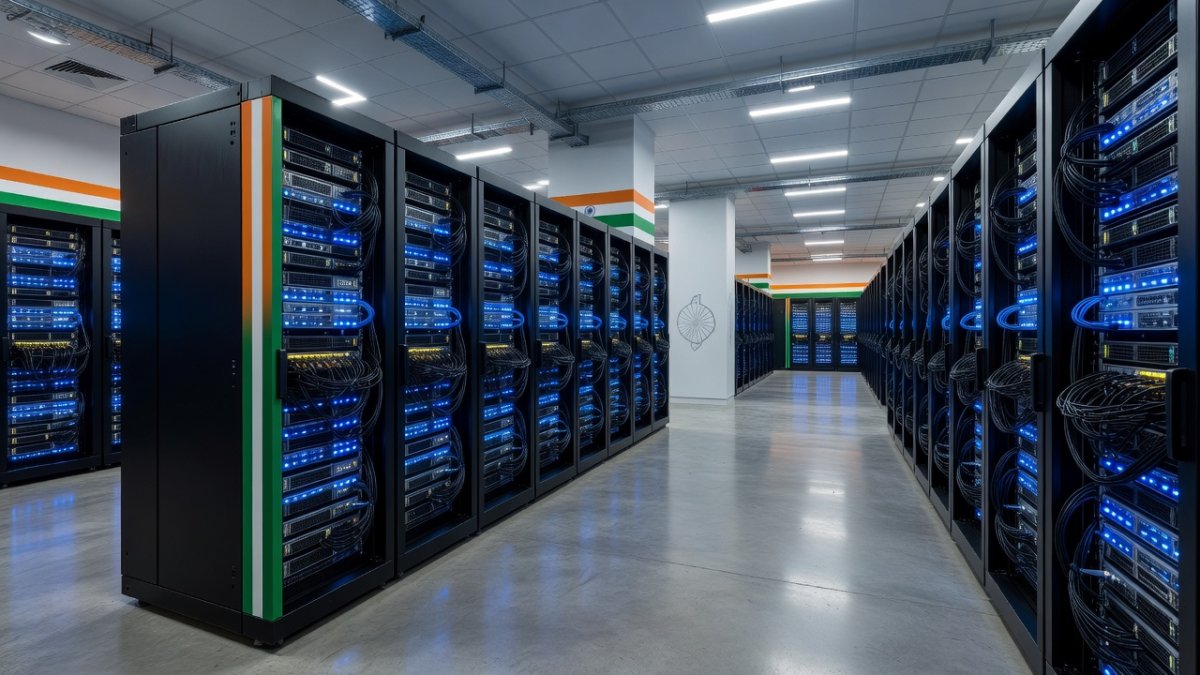

An Indian AI data center facility. (Global 1 News)
India's Sovereign AI Infrastructure: A Strategic Blueprint
The IndiaAI Mission outlines a phased expansion of domestic computing capacity through public-private partnerships that prioritize indigenous hardware development and cloud infrastructure. This includes investments in high-performance computing clusters designed to support training of large language models tailored to India's linguistic diversity, encompassing over 20 major languages. Sectoral deployments target practical outcomes in healthcare diagnostics, precision agriculture, and personalized education tools, aligning with national development priorities outlined in successive economic plans. Foundational models under the mission incorporate safeguards for ethical data usage and bias mitigation, drawing on India's extensive digital public infrastructure such as Aadhaar and UPI systems. These elements enable scalable AI solutions that address local challenges while fostering inclusive growth across rural and urban populations. Implementation timelines remain measured, with initial compute facilities expected to come online progressively rather than through abrupt rollout. The blueprint further integrates regulatory frameworks that balance innovation incentives with oversight mechanisms, ensuring alignment with broader goals of technological autonomy without isolating India from global research networks.Navigating the US-China Technology Chasm
India maintains calibrated engagement with both the United States and China, securing semiconductor access through partnerships like those facilitated by the US CHIPS Act while exploring limited technology inflows from Chinese firms under strict scrutiny. Export controls imposed by Washington on advanced chips have prompted New Delhi to accelerate domestic fabrication initiatives, including collaborations with firms such as Micron Technology for assembly and testing facilities. Data sovereignty provisions embedded in the mission prevent unrestricted cross-border flows that could compromise national security interests. This middle-path strategy allows India to leverage US strengths in foundational research and venture capital while mitigating risks associated with overreliance on any single supplier. Chinese investments in Indian tech sectors face heightened review processes, reflecting concerns over potential backdoors in critical infrastructure. Second-order effects include strengthened ties with ASEAN nations seeking similar balanced approaches to technology procurement. Such navigation underscores India's leverage as a large market and talent pool, enabling it to extract concessions from both sides without full alignment.Parallels and Divergences with China's AI Strategy
China's AI development under the 14th Five-Year Plan emphasizes centralized coordination through the Ministry of Industry and Information Technology, focusing on rapid scaling of domestic models and integration into state-led industrial policies. India's mission shares the objective of reducing foreign dependencies yet diverges in its decentralized governance model, which incorporates greater private sector input and emphasis on linguistic inclusivity rather than uniform national standards. Governance differences manifest in India's lighter regulatory touch on data usage compared to China's more prescriptive content controls and algorithmic oversight. Both nations prioritize applications in agriculture and healthcare to address population-scale challenges, yet China's approach integrates AI more tightly with military-civil fusion doctrines. India's framework avoids explicit security linkages, prioritizing civilian economic gains and multilateral norm-setting. These distinctions influence how each country engages global standards bodies, with Beijing advocating for sovereignty-centric rules and New Delhi promoting interoperable, rights-based alternatives. The comparison reveals India's strategy as more adaptive to democratic constraints and diverse stakeholder interests.
Indian engineers developing AI models for the IndiaAI Mission. (Global 1 News)
A Template for the Global South
Developing nations observe India's model as a pathway toward digital decolonization, reducing vulnerability to technology lock-ins imposed by dominant AI providers. The mission's focus on local language models offers a replicable template for nations seeking culturally attuned AI tools without massive capital outlays. Multilateral institutions such as the United Nations and BRICS forums could amplify these efforts by establishing shared ethical guidelines that prioritize equitable access over proprietary control. AI ethics norms emerging from India's experience stress transparency in training data and accountability for sectoral impacts, providing counterpoints to both US market-driven and Chinese state-centric paradigms. This positions the Global South to influence upcoming governance frameworks, particularly in areas like cross-border data flows and intellectual property for foundational models. Practical implications include enhanced South-South cooperation on compute sharing and joint model development. Such developments could foster more pluralistic AI ecosystems that accommodate varied developmental contexts.Strategic Implications for Asia's Triangular Order
US-China-India dynamics intensify as New Delhi's sovereign AI advances facilitate supply chain diversification away from concentrated East Asian manufacturing hubs. American firms gain alternative production bases in India, while Chinese exporters encounter barriers in sectors where Indian models gain traction. ASEAN countries benefit from spillover effects, including technology transfer opportunities and reduced pressure to choose sides in the broader rivalry. Second-order consequences extend to the European Union, which may pursue similar partnerships with India to bolster its own strategic autonomy in AI components. Regional stability hinges on whether these shifts promote cooperative innovation or fragment standards along geopolitical lines. India's growing role as a swing power enhances its bargaining position in forums addressing semiconductor export regimes and AI safety protocols. Overall, the triangular order evolves toward greater multipolarity, with implications for long-term technological leadership. India's sovereign AI trajectory signals a gradual reconfiguration of global technology hierarchies, where middle powers assert greater agency in shaping infrastructure and norms. Success will depend on sustained investment and adaptive diplomacy amid evolving US and Chinese policies. This path offers lessons for balancing autonomy with international collaboration in an era of strategic competition. By Prof. Marcus Chen, Staff WriterThis article was produced with AI-assisted research and editorial support. Reporting is based on sources cited in the article.
What's Your Reaction?
 Like
0
Like
0
 Dislike
0
Dislike
0
 Love
0
Love
0
 Funny
0
Funny
0
 Wow
0
Wow
0
 Sad
0
Sad
0
 Angry
0
Angry
0

Marcus Chen
World Politics Analyst at Global1.News. Based in Beijing, covering US-China relations, global trade, and geopolitical strategy. Brings deep analytical perspective to the power dynamics shaping international affairs.















Comments (0)