
Screen Time Before Age 2 Can Delay Language, Disrupt Sleep: Landmark UK Study Holds Lessons for India
India's youngest children are growing up with screens as constant companions, and the consequences are becoming impossible to ignore. A landmark review published on 27 June 2026 by researchers from four UK universities — the iADDICT study — has confirmed what paediatricians at NIMHANS Bengaluru and the Indian Academy of Pediatrics have been warning about for years: regular scre
India's youngest children are growing up with screens as constant companions, and the consequences are becoming impossible to ignore. A landmark review published on 27 June 2026 by researchers from four UK universities — the iADDICT study — has confirmed what paediatricians at NIMHANS Bengaluru and the Indian Academy of Pediatrics have been warning about for years: regular screen exposure before age two is linked to lasting developmental harm, from delayed language to disrupted sleep. For Indian families, where under-five children already average 2.22 hours of screen time daily — double the safe limit — the findings carry urgent implications for public health policy, early childhood education, and parenting practices across the country.
The Scale of Screen Exposure Among Indian Children
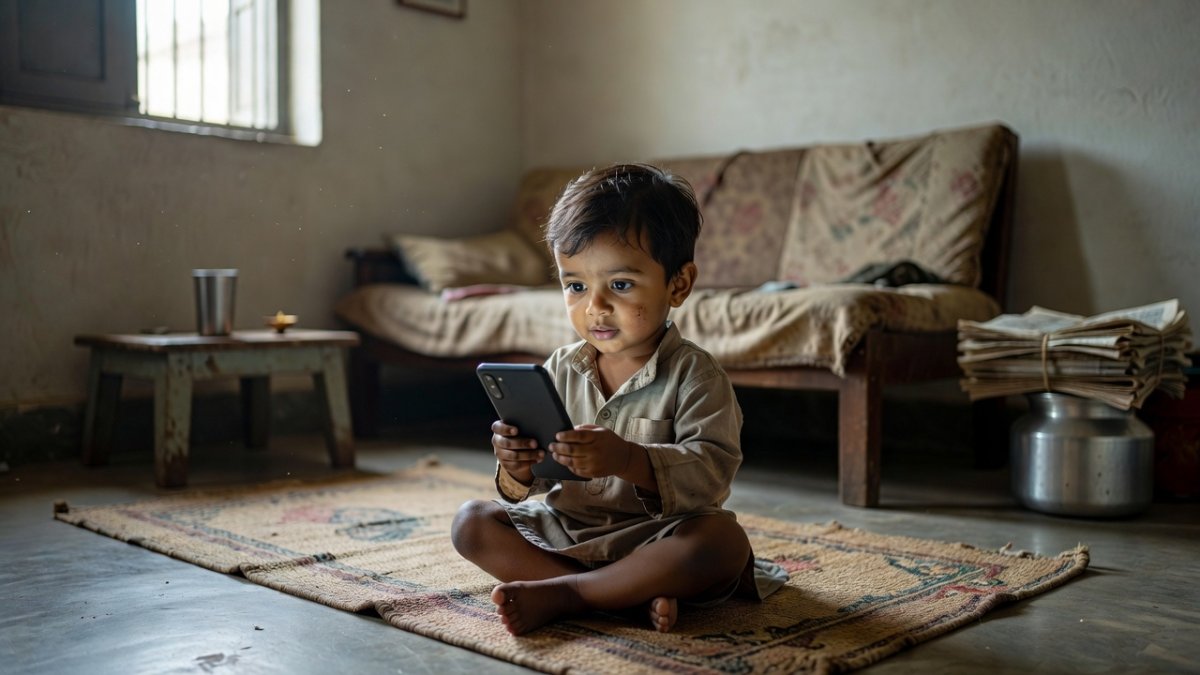
Recent data paints a stark picture of screen exposure among Indian children under the age of two, far exceeding international recommendations and raising urgent public health concerns. A June 2025 meta-analysis revealed that Indian under-five children average 2.22 hours of daily screen time, which is double the limits set by the Indian Academy of Pediatrics and the World Health Organization. This overexposure is particularly alarming in states like Kerala, where a November 2025 survey found that 89.1 percent of under-two children regularly use screens. With India boasting over 900 million internet users by 2026, the proliferation of affordable smartphones and tablets has made digital devices ubiquitous in households across urban and rural areas alike, often serving as default babysitters amid busy parental schedules.
The situation is compounded by a lack of awareness and structured guidelines at the national level, allowing screen habits to form early and persist. Parents themselves contribute significantly, as evidenced by the iADDICT study's survey of 174 UK parents showing strong correlations between adult screen use and children's exposure patterns, a dynamic likely mirrored in Indian families where working parents juggle multiple responsibilities. In many homes, screens become tools for entertainment during meals or bedtime routines, inadvertently disrupting critical developmental windows. This widespread access, fueled by digital expansion, underscores how socioeconomic factors and technological penetration have accelerated exposure rates beyond what previous generations experienced.
Global Evidence from the iADDICT Study and Its Indian Implications
The iADDICT study, released on June 27, 2026, stands as the most comprehensive systematic review of global baby screen time research, conducted by four UK universities and synthesizing evidence from multiple international sources. Key findings highlight reduced parent-child bonding, language delays, diminished physical play, sleep disruptions, overstimulation, and emerging eye health issues among infants exposed to screens. Researchers including Rafe Clayton from Leeds and Dr. Richard James from Loughborough emphasized how even brief exposures can alter neural pathways during the formative first 1,001 days of brain development. These conclusions draw from rigorous meta-analyses, providing a robust foundation that challenges the notion of screens as harmless educational tools for the youngest age groups.
Particularly compelling is the Canadian study integrated within the review, involving 900 participants, which demonstrated that each additional 30 minutes of handheld screen time elevates the risk of expressive language delay by 49 percent. This quantifiable link offers Indian policymakers and clinicians concrete metrics to reference when addressing local trends. The iADDICT findings also note correlations between parental screen habits and child usage, suggesting intergenerational patterns that could amplify risks in India's high-connectivity environment. Dame Andrea Leadsom's contributions to the study further stress the need for protective measures during early childhood, framing excessive screen time as a modifiable risk factor rather than an inevitable byproduct of modern life.
Applying these insights to India reveals parallels with local observations from institutions like NIMHANS in Bengaluru, where screen-linked attention and sleep issues have already surfaced in toddler populations. The absence of equivalent large-scale Indian reviews makes the UK-led effort a vital benchmark, highlighting how global evidence can inform targeted interventions amid rising digital penetration.
What This Means for Indian Child Development
The developmental ramifications of screen time for children under two extend across cognitive, social, and physical domains, with the first 1,001 days representing a critical period for brain architecture formation. Excessive exposure disrupts natural bonding processes, as infants miss out on responsive interactions that build emotional security and language foundations. Data from the iADDICT review consistently links screen overuse to delays in expressive language skills, a concern amplified in India where 2.22 hours of daily average exposure doubles recommended thresholds and coincides with high usage rates in regions like Kerala.
Physical play suffers as well, with screens replacing active exploration essential for motor skills and overall health. Sleep disruption emerges as another major issue, where blue light and overstimulation interfere with circadian rhythms, leading to fragmented rest that affects growth and learning readiness. Eye health concerns, including potential strain from prolonged near-focus activities, add a physiological layer often overlooked in policy discussions. NIMHANS Bengaluru reports already document attention deficits tied to these patterns in Indian toddlers, suggesting early interventions could mitigate long-term educational and behavioral challenges.
These impacts are not isolated but interconnected, creating cascading effects on a child's trajectory. In a nation with vast disparities in access to early childhood resources, unchecked screen exposure risks widening developmental gaps, particularly among families reliant on digital devices for childcare support.
India's Policy Gap — Ministry of Health, ICMR, and IAP
India faces a pronounced policy vacuum regarding screen time guidelines for young children, despite clear recommendations from bodies like the Indian Academy of Pediatrics advocating zero screen time under age two and less than one hour for ages two to five. The Ministry of Health and the Indian Council of Medical Research have yet to establish a national screen protocol, leaving states and local authorities without unified frameworks to address the 2.22-hour average exposure documented in recent meta-analyses. This contrasts sharply with the UK government's March 2026 directive prohibiting screen time under two except for video calls, a proactive stance informed by studies like iADDICT.
The gap is especially evident when considering the scale of India's digital landscape, with over 900 million internet users facilitating easy access to devices. Without coordinated national efforts, initiatives remain fragmented, and awareness campaigns lag behind the pace of technological adoption. The iADDICT study's emphasis on evidence-based limits could serve as a model, yet integration into Indian health strategies requires dedicated research funding and inter-ministerial collaboration to translate global findings into context-specific actions.
ICMR's role in generating localized data is crucial here, as current reliance on international reviews leaves policymakers without tailored insights into cultural and socioeconomic influences on screen habits. Bridging this divide demands urgent prioritization to prevent developmental setbacks on a population level.
Role of Families, Schools, and Anganwadi Centres
Families form the frontline defense against excessive screen exposure, yet many lack guidance on alternatives like interactive play or reading during the critical early years. Parental screen use, shown in the iADDICT survey of 174 UK parents to correlate directly with children's habits, likely follows similar patterns in Indian households where devices double as entertainment and work tools. Educating caregivers on the 49 percent increased language delay risk per 30 extra minutes of handheld time could shift behaviors toward more nurturing interactions that support bonding and development.
Schools and anganwadi centres, numbering 1.4 million nationwide under the Integrated Child Development Services, hold immense potential for community-level interventions. These centres can incorporate screen-free play modules and parent workshops, leveraging their reach into rural and underserved areas where digital exposure is rising rapidly. Training anganwadi workers to recognize signs of overstimulation or sleep issues, as noted in NIMHANS findings, would extend the impact beyond urban centers.
Collaborative efforts between families and these institutions could foster environments prioritizing physical activity and face-to-face engagement, countering the convenience of screens. Scaling such programs requires modest investments but promises substantial returns in healthier developmental outcomes for India's youngest citizens.
The Bottom Line
The convergence of high screen exposure rates, robust global evidence from the iADDICT study, and India's policy shortcomings demands immediate, multifaceted action to safeguard early childhood development. With averages of 2.22 hours daily far surpassing IAP limits and 89.1 percent usage in areas like Kerala, the risks of language delays, sleep disruption, and reduced bonding are no longer theoretical but pressing realities backed by data including the 49 percent risk elevation from additional handheld time.

By drawing on the first 1,001 days as a window of opportunity, stakeholders from the Ministry of Health to anganwadi networks can implement evidence-informed strategies that align with UK precedents and local needs. Ultimately, prioritizing screen-free interactions will yield generations better equipped for cognitive and emotional success, turning the tide on this emerging public health challenge.
The Ministry of Health and Family Welfare, in collaboration with ICMR and state governments, should convene an expert committee to draft national screen time guidelines for children under five, drawing on the iADDICT evidence and consultation with IAP and NIMHANS. Such guidelines could be disseminated through the 1.4 million anganwadi centres already serving 80 million children under six under the ICDS framework. Meanwhile, the National Education Policy 2020's emphasis on early childhood care and education provides a ready platform for integrating digital wellness into preschool curricula. Families, for their part, can take immediate steps — removing devices from bedrooms, replacing passive screen time with structured play, and modelling healthy phone habits — that the evidence shows directly reduce infant exposure. The cost of inaction, measured in delayed language milestones, rising attention deficits, and growing disparities in school readiness, is far greater than the investment required to act now.
— By Dr. Raj Patel, Staff WriterThis article was produced with AI-assisted research and editorial support. Reporting is based on sources cited in the article.
What's Your Reaction?
 Like
0
Like
0
 Dislike
0
Dislike
0
 Love
0
Love
0
 Funny
0
Funny
0
 Wow
0
Wow
0
 Sad
0
Sad
0
 Angry
0
Angry
0

India/South Asia Correspondent at Global1.News. Analytical voice with a background in science and health journalism. Based in New Delhi, covering Indian politics, education, healthcare, technology, and policy. Breaks down complex data into clear, actionable reporting.















Comments (0)