
Israeli Airstrike Destroys Gaza Mosque, Displaces Hundreds
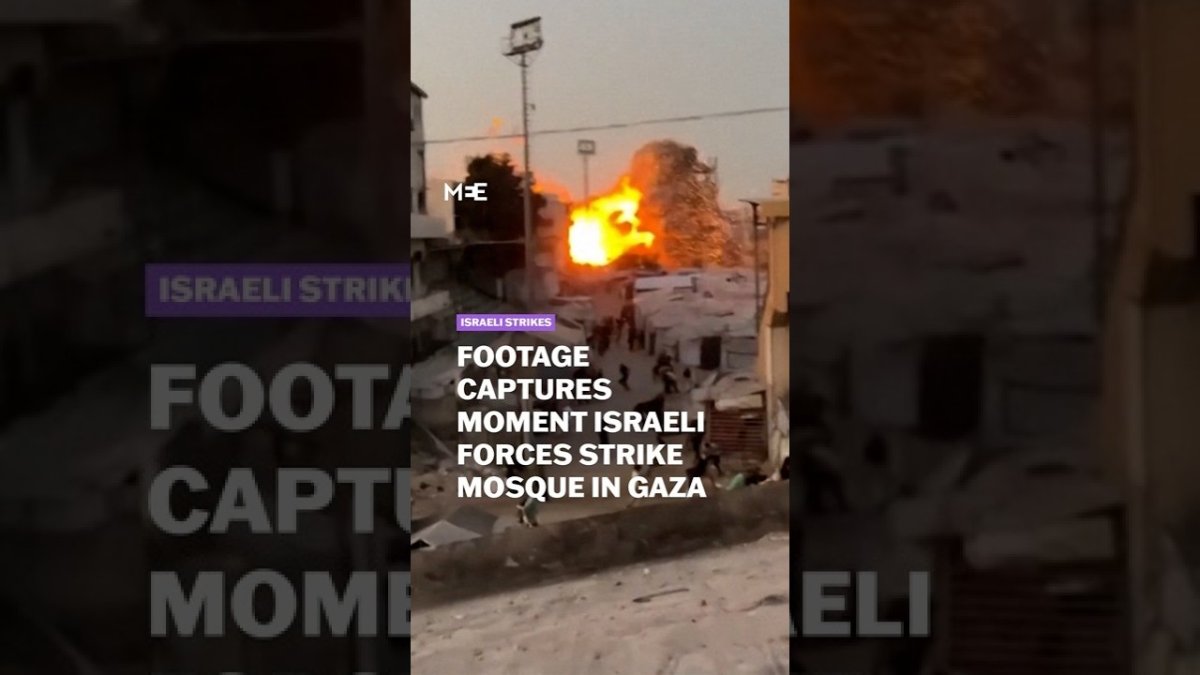
A recent video report from Middle East Eye captured the immediate aftermath of the Israeli airstrike on Al-Muttaqin Mosque, showing plumes of smoke rising over the Yarmouk neighborhood and survivors sifting through rubble next to the flattened tents at Yarmouk Stadium. Israeli Airstrike Destroys Gaza Mosque, Leaving Displaced Families Without Shelter Gaza City, Palestine — On day 1,026 of the war, Israeli warplanes struck Al-Muttaqin Mosque in the Yarmouk neighborhood of cent
A recent video report from Middle East Eye captured the immediate aftermath of the Israeli airstrike on Al-Muttaqin Mosque, showing plumes of smoke rising over the Yarmouk neighborhood and survivors sifting through rubble next to the flattened tents at Yarmouk Stadium.
Israeli Airstrike Destroys Gaza Mosque, Leaving Displaced Families Without Shelter
Gaza City, Palestine — On day 1,026 of the war, Israeli warplanes struck Al-Muttaqin Mosque in the Yarmouk neighborhood of central Gaza City, completely destroying the building. The mosque stood adjacent to Yarmouk Stadium, where dozens of displaced Palestinian families had been sheltering in tents. The strike obliterated those tents as well and caused extensive damage to nearby homes. One Palestinian was killed and more than a dozen others wounded. Hundreds of people were left homeless by the attack.
The Attack on Al-Muttaqin Mosque
The precision strike reduced the historic Al-Muttaqin Mosque to a pile of concrete and twisted metal. Witnesses described hearing multiple explosions shortly after dawn, followed by the collapse of the main dome. The location next to Yarmouk Stadium made the impact particularly devastating, as the open ground around the stadium had become a makeshift camp for families fleeing earlier fighting. Rescue teams worked through the night to recover the single fatality and treat the wounded, many of whom suffered from shrapnel injuries and crush wounds. The destruction of the mosque itself eliminated one of the last remaining community gathering points in the area.
Impact on Displaced Civilians
Dozens of families who had pitched tents beside Yarmouk Stadium lost everything in the strike. The tents were incinerated or buried under debris from the mosque, leaving survivors without shelter, food supplies, or personal belongings. Local aid workers reported that at least 200 people were directly affected, many of them children and elderly residents already weakened by months of displacement. The additional damage to surrounding homes compounded the crisis, forcing even more residents onto the streets. With temperatures rising in July, the sudden loss of shelter has created an urgent humanitarian emergency in central Gaza City.

The Israeli airstrike on Al-Muttaqin Mosque struck at the heart of a fragile sanctuary for families already uprooted multiple times since October 2023, when nearly two million Palestinians were forced from their homes across Gaza. Tents clustered beside Yarmouk Stadium housed households that had fled earlier bombardments, only to lose what little remained in the July 28, 2026 attack. Survivors described the instant destruction of identity documents, essential medicines, and children's few treasured belongings, leaving parents without proof of lineage or access to critical health records amid the chaos.
Compounding this loss is the summer heat crisis that has intensified suffering for those without shelter or cooling resources. With temperatures soaring, the absence of basic supplies has placed additional strain on vulnerable groups, including the estimated 60,000 orphans now scattered throughout Gaza who rely on makeshift community networks for survival. The nearby YMCA building, which once offered limited humanitarian services such as food distribution and medical referrals, was also affected, further eroding the thin layer of support that had sustained displaced residents through repeated displacements.
These personal tragedies reflect a broader pattern of cumulative trauma, where each strike erases not only physical structures but the fragile threads of continuity for families striving to rebuild. Eyewitness accounts highlight how the loss of medicine has led to untreated chronic conditions, while missing documents complicate any future attempts at relocation or aid registration, deepening the isolation felt by those already marginalized by years of conflict.
Israeli Claims and Hamas Response
The Israeli military stated that the mosque was being used by Hamas for weapons storage, justifying the strike as a legitimate military target. In response, the Hamas-run government media office rejected the accusation outright, asserting that Israel uses such claims to rationalize attacks on places of worship and civilian infrastructure. No independent verification of weapons at the site has been provided, and the strike occurred despite the ceasefire that took effect on October 10, 2025. Daily attacks have nevertheless continued, underscoring the fragile nature of the truce.
Widespread Destruction of Religious Sites in Gaza
Gaza's Ministry of Endowments reports that 1,050 mosques have been completely destroyed and 191 others partially damaged out of 1,275 pre-war structures. Only 34 mosques remain untouched. This latest strike on Al-Muttaqin Mosque fits into a pattern of systematic targeting of religious sites across the enclave. The cumulative loss has stripped communities of spiritual and social centers, leaving residents with few places for prayer or communal support. Over 73,000 Palestinians have been killed since October 2023, and the destruction of mosques has added a profound cultural dimension to the human toll.
Mosques have long served as pillars of cultural and historical continuity in Gaza, functioning as centers for worship, education, and communal solidarity long before the current conflict. The Ministry of Endowments recorded 1,275 mosques standing prior to October 2023; today only 34 remain untouched, a statistic that underscores the scale of erasure affecting religious life. This destruction extends beyond prayer halls to the social fabric, as these sites historically hosted Quranic schools, charity distributions, and gatherings that reinforced community resilience during hardship.
The pattern aligns with the reported destruction of 90 percent of Gaza's housing stock and Israeli control over 80 percent of the territory, illustrating a systematic targeting that disrupts daily existence at every level. When mosques are reduced to rubble, residents lose not only places of worship but vital spaces for children's learning, food aid coordination, and collective mourning, leaving spiritual and practical voids that compound the isolation of survivors.
Historical context reveals that such sites have endured through previous conflicts, yet the current scale threatens to sever generational ties to heritage and faith practices. Community leaders note that the absence of these gathering points has forced improvised rituals in open areas, heightening risks for those already navigating restricted movement and scarce resources.
International Reactions and Calls for Accountability
International observers have expressed alarm at the continued attacks on civilian and religious sites despite the ceasefire. Humanitarian organizations are urging independent investigations into the strike and renewed pressure for a lasting halt to hostilities. Diplomats in several capitals have called for accountability mechanisms to address the pattern of mosque destructions. Local leaders in Gaza have appealed for immediate reconstruction aid and protection of remaining religious sites, warning that the cultural erasure compounds the physical devastation already suffered by the population.
The US-brokered ceasefire that took effect on October 10, 2025 offered a brief respite, yet renewed strikes like the one on Al-Muttaqin Mosque have drawn sharp rebukes from UN officials who have repeatedly warned against attacks on protected civilian and religious sites. Human rights organizations including Amnesty International and Human Rights Watch have documented what they describe as deliberate targeting of civilian infrastructure, urging independent investigations into patterns that appear to violate international humanitarian law.
These concerns have prompted discussions at the International Criminal Court regarding potential accountability measures for incidents involving protected locations. The same day as the Gaza strike, US-Saudi airstrikes in Iraq on July 29 further illustrated the widening regional conflict, raising alarms among diplomats about spillover effects that could destabilize multiple fronts and complicate humanitarian access.
Calls for restraint emphasize the need to protect remaining civilian spaces amid escalating tensions, with analysts noting that sustained international pressure may be required to address the cumulative impact on Gaza's population. Such reactions highlight the tension between security claims and the documented human costs, fostering renewed debate on mechanisms to safeguard vulnerable communities in prolonged conflicts.
The strike on Al-Muttaqin Mosque and the adjacent displacement camp stands as a stark reminder that even after more than a thousand days of conflict and a nominal ceasefire, civilian suffering and the destruction of Gaza's religious heritage continue unabated. The loss of one more mosque and the homelessness of hundreds of families deepen an already catastrophic humanitarian situation that shows no sign of resolution.
By Fatima Al-Rashid, Staff Writer
This article was produced with AI-assisted research and editorial support. Reporting is based on sources cited in the article.
What's Your Reaction?
 Like
0
Like
0
 Dislike
0
Dislike
0
 Love
0
Love
0
 Funny
0
Funny
0
 Wow
0
Wow
0
 Sad
0
Sad
0
 Angry
0
Angry
0

Gulf/MENA Correspondent at Global1.News. Based in Doha, covering Gulf politics, energy markets, diplomacy, and development across the Middle East and North Africa. Tracks the economic transformation of the Gulf states.














Comments (0)