
The Quad's Institutional Turn Toward ASEAN: Strategic Ripples for Seoul
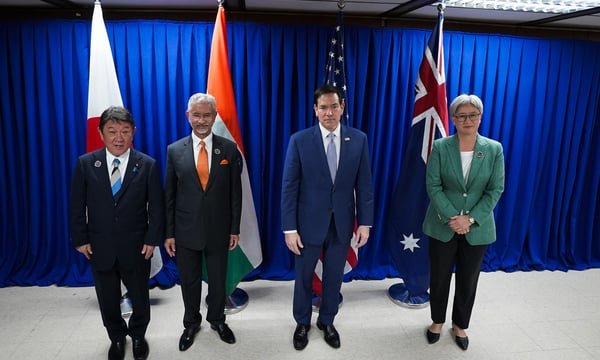
The July 2026 Breakthrough in Quad-ASEAN Relations On July 22, 2026, in Manila, the Quad foreign ministers issued their first dedicated joint statement on cooperation with ASEAN. US Secretary of State Marco Rubio, Australian Foreign Minister Penny Wong, Indian External Affairs Minister Dr. S. Jaishankar, and Japanese Foreign Minister Toshimitsu Motegi framed the grouping as ASEAN Comprehensive Strategic Partners.
The July 2026 Breakthrough in Quad-ASEAN Relations
On July 22, 2026, in Manila, the Quad foreign ministers issued their first dedicated joint statement on cooperation with ASEAN. US Secretary of State Marco Rubio, Australian Foreign Minister Penny Wong, Indian External Affairs Minister Dr. S. Jaishankar, and Japanese Foreign Minister Toshimitsu Motegi framed the grouping as ASEAN Comprehensive Strategic Partners. The statement explicitly linked Quad activities to the practical implementation of the ASEAN Outlook on the Indo-Pacific, moving beyond the previous pattern of side meetings without standalone ASEAN-focused declarations.
This development occurred during the Philippines' 2026 ASEAN chairmanship, whose theme "Navigating Our Future, Together" emphasizes peace, security, economic integration, and digital transformation. The timing, two days after clashes between Chinese and Philippine vessels near Second Thomas Shoal, underscored the statement's regional resonance.
The July 2026 statement emerged against the backdrop of the East Asia Summit Foreign Ministers' Meeting convened in Manila on July 23 with representatives from nineteen countries, providing a multilateral platform that amplified the Quad's dedicated ASEAN outreach. This sequencing allowed the Quad ministers to position their commitments within the broader EAS architecture, where ASEAN centrality remains the organizing principle. The Philippines' assertive chairmanship under President Marcos Jr. placed particular emphasis on South China Sea stability, aligning the timing of the statement with heightened regional tensions and reinforcing ASEAN's collective voice on maritime rules-based order.
The Quad's trajectory from its 2007 origins through its 2017 revival has now entered a phase of structured institutional engagement with ASEAN. Earlier patterns involved only side meetings or leaders' summits held on the margins of the East Asia Summit, which lacked standalone declarations focused exclusively on ASEAN cooperation. By contrast, the Manila statement established a concrete agenda tied directly to the ASEAN Outlook on the Indo-Pacific, marking a shift from ad hoc coordination to formalized partnership mechanisms that include working groups on humanitarian assistance and disaster relief.
Under the Philippines' 2026 theme of "Navigating Our Future, Together," the chairmanship advanced priorities in peace, security, economic integration, and digital transformation. The statement's release two days after reported clashes near Second Thomas Shoal underscored how Quad-ASEAN linkage responds to immediate geopolitical pressures while embedding long-term cooperation in maritime domain awareness and infrastructure development within ASEAN frameworks.
Core Commitments in the Joint Statement
The ministers reaffirmed unwavering support for ASEAN unity and centrality while pledging to strengthen a free and open Indo-Pacific. Specific cooperation areas included maritime domain awareness, infrastructure development, semiconductor supply chain resilience, health security, cyber security, and humanitarian assistance and disaster relief. The Quad's Humanitarian Assistance and Disaster Relief Working Group announced plans for a second tabletop exercise in Brisbane, Australia, building on prior efforts.
These priorities reflect a deliberate institutionalization of Quad-ASEAN engagement. Unlike earlier ministerial gatherings in New Delhi in May 2026, the Manila statement produced a concrete agenda tied directly to ASEAN frameworks rather than parallel diplomacy.
South Korea's Position Outside the Quad
South Korea is not a Quad member yet maintains deep institutional ties with ASEAN as a Dialogue Partner. Under President Yoon Suk Yeol, Seoul advanced the New Southern Policy and its successor, the Korea-ASEAN Solidarity Initiative, seeking elevated strategic engagement. Korea-ASEAN relations reached Comprehensive Strategic Partnership status in 2024, mirroring the language now adopted by the Quad.
Seoul's own Indo-Pacific Strategy, announced in December 2022, explicitly aligns with the ASEAN Outlook on the Indo-Pacific. The Quad's embrace of this same framework places Korea in a position where its policy language overlaps with Quad objectives, even as it remains formally outside the grouping.
South Korea maintained a stance of cautious openness toward the Quad during the Moon Jae-in administration, prioritizing balanced diplomacy that avoided explicit alignment. Under President Yoon Suk Yeol, Seoul adopted a more engaged posture through its Indo-Pacific Strategy, which explicitly references the ASEAN Outlook on the Indo-Pacific. This evolution positions Korea to explore intersections with Quad activities without formal membership, leveraging its status as an ASEAN Dialogue Partner that achieved Comprehensive Strategic Partnership in 2024.
The Korea-ASEAN Solidarity Initiative launched in 2022 has advanced practical cooperation across multiple sectors, building on the New Southern Policy to elevate strategic ties. Korea has participated in Quad-adjacent efforts such as the Indo-Pacific Oceans Initiative and collaborative COVID-19 vaccine distribution, demonstrating functional alignment on health security and maritime issues. These engagements illustrate how Seoul can contribute to regional public goods while preserving autonomy from the Quad's core membership structure.
Korea's defense industry has developed significant linkages with ASEAN states through exports of K9 howitzers, FA-50 fighter jets, and submarines to Indonesia, the Philippines, and Thailand. These transactions complement the Quad's emphasis on maritime security and supply chain resilience, creating additional avenues for Korea to influence regional stability. As ASEAN partners seek diversified defense partnerships, Seoul's industrial capabilities provide strategic depth that intersects with broader Indo-Pacific objectives without requiring Quad accession.
Navigating US Alliance and Chinese Economic Ties
The Quad's move creates a clear strategic dilemma for Seoul. Korea's alliance with the United States, a core Quad member, pulls toward deeper coordination on Indo-Pacific issues. At the same time, China remains Korea's largest trading partner and has consistently viewed the Quad through the lens of containment. North Korea's growing alignment with Beijing further complicates Seoul's calculations, as any perceived tilt toward Quad-led initiatives risks heightening tensions on the peninsula.
Seoul must therefore calibrate its participation in Quad-adjacent activities without triggering direct confrontation with Beijing. The absence of Korean representation at the Manila meeting highlights this careful positioning.
China accounts for approximately 25 percent of Korean exports while ASEAN represents around 18 percent, underscoring the dual economic imperatives that constrain Seoul's strategic choices. Unlike Japan, Australia, and India, which serve as Quad members and ASEAN Dialogue Partners simultaneously, Korea must navigate its US alliance commitments alongside these trade dependencies. This contrast highlights the unique calibration required for Seoul, as any overt tilt toward Quad-led initiatives risks economic repercussions from Beijing.
North Korea's deepening military alignment with Russia and China further narrows Seoul's maneuvering room, as perceived proximity to Quad activities could intensify peninsula tensions. The Korea-US Nuclear Consultative Group and associated extended deterrence arrangements reinforce alliance cohesion on security matters, yet they also shape the parameters within which Seoul articulates its Indo-Pacific posture. Balancing these elements demands careful avoidance of direct confrontation while sustaining credible deterrence.
Korea's expanding defense exports to ASEAN countries intersect directly with Quad maritime security priorities, offering a channel for indirect contribution to regional resilience. Through its Comprehensive Strategic Partnership with ASEAN, Seoul retains institutional pathways to align with emerging cooperation mechanisms in semiconductor supply chains and humanitarian assistance. This positioning allows Korea to protect economic interests and strategic autonomy even as the Quad-ASEAN relationship institutionalizes.
Semiconductor Supply Chains and Corporate Stakes
Korean firms such as Samsung, LG, and Hyundai operate extensive semiconductor and manufacturing networks across ASEAN member states. The Quad statement's emphasis on semiconductor supply chain resilience directly intersects with these interests. Any coordinated Quad-ASEAN initiatives in this domain will shape investment environments and technology standards that Korean companies must navigate.
Because Korea already holds Comprehensive Strategic Partnership status with ASEAN, Seoul possesses institutional channels to influence or align with these emerging cooperation mechanisms. The question is whether Korean policymakers will seek formal observer roles or parallel bilateral arrangements to protect supply chain stability.
Implications for Regional Architecture and Seoul's Options
The Quad's first dedicated ASEAN statement signals a shift from ad hoc engagement to structured partnership. For South Korea, this evolution requires a reassessment of how its Korea-ASEAN Solidarity Initiative and Indo-Pacific Strategy can complement or intersect with Quad efforts without compromising strategic autonomy. The upcoming East Asia Summit Foreign Ministers' Meeting in Manila on July 23, 2026, offers one venue for Seoul to articulate its approach.
Ultimately, the Quad-ASEAN linkage tests Korea's ability to maintain equilibrium between alliance commitments, economic interdependence with China, and its own regional leadership aspirations. How Seoul responds will influence both inter-Korean dynamics and the broader contours of Indo-Pacific order in the years ahead.
By Prof. David Park, Staff WriterThis article was produced with AI-assisted research and editorial support. Reporting is based on sources cited in the article.
What's Your Reaction?
 Like
0
Like
0
 Dislike
0
Dislike
0
 Love
0
Love
0
 Funny
0
Funny
0
 Wow
0
Wow
0
 Sad
0
Sad
0
 Angry
0
Angry
0

East Asia/Technology Correspondent at Global1.News. Seoul-based voice covering Korean politics, technology, business, and culture. Analyzes how technology and geopolitics intersect across East Asia.















Comments (0)