
Teodoro: Stand for West Philippine Sea Must Not Change Despite Political Process
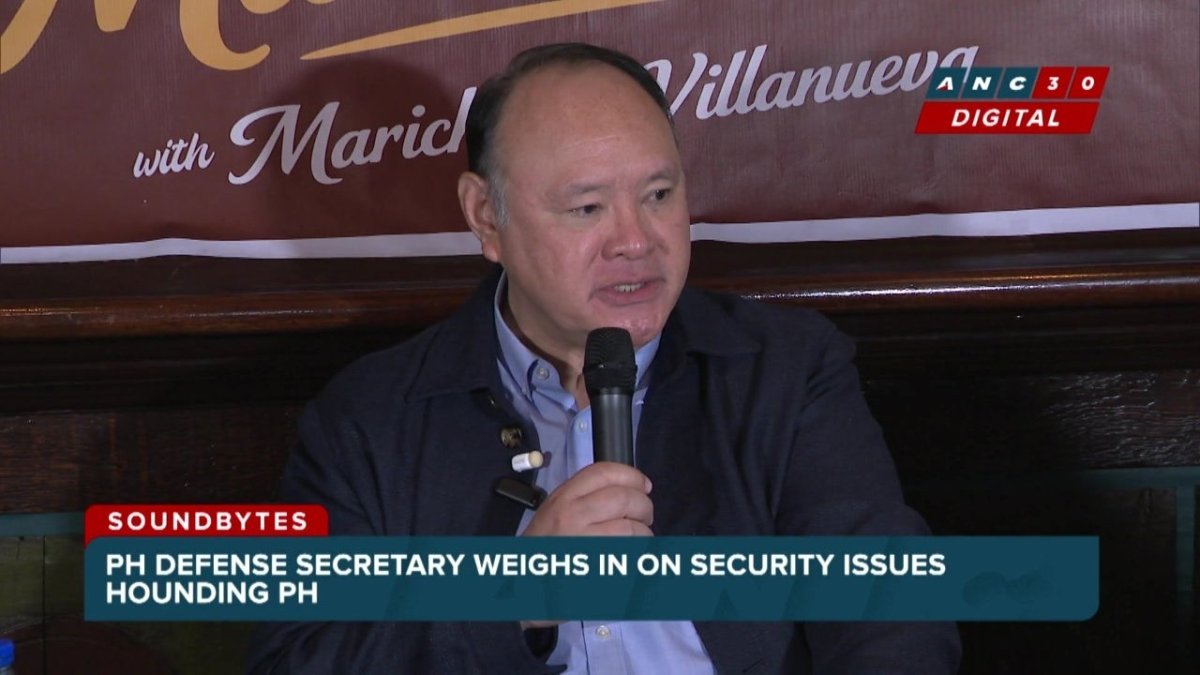
In a wide-ranging interview on ANC 24/7, Philippine Defense Secretary Gilberto Teodoro Jr. made it unmistakably clear — the country's position on the West Philippine Sea must remain firm and consistent, regardless of who sits in Malacañang or what political winds may blow.
In a wide-ranging interview on ANC 24/7, Philippine Defense Secretary Gilberto Teodoro Jr. made it unmistakably clear — the country's position on the West Philippine Sea must remain firm and consistent, regardless of who sits in Malacañang or what political winds may blow. Speaking during the Kapihan sa Manila Bay forum this week, the defense chief delivered a message that cuts straight to the heart of a national security policy that has defined the Philippines' foreign relations for nearly a decade.
Teodoro: Stand for West Philippine Sea Should Not Change Despite Political Process
Manila, Philippines — In a media appearance that covered everything from territorial defense to senatorial ambitions, Defense Secretary Gilberto Teodoro Jr. on Wednesday stressed that the Philippines' position in the West Philippine Sea should remain consistent and unwavering, regardless of the political transitions that may lie ahead.
Consistency in Sovereignty: The Core Message
Teodoro's central argument was straightforward: the West Philippine Sea is not a partisan issue. "Ang paninindigan natin sa West Philippine Sea ay hindi dapat magbago dahil lang sa political process," the defense secretary said, emphasizing that the country's sovereignty claims are rooted in the 2016 Arbitral Award and the United Nations Convention on the Law of the Sea (UNCLOS), both of which transcend any single administration.
The defense chief pointed out that the Philippines has spent over a decade building a legal and diplomatic framework to assert its rights in the resource-rich waterway. This framework, anchored on the unanimous 2016 ruling by the Permanent Court of Arbitration in The Hague, has been the cornerstone of Philippine foreign policy through multiple administrations — and Teodoro made clear that this continuity must be preserved.
Extended Continental Shelf Claim at the United Nations
Adding depth to his remarks, Teodoro noted that the Philippines is actively pursuing its extended continental shelf claim before a United Nations body — a 15-year effort that could add thousands of square kilometers of seabed under Manila's resource jurisdiction. The claim, which was presented to the UN Commission on the Limits of the Continental Shelf this week, seeks to secure sovereign rights over the seafloor beyond the country's 200-nautical-mile exclusive economic zone.
This legal maneuver is separate from the West Philippine Sea dispute itself but directly related to it. Securing the extended continental shelf would give the Philippines exclusive rights to exploit resources on and beneath the seabed — from oil and natural gas to mineral deposits and marine biodiversity. For a nation where millions of Filipinos depend on fishing and maritime livelihoods, the stakes could not be higher.
Beyond ASEAN: A Broader Security Framework
Teodoro also tackled a question that has been quietly debated in diplomatic circles: is ASEAN enough for Philippine national security? His answer was a clear no. While the Association of Southeast Asian Nations remains a vital platform for regional dialogue, the defense secretary argued that the Philippines needs a broader, more diversified network of security partnerships.
This includes the Enhanced Defense Cooperation Agreement with the United States, bilateral patrols with regional allies, and deepening ties with like-minded nations in the Indo-Pacific region. The secretary emphasized that the Philippines cannot rely solely on multilateral organizations when its sovereign rights are being challenged by aggressive actions — including the reported construction of artificial islands, harassment of Filipino fishermen, and the presence of Chinese maritime militia vessels in the country's exclusive economic zone.
China's Rhetoric and the 'Shared Home' Narrative
In a particularly pointed segment of the interview, Teodoro pushed back against China's characterization of the region as a "shared home" where all nations co-exist peacefully. "Pinipilit maging kapit-bahay para sakupin ang ating EEZ," he said — accusing Beijing of using the rhetoric of neighborliness as a cover for what he described as systematic encroachment on Philippine maritime territory.
The defense secretary also raised concerns about what he termed "foreign malign influence," specifically citing the Yang brothers — Chinese nationals whose business activities in the Philippine construction sector have raised red flags among security officials. Teodoro warned that such activities could be part of a broader strategy of economic infiltration that undermines Philippine sovereignty without a single shot being fired.
The Human Side: Senatorial Surveys and Public Perception
When asked about his 29th-place ranking in the latest Pulse Asia senatorial survey, Teodoro responded with characteristic candor and a touch of humor. "29, mangangarap ka?" he said, a rhetorical question that translates roughly to "At 29th, are you dreaming?" His point: he remains focused on his duties at the Department of National Defense, not on electoral politics.
This grounded approach has endeared him to many Filipinos who see the defense secretary as a steady hand during turbulent times. With territorial disputes, military modernization programs, and the ever-present threat of natural disasters, the DND portfolio is arguably one of the most demanding in the Cabinet. Teodoro's insistence on prioritizing substance over surveys reflects a broader message about public service that resonates with a population tired of political theatrics.
Reactions and Responses: A Nation Watching
The defense secretary's remarks have drawn reactions from various quarters. Senator Imee Marcos, chair of the Senate Committee on Foreign Relations, echoed the call for consistency in the country's maritime policy, stating that "what was won at the Arbitral Tribunal cannot be lost at the negotiating table." Meanwhile, civil society groups like the Philippine Alliance for Human Rights and the West Philippine Sea Coalition have called for a more aggressive information campaign to counter Chinese disinformation targeting Filipino communities in the disputed areas.
On social media, netizens have largely rallied behind Teodoro's stance, with hashtags like #PanindiganWPS and #TeodoroWPS trending on X (formerly Twitter) throughout the day. For many Filipinos, the issue is deeply personal — the West Philippine Sea is not just a matter of diplomatic pride but a source of livelihood for thousands of fisherfolk, small boat operators, and their families in coastal barangays from Palawan to Zambales.
What This Means for Ordinary Filipinos
For the average Juan dela Cruz, Teodoro's message carries real-world implications. Every ton of fish caught within the country's exclusive economic zone contributes to food security. Every barrel of oil extracted from the seabed potentially lowers fuel prices at the pump. Every kilometer of maritime territory secured means safer passage for the fishing boats and cargo vessels that keep the Philippine economy moving.
Teodoro's call for sustained deterrence efforts is also a reminder that the defense budget — currently pegged at just over 1% of GDP, far below the 4% the secretary has advocated for — directly affects the lives of soldiers, sailors, and airmen stationed in remote outposts across the archipelago. Adequate funding means better equipment, better training, and ultimately, better protection for the men and women who stand guard over the nation's maritime borders.
Looking Ahead: What to Watch For
The coming months will be critical for the Philippines' maritime security posture. The UN Commission on the Limits of the Continental Shelf is expected to review Manila's extended claim, a process that could take months or even years. Meanwhile, China's activities in the region show no signs of abating, and the 2028 national elections are likely to inject additional political dynamics into the sovereignty debate.
Teodoro's message is clear: regardless of who wins in 2028, the Philippines' stand on the West Philippine Sea should not — and must not — change. For a nation that has fought for its sovereign rights in international courts and on the high seas, that consistency is not just a policy preference. It is a matter of national survival.
By Bella Reyes, Staff Writer
This article was produced with AI-assisted research and editorial support. Reporting is based on sources cited in the article.
What's Your Reaction?
 Like
0
Like
0
 Dislike
0
Dislike
0
 Love
0
Love
0
 Funny
0
Funny
0
 Wow
0
Wow
0
 Sad
0
Sad
0
 Angry
0
Angry
0

Philippines/Southeast Asia Correspondent at Global1.News. Manila-based journalist covering Philippine politics, environment, maritime security, and social issues. Passionate about marine conservation and the communities protecting the Philippines' natural heritage.












Comments (0)