
Daegu Chimac Festival: Korea's Tourism Policy Analysis
The 2026 Daegu Chimac Festival, scheduled for July 1–5 at Duryu Park in Dalseo-gu, represents a significant case study in South Korea’s regional cultural tourism policy framework. Organized by the Daegu Metropolitan Government, the festival leverages the city’s population of approximately 2.4 million and its accessibility via KTX bullet train—reachable in 1.5 hours from Seoul—t
The 2026 Daegu Chimac Festival, scheduled for July 1–5 at Duryu Park in Dalseo-gu, represents a significant case study in South Korea’s regional cultural tourism policy framework. Organized by the Daegu Metropolitan Government, the festival leverages the city’s population of approximately 2.4 million and its accessibility via KTX bullet train—reachable in 1.5 hours from Seoul—to position Daegu as a destination for domestic and international visitors. This approach aligns with the Ministry of Culture, Sports and Tourism’s regional tourism development policies, which emphasize decentralizing tourism flows away from Seoul-centric models toward secondary cities.
2026 Daegu Chimac Festival: South Korea’s Regional Cultural Tourism Strategy
Seoul, South Korea – June 22, 2026 — Policy analysts view the festival as a structured response to longstanding regional imbalances in economic opportunity. By concentrating hundreds of chimac vendors, live K-pop concerts, drone shows, and beer gardens within Duryu Park—including performances at Duryu Baseball Stadium—the Daegu Metropolitan Government creates concentrated economic activity that supports small vendors while generating measurable foot traffic. The 2026 edition, described in KOREA NOW coverage as returning “bigger than ever,” builds on the established framework of 지역축제 (local festival) governance that has characterized Korean regional administration since the early 2000s. These festivals function not merely as entertainment but as calibrated tools for place branding and infrastructure utilization during summer months.
Scholars of Korean public administration note that such events integrate multiple policy objectives: cultural promotion, youth employment through vendor participation, and transport network optimization via KTX connectivity. The festival’s eco-friendly initiatives further reflect alignment with national sustainability targets embedded in the Ministry’s tourism master plans. In this sense, the Chimac Festival operates as a replicable template for other metropolitan governments seeking to convert distinctive local food cultures into sustained tourism revenue.
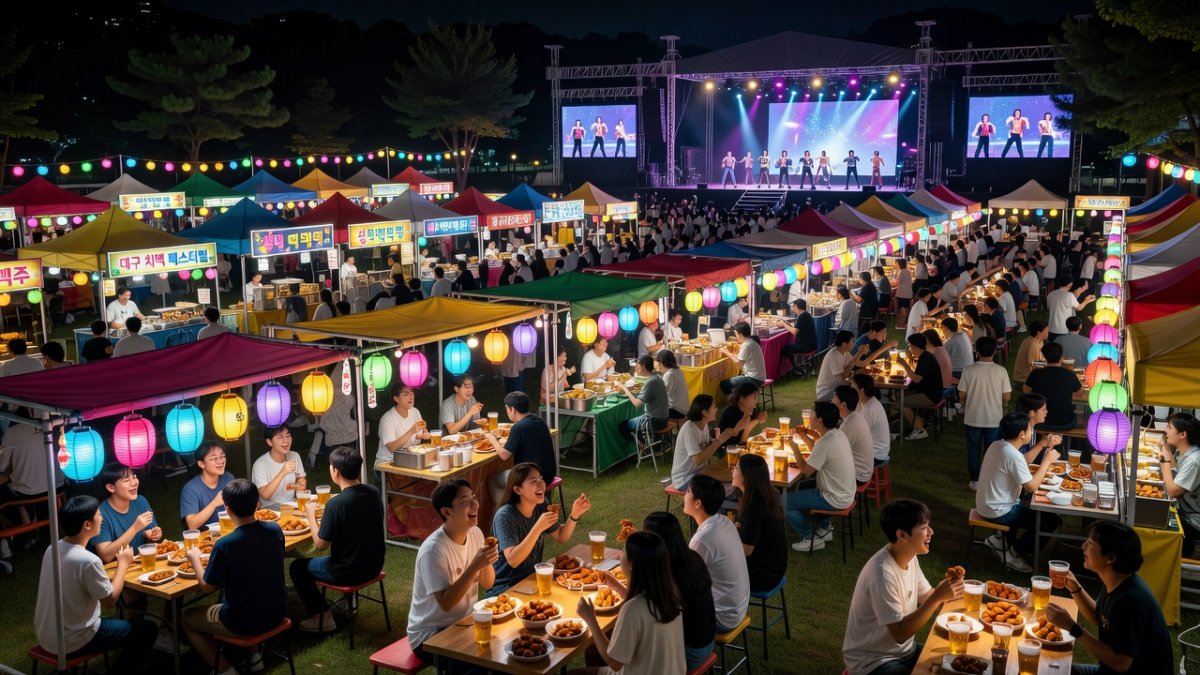
Daegu’s Chimac Festival: A Policy Framework for Regional Cultural Tourism
Food tourism constitutes a measurable component of South Korea’s regional economic development strategy, and the Daegu Chimac Festival provides a concrete illustration of its multiplier effects. Chicken-and-beer consumption, popularized globally through K-dramas, translates into direct vendor revenue, temporary employment, and ancillary spending on accommodation and transport. With the festival sited in Duryu Park, local businesses in Dalseo-gu benefit from concentrated visitor flows that extend beyond the five-day period through media exposure.
Economic studies of Korean local festivals consistently demonstrate that food-focused events generate higher per-visitor expenditure than purely cultural or sporting gatherings. The Daegu Metropolitan Government’s decision to scale the 2026 edition with additional vendors and drone shows reflects calculated expectations of increased domestic tourism following the easing of pandemic restrictions. The KTX connection from Seoul reduces logistical barriers, effectively expanding the catchment area to the capital region without requiring new infrastructure investment. Regional development planners emphasize that food tourism also supports agricultural and processing sectors upstream, creating seasonal but recurring economic activity.
The Economic Calculus of Food Tourism in South Korea
Daegu occupies a distinctive position in Korea’s fried chicken industry, serving as the historical birthplace of several major franchises including Mexicana Chicken, Kyochon Chicken, and Pelicana Chicken. The Chimac Festival capitalizes on this heritage by foregrounding the city’s contribution to a national culinary phenomenon now recognized internationally. This connection transforms a local industry cluster into a tourism asset, allowing the Daegu Metropolitan Government to market authenticity rather than generic festival programming.
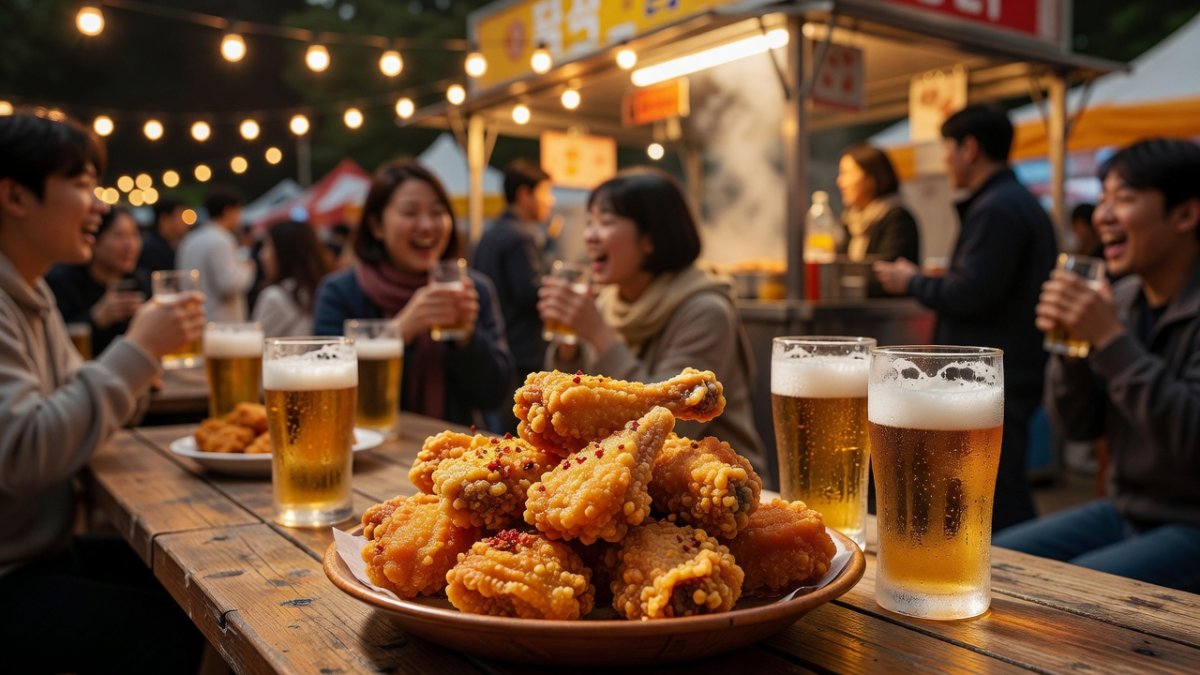
The industry’s evolution from regional enterprise to export-oriented brands illustrates South Korea’s broader economic trajectory. Early chicken franchises emerged in Daegu during periods of rapid urbanization, later scaling nationally and then globally through franchising models. The festival therefore functions as both celebration and soft branding exercise, reminding domestic audiences of Daegu’s foundational role while introducing international visitors to the supply-chain origins of a globally consumed product. Policy linkages exist between the festival and national export promotion strategies, demonstrating how regional festivals can support industrial policy objectives without direct central government intervention.
Daegu’s Fried Chicken Industry: From Local Enterprise to National Export
Korean local festivals increasingly serve as extensions of national soft power initiatives. The Daegu Chimac Festival, through its emphasis on chimaek culture popularized by K-dramas, participates in cultural diplomacy by offering experiential encounters with Korean popular culture. International visitors attending the July 2026 event encounter not only food and music but also the organizational efficiency and technological elements such as drone shows that characterize contemporary Korean event production.
The Ministry of Culture, Sports and Tourism has long supported regional festivals as vehicles for projecting Korean cultural confidence abroad. While the Chimac Festival remains primarily domestic in orientation, its media coverage—exemplified by KOREA NOW’s June 22, 2026 video—extends its reach to global audiences. This secondary circulation amplifies Korea’s image as a vibrant, food-centric society, complementing state-led initiatives such as Korean Wave campaigns. Scholars of cultural policy observe that decentralized festival programming allows regional governments to tailor soft power messaging to local strengths, avoiding overlap with Seoul-centered cultural events.
Local Festivals as Instruments of Soft Power and Cultural Diplomacy
The cancellation of previous Chimac Festival editions in 2020 and 2021 due to the COVID-19 pandemic underscores the event’s role in South Korea’s post-pandemic recovery architecture. The 2026 return, positioned as larger than prior iterations, aligns with national efforts to revive domestic tourism and restore consumer confidence in large public gatherings. The Daegu Metropolitan Government’s programming choices—expanded vendor numbers and additional entertainment such as drone shows—reflect deliberate strategies to maximize attendance and associated economic spillovers.
Domestic tourism policy under the Ministry of Culture, Sports and Tourism prioritizes regional destinations accessible by high-speed rail. The 1.5-hour KTX journey from Seoul positions Daegu competitively against more distant regional festivals. By concentrating activity at Duryu Park, the city optimizes existing public infrastructure while minimizing new capital expenditure, a pragmatic approach consistent with post-pandemic fiscal caution. Recovery strategies also incorporate eco-friendly initiatives as continuity with health adaptations developed during the pandemic years, signaling to visitors that large-scale events can proceed responsibly.
The Post-Pandemic Recovery and South Korea’s Domestic Tourism Strategy
Despite the festival’s evident regional economic benefits, its expansion raises legitimate questions of long-term sustainability. Over-reliance on food and beverage consumption can strain waste management systems, prompting the inclusion of eco-friendly measures such as biodegradable serving materials in 2026 planning. The Daegu Metropolitan Government must balance vendor density with park capacity at Duryu Park to avoid diminishing the visitor experience or creating negative externalities for residents of Dalseo-gu.
Financial sustainability depends on continued central government support through the Ministry of Culture, Sports and Tourism’s regional tourism grant programs. As festival programming grows more elaborate—with drone shows and high-profile K-pop stages—organizers face increasing pressure to demonstrate measurable economic returns that justify ongoing public investment. Data collection on visitor spending patterns and overnight stay durations becomes essential for policy evaluation and budget justification in subsequent fiscal cycles.
Competition among regional festivals presents another structural challenge. Daegu’s distinctive chicken industry heritage provides meaningful differentiation, yet maintaining this competitive edge requires consistent investment in programming quality and international marketing outreach. Without such differentiation, the Chimac Festival risks converging with the broader landscape of Korean summer events rather than establishing a unique and sustainable identity over the long term.
Challenges and Sustainability in Korea’s Festival Economy
The 2026 Daegu Chimac Festival illustrates the maturation of South Korea’s regional cultural tourism framework. By integrating food heritage, transport connectivity, and post-pandemic recovery objectives, the Daegu Metropolitan Government offers a governance model that other secondary Korean cities such as Busan, Gwangju, and Daejeon may adapt for their own local festival strategies. Continued alignment with Ministry of Culture, Sports and Tourism priorities will determine whether the festival evolves into a durable annual institution or remains subject to shifting budgetary and public health conditions.
For policymakers, the Chimac Festival demonstrates that local food culture, when integrated with strategic transport infrastructure and sustained government support, can generate measurable economic outcomes beyond the immediate festival period. The challenge for Daegu and other Korean metropolitan governments will be sustaining this momentum through data-driven planning, environmental accountability, and continuous program innovation that keeps regional festivals relevant in an increasingly competitive domestic and international tourism market.
Looking Ahead
The 2026 Daegu Chimac Festival serves as a microcosm of broader trends in South Korean regional governance: the deliberate conversion of local cultural assets into economic instruments through structured public policy. As Korea’s regional tourism framework continues to evolve, the festival’s long-term significance will depend on the Daegu Metropolitan Government’s ability to balance commercial expansion with environmental stewardship and authentic cultural representation. For scholars of Korean public administration and regional development, the Chimac Festival offers a valuable longitudinal case study in the intersection of food culture, tourism policy, and local economic revitalization in Northeast Asia’s fourth-largest economy.
By Prof. David Park, Staff Writer
This article was produced with AI-assisted research and editorial support. Reporting is based on sources cited in the article.
What's Your Reaction?
 Like
0
Like
0
 Dislike
0
Dislike
0
 Love
0
Love
0
 Funny
0
Funny
0
 Wow
0
Wow
0
 Sad
0
Sad
0
 Angry
0
Angry
0

East Asia/Technology Correspondent at Global1.News. Seoul-based voice covering Korean politics, technology, business, and culture. Analyzes how technology and geopolitics intersect across East Asia.











Comments (0)