
Lindsey Graham: A Hawkish Voice Falls Silent at a Moment of Global Crisis
In a recent BBC News report, the world learned of the sudden death of United States Senator Lindsey Graham, a pivotal Republican voice on foreign policy and a close ally of President Donald Trump, who died at the age of 71 after a brief illness. Lindsey Graham: A Hawkish Voice Falls Silent at a Moment of Global Crisis Washington, DC – July 2026 — Republican Senator Lindsey Grah
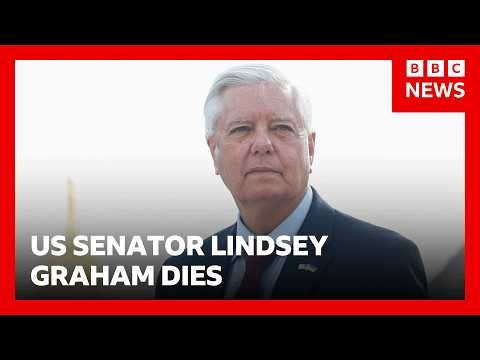
In a recent BBC News report, the world learned of the sudden death of United States Senator Lindsey Graham, a pivotal Republican voice on foreign policy and a close ally of President Donald Trump, who died at the age of 71 after a brief illness.
Lindsey Graham: A Hawkish Voice Falls Silent at a Moment of Global Crisis
Washington, DC – July 2026 — Republican Senator Lindsey Graham of South Carolina, one of the most influential American voices on defence and foreign policy over the past two decades, died on Saturday evening following what his office described as a "brief and sudden illness." Preliminary findings from the medical examiner indicate the cause was a rupture of his aorta, the body's main artery, according to a statement from his spokesman. He was 71.
A Life in Service: From Air Force Prosecutor to Senate Power Broker
Lindsey Olin Graham was born in 1955 in Pickens County, South Carolina, the son of a liquor store owner and a nurse. His early life was marked by tragedy: while studying at the University of South Carolina, he lost both his mother and father within two years of each other. He stepped up to raise his younger sister, whom he later legally adopted — a formative experience that those close to him say shaped his tenacious approach to life and politics.
After graduating from law school at the University of South Carolina, Graham joined the United States Air Force as a military prosecutor and defence attorney, serving in Europe and the United States. He later entered politics, winning a seat in the House of Representatives in 1994 before being elected to the Senate in 2002 — a body where he would serve for the next 23 years, becoming one of its most recognisable and influential members on matters of war and peace.
Graham's political identity was forged alongside Senator John McCain, the Arizona Republican and former presidential candidate, who became a close mentor. Like McCain, Graham championed an interventionist foreign policy that saw American military power as a force for global stability and the protection of democratic allies.
The Transformation: From Trump Critic to Staunch Ally
Graham's career trajectory also mirrored the seismic shifts within the Republican Party itself. In 2015, as a presidential candidate, Graham campaigned on a message of bipartisan cooperation. "If I get to be president, we're going to open up a bar in the White House," he joked. "We're going to get liquored up and solve problems." When Donald Trump entered the political arena, Graham was among his most outspoken critics, memorably calling him a "race-baiting, xenophobic, religious bigot" and a "jackass" who should not be president. In May 2016, he warned that if the Republican Party nominated Trump, it "will get destroyed."
Yet after Trump's victory in 2016, Graham underwent what analysts describe as one of the most dramatic political conversions in modern American history. The two men became close — regularly golfing together, with Graham becoming a fixture on cable news as one of Trump's most ardent defenders. He played a pivotal role in the confirmation of Supreme Court Justice Brett Kavanaugh, angrily condemning allegations of sexual assault against the nominee and helping secure his appointment by a narrow margin.
The relationship fractured in the aftermath of the January 6, 2021 attack on the US Capitol. "Trump and I, we had a hell of a journey," Graham declared on the Senate floor. "I hate it to end this way… All I can say is a count me out. Enough is enough." Yet the rupture was temporary. Graham voted to acquit Trump in his 2021 impeachment trial, supported his 2024 re-election bid, and by the time of his death remained among the president's most loyal allies in Congress. "There is a dark side to Donald Trump," Graham told the BBC in 2023, "and he was a very good president. But I am sticking with him because I saw what he did." Graham cited Trump's border record, the killing of Iranian General Qasem Soleimani, and the appointment of conservative judges as key reasons for his renewed support. He had previously served as a House member from 1995 to 2003 and was elected to the Senate in 2002, where he built a reputation for consistent engagement on national security issues. This evolution from critic to ally reflected broader realignments in Washington power structures, where personal relationships often bridged ideological divides within the Republican caucus. Graham's ability to maintain influence across factions allowed him to shape legislative outcomes on defence spending and foreign aid packages, even as Senate dynamics grew more polarised. His unopposed bid for another six-year term in November 2026 underscored his enduring hold on South Carolina voters, who valued his decades of experience in military and prosecutorial roles from his Air Force service. Analysts note that such conversions strengthened Trump's position in the Senate, enabling smoother confirmations and policy alignments on issues like judicial appointments. Graham's journey illustrated how individual senators could navigate party transformations while retaining core foreign policy priorities, including robust support for allies abroad. This loyalty persisted through multiple election cycles, positioning him as a reliable voice in Trump's inner circle on Capitol Hill matters.
A Hawkish Voice at a Moment of Maximum Tension
Graham's death comes at a particularly volatile moment in international affairs. As a leading Republican voice on defence, he was a consistent advocate for robust US military action abroad — supporting the invasion of Iraq after the September 11 attacks, opposing the withdrawal from Afghanistan in 2021 (which he called a "sad and dangerous event for US national security"), and pushing for sustained American support for Ukraine in its war against Russia.
In recent months, he was among the most vocal proponents of military action against Iran. In one of his last televised interviews, he told CBS that the United States would "obliterate" Iran if the country did not submit to US control of the strategically vital Strait of Hormuz — a waterway through which approximately one-fifth of the world's oil supply passes. This hawkish posture put him at the centre of the ongoing US-Iran confrontation that has escalated dramatically in recent weeks, marked by an exchange of strikes and Iran's temporary closure of the waterway. Graham had just returned from Kyiv, where he met Ukrainian President Volodymyr Zelensky on Friday July 10, reinforcing his commitment to arming Ukraine against Russian advances. President Donald Trump told NBC News that he spoke with Graham hours before his death, noting that the senator "sounded great" but tired after his travels. Trump's tribute described Graham as a "true American Patriot" who would be "greatly missed," highlighting their shared views on strong national defence. Graham's positions aligned with longstanding Republican priorities in the Senate, where he influenced debates on military budgets and sanctions regimes. His advocacy for action in Iraq post-9/11 and against the 2021 Afghanistan withdrawal demonstrated a consistent thread of interventionism that shaped US geopolitical strategy. In the current context of Middle East tensions, Graham's calls for control over key maritime routes underscored the intersection of energy security and military posture. This approach resonated within Washington circles, where Senate Republicans often deferred to his expertise on such matters. The timing of his passing amplifies scrutiny on how these policies will proceed without his direct input in committee deliberations and floor votes.
International Reaction: A Friend of Israel and Ukraine
Graham was a stalwart supporter of Israel, a position that earned him deep respect in Jerusalem. Prime Minister Benjamin Netanyahu said on Sunday that "Lindsey understood that the security of Israel and America are inseparable" and called him "one of Israel's greatest friends."
He was equally committed to Ukraine's defence against Russian aggression. Days before his death, Graham was in Kyiv meeting President Volodymyr Zelensky — his last overseas trip. Zelensky said in a statement that he was "deeply saddened" by the senator's death, adding that "America and the world have lost a determined leader." Graham consistently pushed for the supply of advanced American weaponry to Kyiv and supported sanctions against Moscow, though he tempered his criticism of Trump's overtures to Vladimir Putin. Netanyahu's remarks emphasised the intertwined interests Graham championed, reflecting years of advocacy that bolstered bilateral ties between Washington and Jerusalem. Zelensky's response highlighted Graham's role in sustaining US assistance amid ongoing conflict, noting the senator's frequent visits and legislative efforts. These international perspectives underscore Graham's influence beyond domestic politics, extending to alliances that affect global stability. His meetings with Zelensky on Friday July 10 exemplified this engagement, occurring just before his return to the United States. Graham's hawkish stance on Iran complemented his Israel support, as both involved firm positions on regional security threats. In Senate dynamics, such views often bridged gaps with Democrats on aid packages, though they drew criticism from isolationist factions within his own party. The reactions from Netanyahu and Zelensky illustrate how Graham's absence may alter diplomatic momentum at a time of heightened tensions. His prior service as an Air Force prosecutor informed a worldview prioritising deterrence and alliance maintenance, which resonated in foreign capitals. This network of relationships positioned him as a key interlocutor in Washington power structures, facilitating coordination on defence matters across administrations.
Senate Implications: A Critical Seat at a Critical Time
Graham's death reshapes the political landscape in Washington at a moment when Republicans are already dealing with Senator Mitch McConnell's extended hospitalisation. The Kentucky Republican, 84, has been hospitalised for weeks with what his aides have described as pneumonia complicated by a fall, but few additional details about his condition have been released. The loss of two senior Republican voices — one by prolonged illness, the other by sudden death — leaves the party's Senate leadership thinner than at any point in the current Congress.
South Carolina Governor Henry McMaster, a Republican, now has the authority to appoint a temporary replacement to serve until the end of Graham's term in January. However, the permanent successor will be chosen in a special election during November's midterms — a contest that, in a reliably conservative state like South Carolina, would normally favour the Republican candidate but could become unexpectedly competitive if the national political climate continues to shift. The party will also need to hold a new primary to select its candidate. Before his death, Graham had been running unopposed for a new six-year term. Republicans held a 53-47 Senate majority prior to this development, giving them procedural advantages in confirming nominees and advancing legislation. McMaster's appointment power introduces uncertainty, as the interim senator may lack Graham's seniority and established relationships with figures like President Donald Trump. McConnell's ongoing absence compounds the challenge, reducing experienced voices on procedural matters central to Senate operations. In this environment, the loss affects how the chamber addresses foreign policy priorities, including aid to Ukraine and responses to Iran. Graham's prior House service from 1995 to 2003 and long Senate tenure provided institutional knowledge that newer members may not replicate immediately. The upcoming special election dynamics in South Carolina could test party unity, particularly if external pressures influence voter turnout. This shift in Senate composition may influence negotiations on defence bills, where Graham often played a mediating role across party lines.
Analysis — The Geopolitical Void
Graham's absence from the Senate floor will be felt most acutely in the realm of foreign policy, where his influence extended far beyond his institutional role. As one of the few remaining Republican voices with deep relationships across the aisle — Trump noted that "if I had a problem with a Democrat, he could work it out" — Graham functioned as an informal bridge between the administration and skeptical senators on military matters, particularly on aid to Ukraine and the Iran confrontation.
His death removes that bridge at precisely the moment when the United States faces its most serious military engagement in the Middle East in decades. With the Strait of Hormuz crisis escalating and the administration pursuing simultaneous military and diplomatic tracks, the loss of a seasoned, bipartisan foreign policy voice in the Senate creates a vacuum that will not be easily filled. Whoever succeeds Graham in November will be a junior senator without the decades of accumulated influence, seniority, and personal relationships that defined his career — a fact that may quietly reshape the trajectory of American foreign policy in the months ahead, for better or worse.
By Irina Volkov, Staff Writer
This article was produced with AI-assisted research and editorial support. Reporting is based on sources cited in the article.
What's Your Reaction?
 Like
0
Like
0
 Dislike
0
Dislike
0
 Love
0
Love
0
 Funny
0
Funny
0
 Wow
0
Wow
0
 Sad
0
Sad
0
 Angry
0
Angry
0

Russia/Eastern Europe Correspondent at Global1.News. Covering Russian politics, energy, security, and the shifting dynamics of the post-Soviet space. Provides clear-eyed analysis on one of the world's most opaque regions.














Comments (0)