
ASEAN-Myanmar Dialogue Resumes: Strategic Implications for South Korea
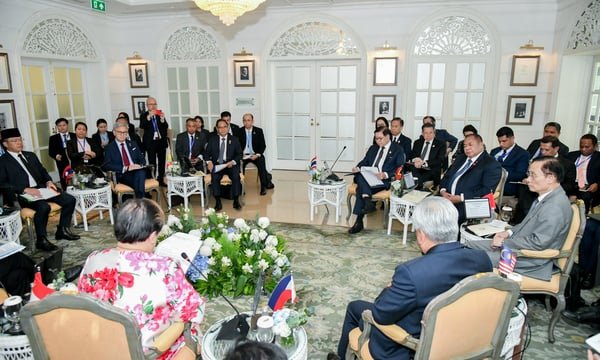
Reviving Regional Peace Initiatives in Southeast Asia The informal meeting between ASEAN foreign ministers and Tin Maung Swe, foreign minister of Myanmar's new military-backed civilian government, marks the first such encounter in five years. Held in Bangkok on July 12, 2026, the session sought to restart implementation of the Five-Point Consensus adopted at a special ASEAN mee
Reviving Regional Peace Initiatives in Southeast Asia
The informal meeting between ASEAN foreign ministers and Tin Maung Swe, foreign minister of Myanmar's new military-backed civilian government, marks the first such encounter in five years. Held in Bangkok on July 12, 2026, the session sought to restart implementation of the Five-Point Consensus adopted at a special ASEAN meeting in April 2021. That framework calls for an immediate cessation of violence and inclusive dialogue among all parties to Myanmar's civil conflict. Myanmar has remained excluded from ASEAN summits since late 2021 owing to limited progress on these commitments.
Philippine Foreign Secretary Ma. Theresa Lazaro noted that Tin Maung Swe provided briefings on the military's peace efforts, the status of Aung San Suu Kyi, and cooperation against cross-border criminal networks. Thai Foreign Minister Sihasak Phuangketkaew described the gathering as an icebreaker and emphasized calibrated engagement. ASEAN members reaffirmed the Consensus yet stressed the need for a concrete implementation strategy, underscoring that engagement requires reciprocal steps from Naypyidaw.
The Role of Thailand in Facilitating Engagement
Thailand's government played a central part in convening the Bangkok session, reflecting its longstanding interest in stabilizing relations with Myanmar. Bangkok has consistently advocated measured re-engagement rather than continued isolation. The meeting proceeded without representatives from Cambodia, while Malaysia sent Foreign Ministry Secretary-General Tan Sri Amran Mohamed Zin. This selective attendance illustrates the varied approaches within ASEAN toward Myanmar's post-coup authorities.
The discussions also addressed Aung San Suu Kyi's relocation to house arrest in May 2026. Tin Maung Swe stated that the 81-year-old former leader remains in good health. ASEAN's current special envoy has so far been denied a requested meeting, highlighting persistent gaps between the bloc's expectations and Myanmar's domestic political realities. The military-dominated parliament recently rejected the Five-Point Consensus as external interference, further complicating prospects for rapid implementation.
South Korea's ASEAN Partnership and Myanmar Investments
As an ASEAN dialogue partner since 1989, South Korea maintains institutional channels that position it to observe and potentially support regional initiatives such as the revived Myanmar engagement. Seoul participates in ASEAN+3 and East Asia Summit mechanisms, giving it a stake in the bloc's cohesion. The Bangkok meeting therefore carries indirect relevance for Korean foreign policy, which has long sought to balance relations with Southeast Asian states amid shifting great-power dynamics in the Indo-Pacific.
Korea's diplomatic posture emphasizes multilateral dialogue and economic connectivity. The resumption of ASEAN-Myanmar talks aligns with Seoul's preference for incremental diplomacy over abrupt isolation. While South Korea has not issued a formal statement on the July 2026 session, its established role as dialogue partner provides avenues for quiet consultation with ASEAN counterparts on how best to encourage compliance with the Five-Point Consensus.
Economic Interests and Chaebol Involvement in Myanmar
South Korean firms have pursued opportunities in Myanmar's energy, infrastructure, and manufacturing sectors over the past decade. Major conglomerates maintain investments that could be affected by any sustained improvement or deterioration in Naypyidaw's regional standing. Renewed ASEAN engagement may create conditions for more predictable operating environments, though political uncertainty continues to pose risks to project timelines and supply-chain stability.
These economic linkages intersect with Korea's broader New Southern Policy framework, which seeks to diversify trade and investment beyond traditional Northeast Asian partners. Myanmar's strategic location along the Bay of Bengal offers potential transit routes and resource access that complement Korean industrial needs. Any calibrated normalization process endorsed by ASEAN could therefore influence the risk calculations of Korean enterprises evaluating long-term commitments in the country.
Broader Northeast Asian Diplomatic Ramifications
The ASEAN-Myanmar icebreaker carries implications that extend into Northeast Asian diplomacy, particularly regarding coordination among South Korea, Japan, and China. All three Northeast Asian powers maintain distinct interests in Myanmar's stability and resource development. South Korea's participation in ASEAN-led forums allows it to signal support for regional ownership of conflict resolution while avoiding direct entanglement in Myanmar's internal affairs.
China's extensive infrastructure presence and Japan's emphasis on quality investment create a competitive yet complementary landscape. Seoul's approach has historically stressed development cooperation and capacity building, areas where ASEAN engagement could open modest windows for trilateral or quadrilateral initiatives. The Five-Point Consensus itself may serve as a reference point for Northeast Asian actors seeking to align their Myanmar policies with Southeast Asian consensus, thereby reducing friction in wider Indo-Pacific strategy discussions.
Human Rights Concerns and the Path Forward
Criticism from groups such as ASEAN Parliamentarians for Human Rights and the Special Advisory Council for Myanmar underscores the tension between diplomatic re-engagement and accountability demands. These organizations argue that renewed contact risks legitimizing Myanmar's military authorities without corresponding progress on inclusive dialogue or the release of political detainees. ASEAN's own commitment to the Five-Point Consensus remains the benchmark against which future steps will be measured.
For South Korea, balancing economic interests with normative considerations requires careful calibration. Seoul has traditionally supported ASEAN centrality while advocating human rights in multilateral settings. The outcome of the Bangkok process will test whether calibrated engagement can produce tangible movement toward the Consensus goals or whether deeper divisions within both ASEAN and Myanmar will persist. Observers in Northeast Asia will watch closely for signs that the icebreaker meeting translates into sustained implementation rather than episodic contact.
By Prof. David Park, Staff WriterThis article was produced with AI-assisted research and editorial support. Reporting is based on sources cited in the article.
What's Your Reaction?
 Like
0
Like
0
 Dislike
0
Dislike
0
 Love
0
Love
0
 Funny
0
Funny
0
 Wow
0
Wow
0
 Sad
0
Sad
0
 Angry
0
Angry
0

East Asia/Technology Correspondent at Global1.News. Seoul-based voice covering Korean politics, technology, business, and culture. Analyzes how technology and geopolitics intersect across East Asia.











Comments (0)