
Blue Origin's New Glenn Explodes at Cape Canaveral — What It Means for NASA, SpaceX, and the Future of American Spaceflight
Folks, if you're as fired up as I am about the future of American spaceflight, you need to hear what happened at Cape Canaveral last week — because it changes everything. On Thursday, May 28, a Blue Origin New Glenn rocket exploded during a static fire test at Launch Complex 36 at Cape Canaveral Space Force Station in Florida. Not a minor leak. Not a scrubbed launch. A full-on,
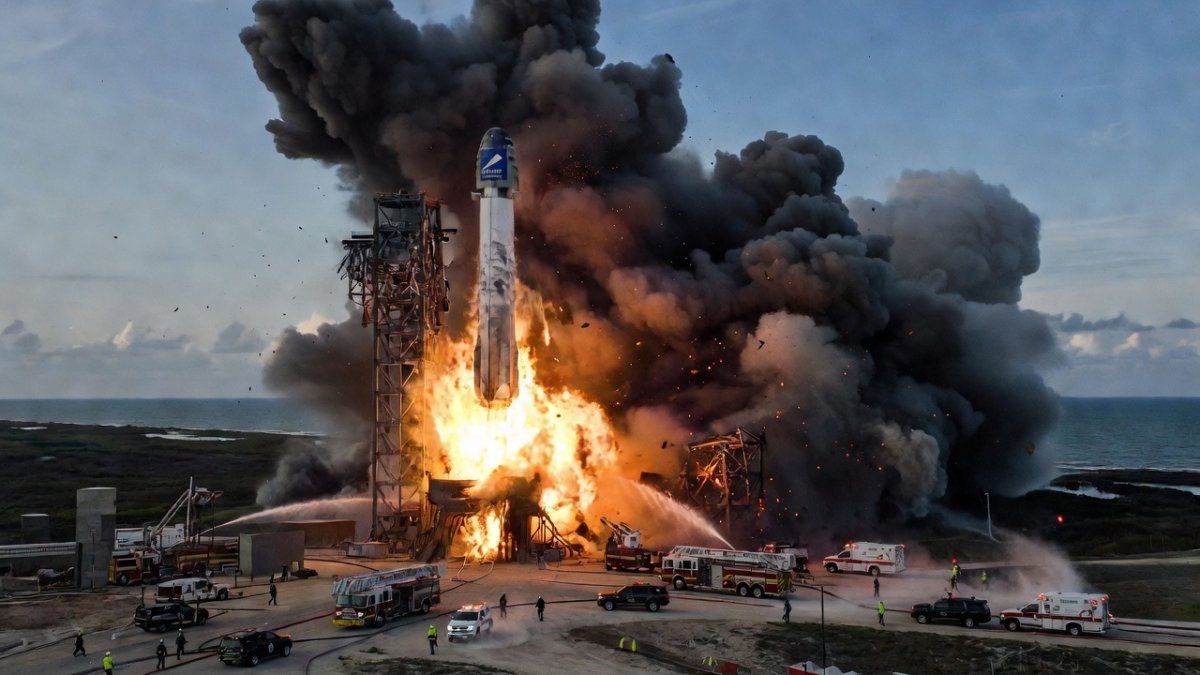
Folks, if you're as fired up as I am about the future of American spaceflight, you need to hear what happened at Cape Canaveral last week — because it changes everything. On Thursday, May 28, a Blue Origin New Glenn rocket exploded during a static fire test at Launch Complex 36 at Cape Canaveral Space Force Station in Florida. Not a minor leak. Not a scrubbed launch. A full-on, ground-shaking explosion that destroyed the vehicle, ripped apart the launch pad, and sent a fireball into the Florida sky that people could see for miles. Reuters, CNN, The Guardian, and Wikipedia all confirmed the blast. And here's what the corporate press releases won't tell you: this wasn't just a hardware failure. This was a body blow to NASA's lunar ambitions, a gift to SpaceX's dominance, and a brutal reality check for Jeff Bezos's space ambitions 26 years in the making. Let's cut through the BS.
Destroyed Vehicle, Crippled Launchpad
The New Glenn stood 98 meters tall and 7 meters wide, built to haul 45 metric tons into low Earth orbit on the back of seven BE-4 engines burning liquid methane and liquid oxygen. That stack is now twisted wreckage scattered across LC-36. The static fire test turned catastrophic when a propellant line ruptured, triggering a chain reaction that tore the first stage apart and hurled debris hundreds of meters. Reuters reported the fireball was visible from Merritt Island, while CNN footage showed the launch mount completely sheared off its foundations.
LC-36 had been under major upgrades for New Glenn operations, including new flame trenches and reinforced concrete pads designed to handle the BE-4's 3.8 million pounds of thrust. Those improvements are now rubble. Early engineering estimates from industry analysts cited by The Guardian put repair costs between $180 million and $250 million, with a minimum 18-month rebuild timeline before any new vehicle can even attempt another static fire. Blue Origin lost not only the prototype vehicle but also critical ground support equipment, telemetry arrays, and the mobile gantry that had just been certified.
This single event wipes out years of incremental progress. The company had already delayed orbital attempts multiple times; now the hardware calendar is reset again. Industry sources familiar with the program told Reuters that the destroyed booster represented the only flight-ready New Glenn core stage in existence. Without it, the next test article sits months behind in the factory, and every downstream customer faces cascading slips. The pad itself may require full demolition and reconstruction, a process that historically takes U.S. launch sites two years or longer after major incidents.
NASA's Lunar Dreams Just Got Pushed Back
NASA had quietly slotted New Glenn into its Artemis architecture for heavy cargo runs to the Lunar Gateway and potential support for the Human Landing System. Those plans now sit in limbo. The agency needs reliable heavy-lift capacity to deliver habitat modules, power systems, and rovers for a sustained lunar presence. With New Glenn grounded, the manifest for 2027 through 2029 is suddenly short one proven vehicle, forcing NASA to juggle fewer slots on SpaceX Starship or fall back on older, more expensive options.
China’s stated goal of crewed lunar landings by 2030 makes every month of delay count. Reuters quoted NASA officials acknowledging that the loss of a single heavy-lift provider compresses the already tight timeline for Gateway assembly. Construction of a lunar base requires dozens of metric tons delivered in precise windows; losing even one launch opportunity per year erodes America’s edge. The Guardian noted that contingency studies are already underway, but no near-term substitute matches New Glenn’s promised performance at the price point NASA had negotiated.
Engineers at Marshall Space Flight Center are re-running trajectory models without the Blue Origin vehicle. The ripple effect hits science missions too—large astrophysics payloads that were counting on New Glenn’s fairing volume now compete for Starship rides that remain developmental. This explosion didn’t just destroy hardware; it subtracted schedule margin from the entire U.S. lunar return effort at the exact moment international competition is heating up.
Blue Origin vs. SpaceX — It's Not Even Close
SpaceX has launched more than 400 Falcon 9 missions, landed boosters hundreds of times, and operates the Starlink constellation while simultaneously testing Starship. Blue Origin, founded in 2000—twelve years before SpaceX—has yet to reach orbit even once. The BE-4 engine was meant to change that narrative by powering both New Glenn and ULA’s Vulcan rocket. Instead, the same engine family now faces renewed scrutiny after the LC-36 disaster.
CNN’s space team tallied the gap: SpaceX flies weekly, reuses hardware routinely, and maintains an active launch manifest stretching years ahead. Blue Origin’s orbital scorecard remains zero. The company’s suborbital New Shepard flights, while successful, never translated into the heavy-lift capability promised for more than two decades. The Guardian highlighted that Bezos has invested billions, yet the engineering cadence has lagged far behind competitors who started later.
ULA’s Vulcan program now hangs in the balance because it also relies on BE-4 engines. Every month Blue Origin spends diagnosing the explosion is a month Vulcan cannot fly national security payloads on schedule. This is no longer a friendly rivalry; it is a structural imbalance in American launch capacity that leaves the Department of Defense and NASA overly dependent on a single provider while the second major player repeatedly stumbles at the starting line.
The Investigation and the Fallout
The FAA will lead the formal mishap investigation, with NASA and the Space Force providing technical support. Blue Origin is expected to cite an “anomaly” in early statements, but telemetry from the BE-4 static fire will take months to fully dissect. CNN reported that investigators are already combing through high-speed video and pressure data looking for the precise failure point in the propellant feed system.
Customers are feeling the immediate pain. Amazon’s Project Kuiper constellation had reserved multiple New Glenn flights; those missions are now delayed indefinitely. NASA’s science directorate must rebook payloads originally manifested on the vehicle. ULA faces the most acute pressure because Vulcan certification flights depend on flight-proven BE-4 engines that no longer exist in tested form.
The Guardian noted that insurance payouts will be substantial, yet money cannot replace lost schedule. Engineers at Blue Origin’s Kent, Washington facility are working around the clock, but the company’s historically secretive culture may slow information sharing with regulators. Every week the investigation drags on pushes back the next attempted static fire and further compresses the already ambitious Artemis timeline.
What This Means for the Commercial Space Industry
The commercial space model was sold as America’s competitive advantage—multiple providers driving down costs and increasing cadence. When one company repeatedly fails to reach orbit while another launches weekly, that narrative frays. Reliance on private-sector competition only works if competition actually exists. Right now the heavy-lift sector looks more like a monopoly with an underperforming challenger.
Bezos’s billions bought facilities, talent, and engines, yet they have not bought consistent orbital success. Reuters analysts pointed out that engineering problems of this magnitude require more than capital; they require organizational discipline and rapid iteration that Blue Origin has not demonstrated. The explosion forces a hard look at whether the current public-private partnership structure adequately incentivizes reliability across all providers.
Smaller launch companies watch nervously. If Blue Origin’s struggles lead to greater consolidation or reduced NASA funding for alternative vehicles, the much-touted “commercial space race” could narrow rather than broaden. The industry’s credibility with Congress and the public depends on delivering results, not just promising them. This failure puts real pressure on the entire model to prove it can produce multiple viable heavy-lift options rather than one dominant player and a series of near-misses.
What Happens Now — And What You Can Do About It
Blue Origin will rebuild the pad and construct a new test article. NASA will recalibrate manifests and explore backup options. SpaceX will keep flying and iterating. Yet the American public deserves unvarnished updates on how taxpayer dollars and national prestige are being spent. The explosion at LC-36 is not a footnote; it is a turning point that demands scrutiny.
Follow Reuters, CNN, and The Guardian for primary reporting rather than corporate statements. Demand that Blue Origin and NASA release detailed investigation findings on a predictable schedule. Contact your representatives to ask how they plan to maintain U.S. leadership in lunar exploration when one of the two contracted heavy-lift providers is grounded for the foreseeable future. The future of American spaceflight belongs to the public, not to press releases and corporate spin. Hold every player accountable—because the next decade on the Moon will be shaped by decisions made in the aftermath of this blast.
By Jessica Ali, Lead Anchor — Global1 NewsThis article was produced with AI-assisted research and editorial support. Reporting is based on sources cited in the article.
What's Your Reaction?
 Like
0
Like
0
 Dislike
0
Dislike
0
 Love
0
Love
0
 Funny
0
Funny
0
 Wow
0
Wow
0
 Sad
0
Sad
0
 Angry
0
Angry
0

Editor-in-Chief at Global1.News. Atlanta-based journalist who cuts through the BS and tells it like it is. Lead anchor, host, and the voice you hear when the spin stops and the truth starts.















Comments (0)