
Bees need a place to stay, so Durango local officials built them hotels
Bees Find Sanctuary in Durango’s New ‘Insect Hotels’ as Locals Tackle Pollinator Crisis
In the sun-baked streets of Gómez Palacio, Durango, a quiet revolution is underway. Local researchers and city officials have installed the first wave of wooden insect hotels designed specifically to shelter native bees, giving these vital pollinators a safe place to nest amid shrinking habitats and harsh northern weather. What began as a university-led experiment has quickly become a symbol of community-driven conservation in one of Mexico’s key agricultural regions.
A Practical Response to an Urgent Threat
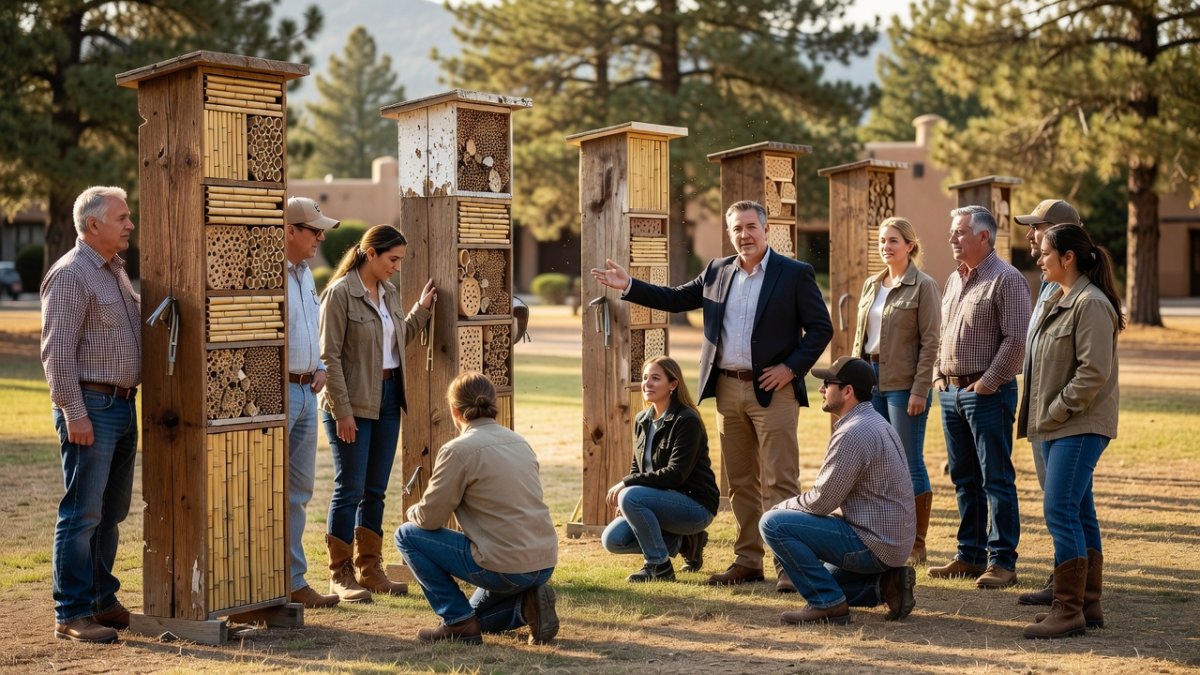
The project, launched in partnership between the Juárez University of the State of Durango (UJED) and Gómez Palacio’s municipal government, has so far placed ten handcrafted wooden structures across parks, schoolyards, and green corridors. Each “hotel” features drilled cavities, bamboo tubes, and layered wood blocks that mimic the hollow stems and deadwood solitary bees naturally seek. Unlike commercial hives for honeybees, these installations target the region’s wild pollinators—species that rarely sting and play an outsized role in pollinating local crops such as alfalfa, chilies, and melons.
Dr. Elena Vargas, lead entomologist at UJED, explained the urgency during a recent site visit. “We’ve documented a 40 percent drop in solitary bee sightings around Gómez Palacio over the past eight years. Pesticides, urban sprawl, and prolonged droughts have stripped away nesting sites. These hotels are not luxury—they are emergency housing.”
Why Durango Bees Are Struggling
Northern Durango sits at the edge of the Chihuahuan Desert, where extreme temperature swings and irregular rainfall already challenge insect life. Add Mexico’s broader pollinator challenges—neonicotinoid use in commercial farming and the loss of native vegetation—and the pressure mounts quickly. National data from the Secretariat of Agriculture show that pollinator-dependent crops contribute roughly 12 billion pesos annually to the economy; any sustained decline risks both yields and rural livelihoods.
Local farmer Miguel Ángel Soto, whose family has grown alfalfa for three generations, has noticed the change firsthand. “Five years ago I could count dozens of native bees on a single hectare. Now I see mostly flies. The hotels give me hope that we can bring the balance back without waiting for federal programs that never arrive.”
How the Hotels Are Built and Monitored
Each structure stands about 1.2 meters tall, constructed from untreated pine and cedar to avoid chemical leaching. Volunteers from UJED’s biology department and local high-school students drilled holes of varying diameters—between 2 and 10 millimeters—to accommodate different bee species. The installations face southeast to capture morning warmth while remaining shaded in the afternoon, a design detail refined after three months of temperature logging.
Monitoring equipment installed on two prototype units has already recorded 47 nesting attempts in the first six weeks. Researchers use non-invasive cameras and gentle fiber-optic scopes to track occupancy without disturbing the insects. Early data suggest the most popular cavities are those lined with dried bamboo, echoing the reeds once abundant along the Nazas River before channelization projects altered the landscape.
Community Ownership and Cultural Resonance
Unlike top-down conservation efforts that sometimes falter, this initiative has drawn enthusiastic local participation. Neighborhood associations helped choose installation sites, and a small team of retirees now tends the hotels weekly, clearing debris and noting which blocks show fresh nesting seals. “It feels like we’re welcoming neighbors,” said María del Carmen Ruiz, a retired teacher who volunteers. “Bees work hard for us; now we give them a place to rest.”
The cultural framing matters in a region where community ties run deep. Officials have begun referring to the structures as “posadas de abejas,” evoking the traditional Christmas posadas and underscoring hospitality as a shared value. Bilingual signage at each site explains the project in both Spanish and English, anticipating interest from cross-border agricultural researchers.
Broader Implications for Mexico’s Food System
Durango’s experiment arrives as Mexico grapples with pollinator declines documented across multiple states. While honeybee colony losses often dominate headlines, solitary bees and other native species provide irreplaceable “background” pollination that commercial hives cannot fully replace. Studies from the National Autonomous University of Mexico estimate that wild pollinators contribute up to 30 percent of the yield stability in rain-fed crops common in the north.
If the Gómez Palacio model proves scalable, similar hotels could be replicated in neighboring states facing comparable pressures. City officials have already committed funds for 15 additional units by the end of the year, with an emphasis on schools so children can observe the insects’ life cycles. Early classroom visits have sparked questions about biodiversity that textbooks alone rarely prompt.
Challenges and Measured Expectations
Researchers caution against viewing the hotels as a complete solution. Ongoing pesticide monitoring, restoration of native flowering plants, and reduced tillage remain essential. Dr. Vargas noted that the structures will require seasonal maintenance and that occupancy rates may fluctuate with rainfall patterns. Still, the project’s low cost—roughly 2,800 pesos per unit—and visible community buy-in make it a replicable starting point rather than an isolated novelty.
International observers have taken note. A delegation from the Inter-American Institute for Cooperation on Agriculture visited last month, interested in adapting the design for Central American contexts where habitat fragmentation threatens stingless bee populations. The exchange underscores how local Mexican ingenuity can inform wider Latin American strategies.
As evening light falls over Gómez Palacio, the wooden hotels stand quietly among mesquite trees and playgrounds. Inside their carefully drilled chambers, solitary bees are beginning to seal their nests with mud and leaves, preparing for the cooler months ahead. In a region long defined by resilience, these small sanctuaries offer both practical shelter and a reminder that even the smallest creatures deserve a place to call home.
This is Rosa Martinez for Global1 News, reporting from Mexico City. 🇲🇽
This article was produced with AI-assisted research and editorial support. Reporting is based on sources cited in the article.
What's Your Reaction?
 Like
0
Like
0
 Dislike
0
Dislike
0
 Love
0
Love
0
 Funny
0
Funny
0
 Wow
0
Wow
0
 Sad
0
Sad
0
 Angry
0
Angry
0

Latin America/Andes Correspondent at Global1.News. Based in Bogota, covering politics, environment, energy, and social movements across the Andean region. Passionate about environmental journalism and communities protecting their land.














Comments (0)