
Behind Mexico’s low unemployment rate, a surge in informal work and shrinking formal sector
Mexico's Unemployment Mirage: Informal Jobs Surge as Formal Sector Shrinks, Revealing Deeper Economic Strains
The official unemployment rate in Mexico continues to paint a picture of resilience, hovering near historic lows. Yet behind those figures lies a stark reality: job creation has slowed dramatically, with nearly all net gains flowing into the informal economy while the formal sector contracts. According to the latest data from the national statistics agency INEGI, Mexico’s active workforce grew by 551,651 people in the first quarter compared to the same period last year. Annual job creation at the end of Q1 marked the third-lowest level in 15 years, a troubling signal for an economy that prides itself on nearshoring opportunities and post-pandemic recovery.
Behind the Headlines: What the INEGI Numbers Really Show
INEGI’s Encuesta Nacional de Ocupación y Empleo reveals that formal employment, which provides access to social security, health benefits, and pensions through IMSS, actually declined by approximately 87,000 positions year-over-year. Meanwhile, informal work—street vending, unregulated services, family businesses without contracts—accounted for the entire net increase and then some. This shift means more than 55 percent of Mexico’s workforce now operates outside formal protections, a figure that has crept upward even as total employment edges higher.
The 551,651 additional workers entering the active population include many young people and women re-entering the labor market after pandemic disruptions. However, the quality of those positions matters far more than the raw count. Informal jobs typically pay 40 percent less on average and offer zero job security. In states like Oaxaca and Chiapas, informal rates exceed 70 percent, turning what looks like national progress into localized hardship.
Why Formal Jobs Are Disappearing
Business owners cite rising labor costs after the 2023 minimum wage hikes, combined with stricter enforcement of outsourcing regulations under the 2021 labor reform. Manufacturing firms that once absorbed workers in border states have slowed hiring amid global supply-chain recalibrations and higher energy prices. Nearshoring announcements dominate headlines, yet many of those investments remain in the planning stage, leaving communities waiting for promised formal payrolls.
Economist Mariana Campos of México Evalúa notes that “the formal sector requires predictability—clear tax rules, reliable energy, and skilled labor pipelines. When those elements falter, companies choose automation or simply stay small to avoid formal obligations.” Her analysis shows that firms with fewer than 50 employees, which dominate Mexico’s business landscape, are the most likely to operate informally to survive thin margins.
Stories from Mexico City’s Neighborhoods
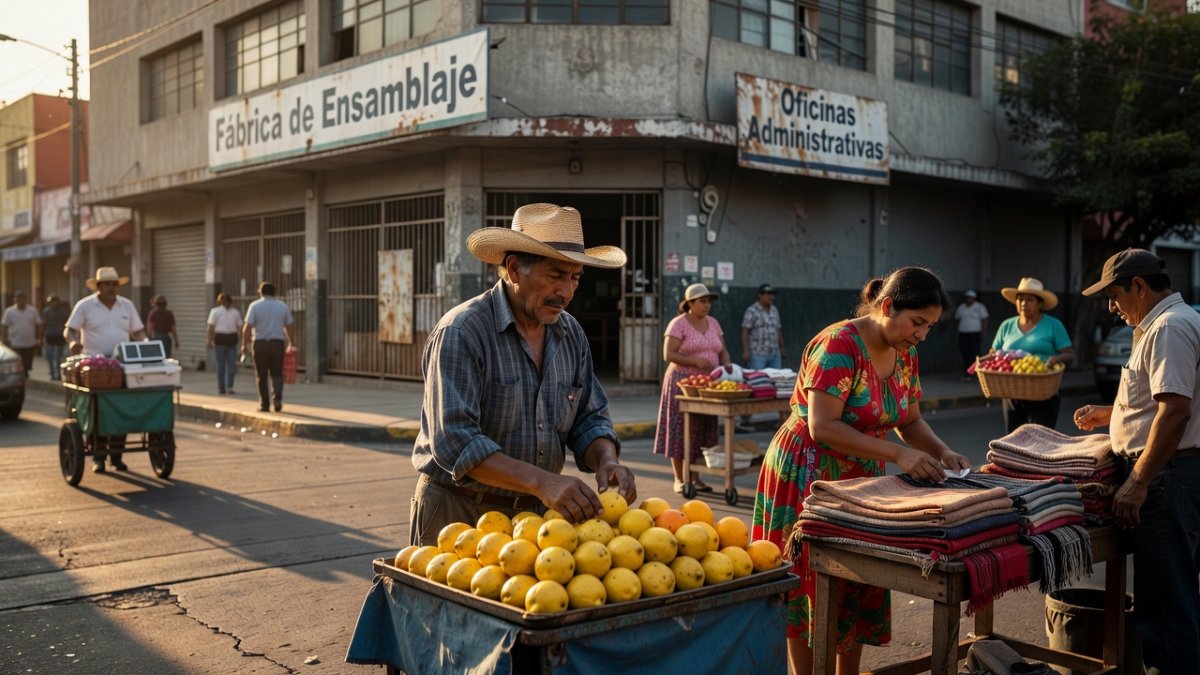
In Iztapalapa, one of the capital’s most populous boroughs, 42-year-old María Elena Torres now sells prepared meals from a cart after losing her formal position at a textile workshop last November. “I had IMSS, paid vacations, and a steady check,” she told me over fresh tortillas. “Now every day is uncertainty, but at least I feed my children without begging for shifts.” Her story repeats across tianguis markets from Tepito to Coyoacán, where vendors report longer hours for the same or lower daily earnings.
Construction worker José Ramírez, 29, from Ecatepec in the State of Mexico, echoes the pattern. After two years of formal site work with benefits, his employer shifted to day laborers paid in cash. “They say the paperwork is too expensive,” he said. “I still work the same hours, but if I get hurt, my family pays.” These personal accounts illustrate how the statistics translate into daily trade-offs between dignity and survival.
Expert Perspectives on Long-Term Consequences
Dr. Gerardo Esquivel, a researcher at El Colegio de México, warns that sustained growth in informality erodes tax collection and weakens the social security system that funds pensions and healthcare. “Every informal worker represents lost revenue for IMSS and SAT,” he explained. “Over time, this creates a vicious cycle: fewer contributors mean higher contribution rates for those still formal, pushing more people out.”
Regional disparities compound the problem. While Mexico City and Nuevo León show modest formal gains tied to services and automotive clusters, southern states continue losing ground. Women, who entered the workforce in record numbers during the pandemic, face the steepest barriers to formal re-entry because many informal roles lack childcare support or flexible hours.
Implications for Families and Communities
The human cost extends beyond wages. Informal workers rarely accumulate retirement savings or qualify for unemployment insurance. When illness strikes, families often sell assets or rely on remittances from relatives abroad. Community organizations in Mexico City report rising demand for food banks and microloans among households previously stable on formal salaries.
Younger workers face particular risks. Recent graduates with technical degrees find themselves underemployed in gig platforms or family enterprises, delaying household formation and homeownership. This generation’s experience could reshape consumption patterns and political expectations for years to come.
Policy Responses and What Comes Next
Government programs such as Jóvenes Construyendo el Futuro have placed some participants into formal apprenticeships, yet critics argue the scale remains insufficient relative to the 551,651-worker influx. Proposals circulating in Congress include simplified tax regimes for micro-enterprises and expanded credit guarantees, but implementation timelines stretch into 2025.
Business chambers advocate faster permitting and energy-cost relief to encourage formal expansion. Labor unions push for stronger inspection regimes to prevent misclassification. Both sides agree that without coordinated action, the current trajectory risks entrenching a dual economy where a shrinking formal core supports an expanding informal majority.
The coming quarters will test whether nearshoring momentum finally translates into broad-based formal hiring or merely reinforces existing divides. For now, the data from INEGI serves as a clear reminder that headline unemployment figures tell only part of Mexico’s employment story.
This is Rosa Martinez for Global1 News, reporting from Mexico City. 🇲🇽
This article was produced with AI-assisted research and editorial support. Reporting is based on sources cited in the article.
What's Your Reaction?
 Like
0
Like
0
 Dislike
0
Dislike
0
 Love
0
Love
0
 Funny
0
Funny
0
 Wow
0
Wow
0
 Sad
0
Sad
0
 Angry
0
Angry
0

Latin America/Andes Correspondent at Global1.News. Based in Bogota, covering politics, environment, energy, and social movements across the Andean region. Passionate about environmental journalism and communities protecting their land.












Comments (0)