
APEC China Year 2026: Advancing Free Trade and Innovation in the Asia-Pacific
In its coverage of China's hosting year for the Asia-Pacific Economic Cooperation forum, CGTN's report "2026 APEC 'China Year': Free trade, innovation and Asia-Pacific cooperation" examines how Beijing is leveraging its chairmanship to reshape regional trade architecture. The video highlights the strategic priorities China has set for its year at APEC's helm — digitalization, i
In its coverage of China's hosting year for the Asia-Pacific Economic Cooperation forum, CGTN's report "2026 APEC 'China Year': Free trade, innovation and Asia-Pacific cooperation" examines how Beijing is leveraging its chairmanship to reshape regional trade architecture. The video highlights the strategic priorities China has set for its year at APEC's helm — digitalization, innovation-driven growth, and renewed momentum toward a Free Trade Area of the Asia-Pacific — set against the backdrop of intensifying US-China competition and the launch of China's 15th Five-Year Plan.
APEC China Year 2026: Advancing Free Trade and Innovation in the Asia-Pacific
Beijing, China – June 23, 2026 — The designation of 2026 as APEC China Year positions Beijing to shape the forum's agenda at a critical juncture for Asia-Pacific economic governance, with the 33rd APEC Economic Leaders' Meeting set for November 18-19 in Shenzhen.
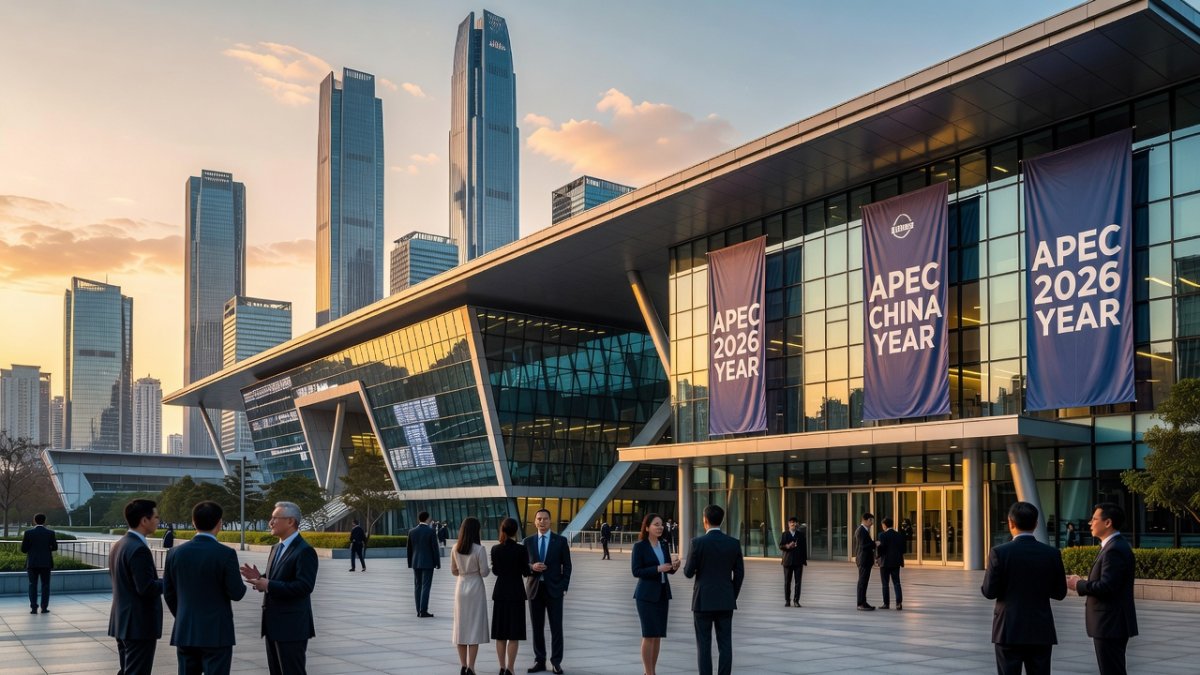
The Significance of APEC China Year 2026
As the Asia-Pacific Economic Cooperation forum enters its 2026 cycle under Chinese leadership, the designation of an “APEC China Year” carries profound implications for regional economic governance and multilateral diplomacy. China’s hosting role, centered on the Leaders’ Meeting scheduled for November 18-19 in Shenzhen, positions the country to steer discussions on digitalization, free trade, and innovation at a moment when global supply chains remain fragile and geopolitical tensions continue to reshape trade flows. The CGTN video “2026 APEC ‘China Year’: Free trade, innovation and Asia-Pacific cooperation” underscores how Beijing intends to leverage this platform to advance an inclusive vision of economic integration that contrasts with more exclusive bilateral or minilateral arrangements.
With 21 member economies representing nearly 60 percent of global GDP, APEC’s consensus-driven model offers China a unique venue to promote the Free Trade Area of the Asia-Pacific (FTAAP) concept, now marking its twentieth anniversary. Officials such as Foreign Minister Wang Yi have already signaled that the year will emphasize practical deliverables rather than rhetorical commitments, particularly in areas where technological standards and regulatory harmonization can unlock new growth. The overlap with China’s own 15th Five-Year Plan (2026-30) further amplifies the stakes, allowing Beijing to align domestic industrial policy with regional priorities in a manner that reinforces its narrative of mutual benefit.
Geopolitically, the APEC China Year arrives amid heightened strategic competition, yet the forum’s inclusive membership—including both the United States and Chinese Taipei—provides a rare channel for sustained dialogue. By focusing on concrete initiatives such as digital trade rules and healthcare cooperation, exemplified by Chinese Taipei’s June 2026 contribution of USD 1.5 million to the APEC Healthcare Sub-Fund, China can demonstrate stewardship without forcing divisive votes. This approach reflects a calculated effort to rebuild trust eroded by pandemic disruptions and tariff disputes, positioning Shenzhen not merely as a host city but as a symbol of China’s reform-era openness extended to the wider region.
Setting the Agenda: From Guangzhou to Shenzhen
The preparatory architecture for APEC 2026 reveals a deliberate sequencing designed to build momentum from technical discussions to high-level political commitments. Senior Officials’ Meeting One (SOM1), held in Guangzhou from February 1-10, established the foundational workstreams under the watchful eye of Foreign Minister Wang Yi, whose participation signaled the priority Beijing attaches to the process. These early sessions focused on scoping papers for digital economy frameworks and supply-chain resilience, setting parameters that subsequent meetings would refine ahead of the November Leaders’ Meeting in Shenzhen.
Finance Deputies convened under the chairmanship of Liao Min on April 29, advancing discussions on fiscal coordination and sustainable finance that complement the broader trade agenda. Liao’s role as a seasoned macroeconomic official ensured that macroeconomic stability remained central, particularly as member economies grapple with divergent recovery trajectories and inflationary pressures. The Guangzhou-to-Shenzhen progression mirrors China’s own development narrative, moving from the Pearl River Delta’s manufacturing roots to its emerging status as a technology and innovation hub, thereby offering tangible illustrations of the digitalization theme.
Strategic analysis suggests this timeline allows China to test proposals with diverse stakeholders before the leaders gather. By front-loading consensus on non-controversial areas such as cross-border data flows and green finance, negotiators aim to create goodwill that can later extend to more sensitive topics like investment screening. The CGTN video highlights how these preparatory steps are framed as evidence of China’s commitment to multilateralism, contrasting with perceptions of unilateral assertiveness elsewhere. With 21 economies participating, the process also serves as a barometer for measuring support for FTAAP revival, ensuring that Shenzhen delivers not only photo opportunities but substantive outcomes aligned with regional needs.
FTAAP at 20: A Milestone for Regional Trade Architecture
The twentieth anniversary of the Free Trade Area of the Asia-Pacific proposal in 2026 provides both symbolic resonance and substantive opportunity for APEC members. Originally floated in 2006, FTAAP envisioned a comprehensive, region-wide agreement that would consolidate the proliferating network of bilateral and plurilateral deals into a single high-standard framework. Two decades later, the proposal’s revival under Chinese auspices reflects frustration with stalled multilateral negotiations and the fragmentation caused by competing mega-regional agreements.
China’s emphasis on FTAAP aligns with its broader push for free trade and innovation, themes prominently featured in the referenced CGTN video. By advocating updated modalities that incorporate digital trade, e-commerce, and technology transfer provisions, Beijing seeks to modernize the original vision while addressing contemporary concerns over data sovereignty and intellectual property. Officials have indicated that Shenzhen could produce a roadmap for renewed negotiations, potentially involving working groups that report directly to leaders rather than remaining confined to technical committees.
Geopolitical considerations loom large. While some members view FTAAP as a counterweight to exclusionary blocs, others worry it could dilute higher-standard commitments already embedded in existing pacts. Chinese Taipei’s constructive engagement, including its healthcare sub-fund contribution, illustrates how even politically sensitive participants can advance functional cooperation. Strategic analysts note that successful FTAAP progress would enhance China’s normative influence over regional trade rules, potentially shaping standards in emerging technologies where the United States and China compete most intensely. The anniversary thus serves as a litmus test for whether APEC can still deliver ambitious liberalization or whether it will settle for incremental, lowest-common-denominator outcomes.
Aligning the 15th Five-Year Plan with APEC Priorities
The temporal overlap between APEC China Year and the launch of China’s 15th Five-Year Plan (2026-30) creates a unique opportunity for policy synchronization. The plan’s anticipated focus on high-quality development, technological self-reliance, and green transition dovetails closely with APEC’s declared priorities of digitalization, free trade, and innovation. By hosting the Leaders’ Meeting in Shenzhen—a city emblematic of China’s opening-up and tech dynamism—Beijing can showcase how national planning instruments support regional public goods.
Foreign Minister Wang Yi’s early interventions during SOM1 in Guangzhou already previewed this alignment, stressing that APEC deliverables should reinforce rather than contradict domestic reform agendas. Finance Deputy Liao Min’s April 29 meeting further embedded macroeconomic coordination within this framework, ensuring fiscal tools remain available to support structural adjustments required by digital and green transitions. The CGTN video frames this convergence as evidence of China’s willingness to integrate its development strategy with collective regional goals.
From a strategic perspective, such alignment allows China to channel APEC resources toward initiatives that advance its industrial upgrading while offering tangible benefits to smaller economies through capacity-building programs. Digital economy standards developed under APEC auspices could, for instance, inform China’s own regulatory experiments, creating first-mover advantages. Yet this approach also invites scrutiny regarding whether APEC priorities are being subtly subordinated to Chinese planning cycles. Member economies will watch closely to see whether Shenzhen produces balanced outcomes or whether the 15th Five-Year Plan’s domestic imperatives overshadow genuinely multilateral ambitions.
Navigating US-China Competition in the Asia-Pacific
US-China strategic rivalry casts a long shadow over APEC 2026, yet the forum’s inclusive format offers mechanisms for managed competition rather than outright confrontation. With both powers among the 21 member economies, Shenzhen will test whether economic cooperation can be insulated from security frictions. China’s hosting role provides agenda-setting advantages, but Washington retains significant influence through alliances and its own Indo-Pacific economic initiatives.
Preparatory meetings in Guangzhou and the finance deputies’ session chaired by Liao Min have already navigated sensitive topics such as export controls and technology standards by emphasizing voluntary, non-binding pathways. Foreign Minister Wang Yi’s presence signaled high-level attention to preventing politicization of technical workstreams. The CGTN video portrays these efforts as part of a broader Chinese commitment to keeping APEC focused on shared prosperity rather than zero-sum competition.
Strategic analysis indicates that success in Shenzhen hinges on identifying “coalitions of the willing” around issues like supply-chain diversification and digital infrastructure, where mutual gains remain feasible. Chinese Taipei’s USD 1.5 million healthcare contribution demonstrates how functional cooperation can proceed even amid political sensitivities. Nevertheless, underlying tensions over Taiwan, semiconductors, and regional security architectures will require careful choreography to avoid derailing the summit. APEC’s consensus rule ultimately favors incremental progress, allowing both Beijing and Washington to claim victories without forcing decisive choices that could fracture the grouping.
Outlook: What the November Summit Means for the Region
The November 18-19 Leaders’ Meeting in Shenzhen represents a pivotal moment for determining whether APEC can reclaim its role as the premier Asia-Pacific economic forum or whether it will continue ceding ground to narrower arrangements. Outcomes on FTAAP modernization, digital trade rules, and innovation cooperation will shape expectations for the remainder of the decade, particularly as the 15th Five-Year Plan unfolds in parallel.
By referencing the CGTN video’s emphasis on free trade and Asia-Pacific cooperation, observers can anticipate that China will present a narrative of constructive leadership. Yet the true measure of success will lie in whether concrete deliverables emerge that accommodate diverse member interests, including those of the United States and Chinese Taipei. Finance and senior officials’ preparatory work under figures such as Wang Yi and Liao Min has laid important groundwork, but political will at the leaders’ level remains indispensable.
Looking ahead, the region’s economic trajectory will depend on whether Shenzhen fosters renewed momentum toward integration or merely papers over deepening fractures. If APEC can deliver credible pathways on digitalization and healthcare cooperation while advancing the twentieth-anniversary FTAAP agenda, it could help stabilize the broader geopolitical environment. Conversely, failure to bridge US-China differences risks accelerating fragmentation. The stakes for the 21 member economies could not be higher as they converge on Shenzhen.
By Prof. Marcus Chen, Staff WriterThis article was produced with AI-assisted research and editorial support. Reporting is based on sources cited in the article.
What's Your Reaction?
 Like
0
Like
0
 Dislike
0
Dislike
0
 Love
0
Love
0
 Funny
0
Funny
0
 Wow
0
Wow
0
 Sad
0
Sad
0
 Angry
0
Angry
0

World Politics Analyst at Global1.News. Based in Beijing, covering US-China relations, global trade, and geopolitical strategy. Brings deep analytical perspective to the power dynamics shaping international affairs.















Comments (0)