
Ancient Phetchaburi Burial Site Reveals 2,000-Year-Old Trade Networks
The Gentle Discovery Beneath Phetchaburi Rice Fields In Ban Don Phlap village of Ban Lat district, Phetchaburi province, a metal detector scan earlier this year revealed Phetchaburi's first bronze drum beneath a working rice field at the Don Yai Thong archaeological site. (Khaosod English) Archaeologists from Thailand's Fine Arts Department began work in February to recover wha
The Gentle Discovery Beneath Phetchaburi Rice Fields
In Ban Don Phlap village of Ban Lat district, Phetchaburi province, a metal detector scan earlier this year revealed Phetchaburi's first bronze drum beneath a working rice field at the Don Yai Thong archaeological site.
(Khaosod English)
Archaeologists from Thailand's Fine Arts Department began work in February to recover what they expected would be two bronze drums, yet the excavation quickly expanded into a full prehistoric cemetery.
This quiet corner of Phetchaburi, known locally for its fertile paddies and proximity to the Gulf of Thailand coast, now stands as one of Thailand's most important prehistoric sites, directly linking modern Thai communities to ancient trade routes.
Eight Skeletons and Their Accompanying Grave Goods
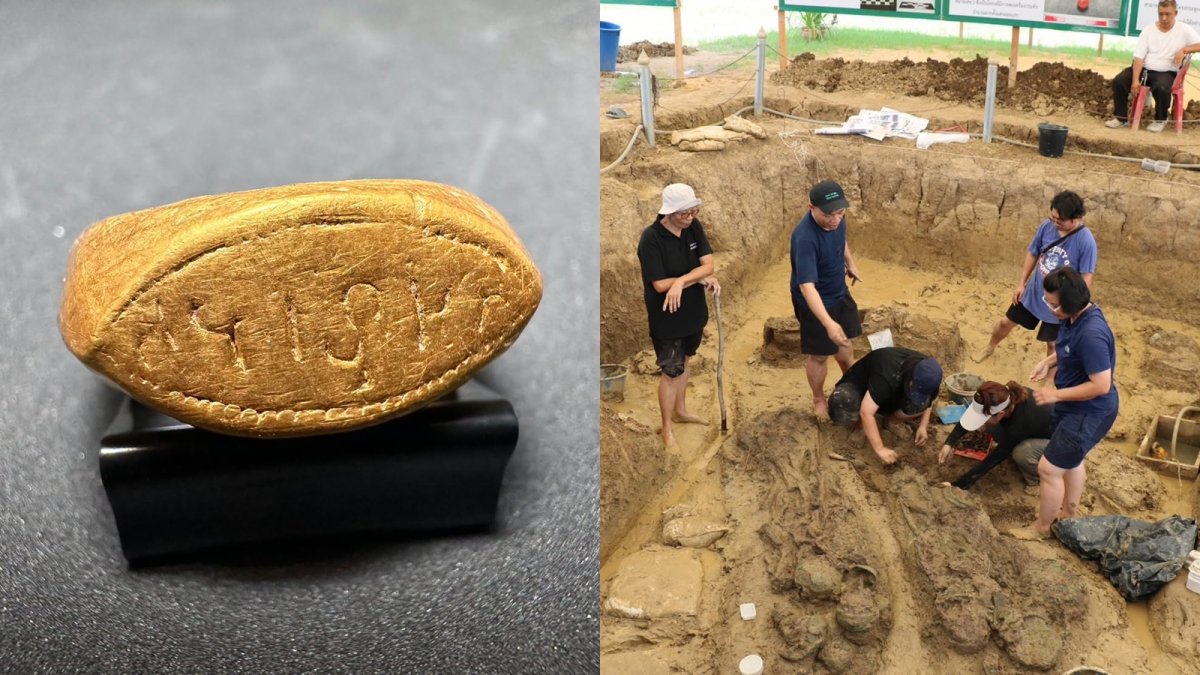
Layer by layer, the team uncovered eight human skeletons, all positioned with heads facing northeast, each accompanied by bronze vessels placed near the head, body and feet.
Many of the deceased wore bronze ornaments including anklets, along with strings of stone and glass beads and bronze head coverings, while gold jewellery such as rings, a bracelet and a pendant appeared beside several burials.
One gold bracelet remained on the arm of a skeleton, showing the care with which these items were placed during funeral rites more than two thousand years ago.
The Fine Arts Department noted that four skeletons on the southern side were likely buried together, while northern burials appear to represent later interments that disturbed earlier graves.
Six Dong Son Bronze Drums in Funeral Ritual
Instead of two drums, six Dong Son-style bronze drums emerged, ceremonial objects linked to the Bronze Age culture centred in northern Vietnam.
These drums were laid on the same level as the bodies and then covered with pottery, indicating they formed an intentional part of the burial ceremony rather than separate offerings.
For Thai readers familiar with the cultural weight of bronze drums in regional heritage, their presence in Phetchaburi confirms that local communities two millennia ago held similar symbols of authority and spiritual power.
The drums closely match examples previously found at the ancient city of Khu Bua in neighbouring Ratchaburi province, strengthening ties between these two Thai sites.
Evidence of an Affluent Prehistoric Community
The quantity of gold jewellery, bronze ornaments and imported beads found with the burials points to individuals of considerable social standing within an elite community.
Bronze drums across mainland Southeast Asia served as markers of prestige and ceremonial authority, and their concentration here suggests the people of Don Yai Thong occupied positions of influence.
Archaeologists from the Fine Arts Department observed that the cemetery was reused over time, reflecting ongoing community practices rather than a single event.
This picture of wealth and organisation enriches Thailand's understanding of its own deep history, showing that Phetchaburi's residents participated in networks far beyond the province's current borders.
Trade Links Reaching India and Vietnam
Glass beads at the site resemble those excavated at Khao Sam Kaeo in Chumphon province, one of Southeast Asia's earliest international trading ports.
Gold ornaments share stylistic features with finds from Chumphon and Surat Thani, reflecting Indian artistic influence that travelled along maritime routes connecting the Gulf of Thailand to the Indian subcontinent.
These connections matter today for Thailand's place within ASEAN, as they demonstrate that communities in what is now Phetchaburi were already part of regional exchange systems nearly two thousand years ago.
Such evidence supports ongoing efforts by the Thai Ministry of Culture to highlight ancient maritime heritage when promoting tourism and cultural diplomacy across Southeast Asia.
The Brahmi Inscription on a Gold Ring
As the team worked to recover fragile items before the rainy season, two additional gold rings appeared, one bearing an inscription in ancient Brahmi script.
Specialists have tentatively read the inscription as "Pusarakhitasa", meaning "belonging to Pusarakhita" or "protected by the Pushya star".
Researchers believe the ring's owner may have been a merchant tied to Indian trade networks, providing direct evidence that Phetchaburi participated in long-distance commerce during that era.
The Brahmi script itself connects to the broader cultural flows that later shaped Buddhist traditions and writing systems across Thailand, offering Thai readers a tangible link between ancient traders and the heritage preserved in temples from Bangkok to Chiang Mai.
Preservation Challenges and Lasting Regional Meaning
Acidic soil and groundwater have left the skeletons in poor condition, preventing determination of age or sex at this stage.
The Fine Arts Department plans further scientific analysis, including studies of dental remains, to learn more about the individuals once buried at Don Yai Thong.
For communities in Phetchaburi and across the Isaan region who value their ancestral stories, the site transforms a working rice field into a source of shared pride and a reminder of Thailand's longstanding role in Southeast Asian exchange.
The excavation shows that Thailand's cultural landscape extends far deeper than recorded history, strengthening national identity while highlighting opportunities for cross-border heritage cooperation with Vietnam and India.
By Ann Srisawat, Staff WriterThis article was produced with AI-assisted research and editorial support. Reporting is based on sources cited in the article.
What's Your Reaction?
 Like
0
Like
0
 Dislike
0
Dislike
0
 Love
0
Love
0
 Funny
0
Funny
0
 Wow
0
Wow
0
 Sad
0
Sad
0
 Angry
0
Angry
0

Southeast Asia Correspondent at Global1.News. Based in Bangkok, covering Thai and Southeast Asian politics, economy, technology, and culture. Deep regional perspective on one of the world's most dynamic regions.











Comments (0)