
Ukrainian Drone Hits Belarus Youth Soccer Bus in Bryansk
The Attack On Wednesday, a Ukrainian drone struck a civilian bus transporting a Belarusian youth soccer team through Russia’s Bryansk region near the Ukrainian border. The 44-passenger vehicle carried 28 children from Gomel, Belarus, who were returning from a vacation in the Black Sea resort of Gelendzhik. Confirmed details indicate the strike occurred during daylight hours on
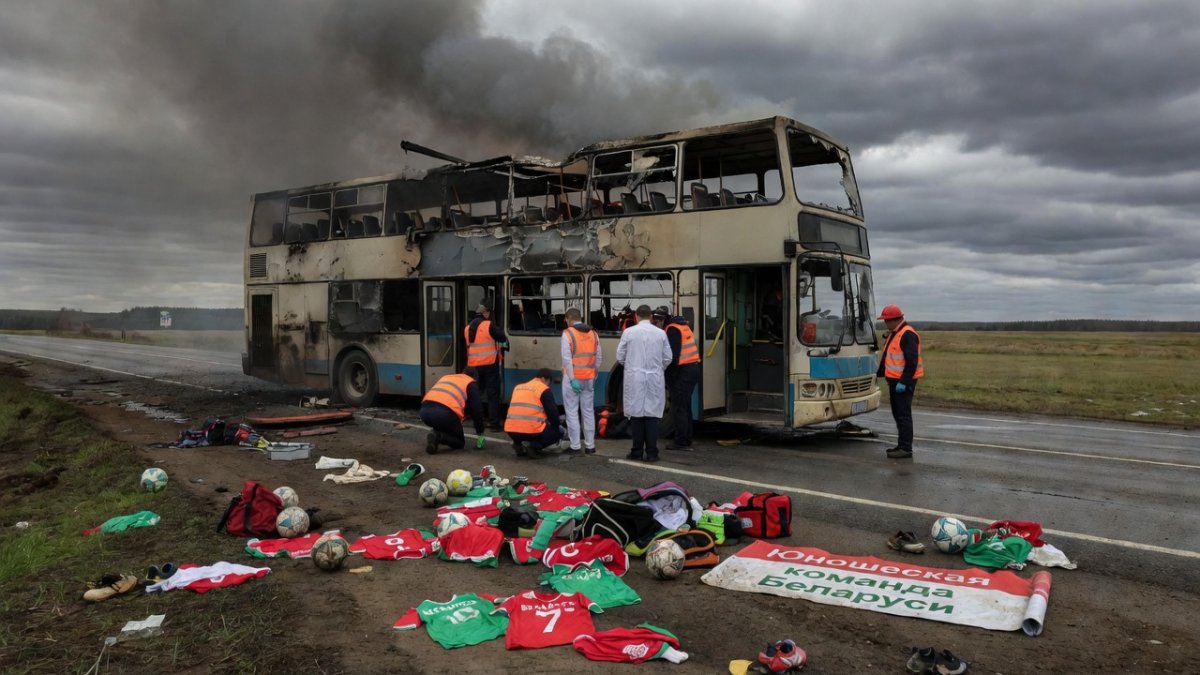
The Attack
On Wednesday, a Ukrainian drone struck a civilian bus transporting a Belarusian youth soccer team through Russia’s Bryansk region near the Ukrainian border. The 44-passenger vehicle carried 28 children from Gomel, Belarus, who were returning from a vacation in the Black Sea resort of Gelendzhik. Confirmed details indicate the strike occurred during daylight hours on a regional road, with the drone impacting the bus directly. Official Russian reports describe the incident as a targeted aerial attack on a clearly marked civilian conveyance. Analysis of the geography suggests the route was a standard transit corridor used by Belarusian groups traveling between southern Russian resorts and their home region, highlighting the vulnerability of such movements amid ongoing cross-border tensions. The timing, mid-week in mid-June 2026, aligns with peak summer travel periods for families and youth groups seeking respite from the conflict zone’s periphery.
Further examination of the event reveals that the bus was traveling without military escort or markings, underscoring its civilian status. Russia’s state media and the Investigative Committee have attributed the drone’s origin to Ukrainian forces operating from across the border, though independent verification remains limited at this stage. In the broader context of the protracted conflict, such incidents illustrate how unmanned aerial systems have extended the reach of hostilities into adjacent civilian spaces, transforming routine journeys into potential flashpoints. Geopolitical observers note that Bryansk’s proximity to both Ukraine and Belarus creates a narrow corridor where commercial and recreational traffic intersects with military surveillance zones, increasing the likelihood of misidentification or deliberate strikes on perceived logistical routes.
The Human Toll
The human cost of the strike centers on the young passengers and accompanying adults from Gomel. One woman, traveling with the group, was killed in the attack, while six individuals, including several children, were hospitalized with injuries ranging from shrapnel wounds to trauma. The remaining passengers, primarily the 28 children aged roughly between eight and fourteen who formed the soccer team, escaped with varying degrees of shock but required immediate psychological support upon return. Community impact in Gomel has been profound, as the city’s tight-knit sports programs and family networks grapple with the sudden loss and injuries among their youth. Local schools and sports clubs in Gomel have begun organizing counseling sessions, reflecting the ripple effects on a regional population already attuned to cross-border instability.
Interviews with relatives and community leaders in Gomel, though limited by official reticence, paint a picture of disrupted childhoods and heightened parental anxiety over future travels. The children’s return from Gelendzhik was meant to mark the end of a restorative summer break, yet it has instead become a focal point for discussions on civilian exposure in the wider Russia-Ukraine-Belarus theater. Analysts interpret this toll as emblematic of how peripheral regions absorb the indirect consequences of drone warfare, where recreational movements become entangled in strategic calculations. The absence of immediate statements from Belarusian authorities has left Gomel families navigating grief without clear governmental guidance, amplifying local perceptions of isolation within the tripartite relationship.
Russia's Response
Russia’s Investigative Committee swiftly opened a criminal case, classifying the drone strike as an act of terrorism. Officials in Moscow, including spokespersons from the Committee, have emphasized the deliberate nature of the attack on a non-combatant vehicle carrying minors. This designation triggers enhanced investigative protocols, including forensic analysis of drone remnants and coordination with border security units in Bryansk. On Wednesday evening, Committee representatives confirmed that evidence collection at the site was underway, with preliminary findings pointing to Ukrainian-manufactured unmanned aerial vehicle components. Such classifications carry significant legal weight, potentially influencing future diplomatic rhetoric and domestic security measures along Russia’s western frontier.
Deeper scrutiny of Russia’s institutional response reveals a pattern of framing border incidents through the lens of terrorism to justify expanded defensive postures. The Bryansk regional administration has coordinated with federal agencies to review transit permissions for Belarusian groups, though no formal policy changes have been announced this week. Geopolitical context suggests this approach serves to consolidate internal narratives around Ukrainian aggression while signaling resolve to Minsk. Official claims stress the protection of civilian infrastructure, yet independent analysts caution that terrorism labeling may also facilitate broader military operations near the border without immediate international oversight. The Committee’s ongoing work, expected to span several weeks, will likely shape Russia’s public positioning in the coming months.
The Geopolitical Triangle
The incident exposes the delicate dynamics within the Russia-Ukraine-Belarus triangle, where Minsk’s notable silence stands in contrast to Moscow’s vocal condemnation. Belarus, under President Alexander Lukashenko, has historically aligned closely with Russian security policies, yet the lack of official commentary from Minsk on Wednesday or in subsequent days suggests internal calculations regarding neutrality or caution. Ukraine has similarly refrained from statements, leaving the narrative space dominated by Russian sources. This mutual reticence underscores the complexities of alliance obligations, as Belarusian youth were the primary victims despite the attack occurring on Russian soil.
Interpretations of this silence point to Minsk’s efforts to balance domestic stability with its strategic dependence on Moscow, avoiding escalation that could draw Belarus deeper into direct conflict roles. The Gomel region’s economic and familial ties to both Russia and Ukraine further complicate public positioning. In the wider war context, such events test the limits of Belarusian non-belligerence, potentially influencing future transit agreements and youth exchange programs. Analysts frame the triangle as increasingly strained by asymmetric threats like drones, where civilian casualties blur lines between state actors and force recalibrations in Minsk’s hedging strategy toward both neighbors.
Border Security
Bryansk region’s border security apparatus faces renewed scrutiny following the strike, given its established vulnerabilities to low-altitude drone incursions. The area’s extensive rural road network and proximity to Ukrainian territory have long presented challenges for comprehensive aerial monitoring, particularly for civilian traffic. Russian federal border services have intensified patrols this week, yet the incident highlights gaps in protecting non-military movements along routes frequently used by Belarusian travelers. Civilian infrastructure, including highways connecting to southern resorts, remains at elevated risk as drone technology proliferates among conflict participants.
Contextual analysis indicates that Bryansk’s security posture, shaped by years of hybrid threats, prioritizes military assets over recreational corridors. This prioritization leaves groups like the Gomel soccer team exposed during peak travel seasons. Regional officials have called for enhanced radar coverage and rapid-response protocols, though implementation timelines remain unclear. The strike serves as a case study in how border zones absorb spillover from the main theater of operations, with implications for cross-border commerce and family travel that extend well beyond immediate military concerns. Sustained investment in layered defenses may be required to mitigate similar risks in adjacent sectors.
Analysis and Implications
This drone incident carries significant implications for the trajectory of the conflict, diplomatic channels, and civilian safety norms across the region. In terms of the war’s evolution, it demonstrates the expanding operational envelope of Ukrainian unmanned systems into Russian rear areas, potentially prompting Moscow to accelerate counter-drone deployments along the entire western perimeter. Diplomatically, the absence of Belarusian and Ukrainian statements may delay multilateral de-escalation efforts, leaving humanitarian corridors and youth travel arrangements in limbo. Civilian safety emerges as a paramount concern, as routine movements through border regions become subject to heightened peril without clear accountability mechanisms.
Longer-term interpretations suggest that such events could erode remaining buffers between the three states, influencing everything from energy transit negotiations to sports diplomacy. Russia’s terrorism classification may harden negotiating positions at any future talks, while Gomel communities advocate quietly for protective measures. Overall, the strike reinforces patterns of attrition warfare extending into civilian domains, necessitating renewed focus on international monitoring of drone usage and border transit protocols to safeguard non-combatants in this protracted geopolitical standoff.
By Irina Volkov, Staff WriterThis article was produced with AI-assisted research and editorial support. Reporting is based on sources cited in the article.
What's Your Reaction?
 Like
0
Like
0
 Dislike
0
Dislike
0
 Love
0
Love
0
 Funny
0
Funny
0
 Wow
0
Wow
0
 Sad
0
Sad
0
 Angry
0
Angry
0
Russia/Eastern Europe Correspondent at Global1.News. Covering Russian politics, energy, security, and the shifting dynamics of the post-Soviet space. Provides clear-eyed analysis on one of the world's most opaque regions.












Comments (0)