
Teodoro slams China Daily racist video depicting Filipinos as monkeys
Philippine Defense Secretary Teodoro condemns China Daily's racist AI-generated video depicting Filipinos as monkeys, calling it propaganda that exposes Beijing's moral bankruptcy. The video mocked the 2016 arbitral ruling and glorified violence against Filipinos. Teodoro warned against deception...
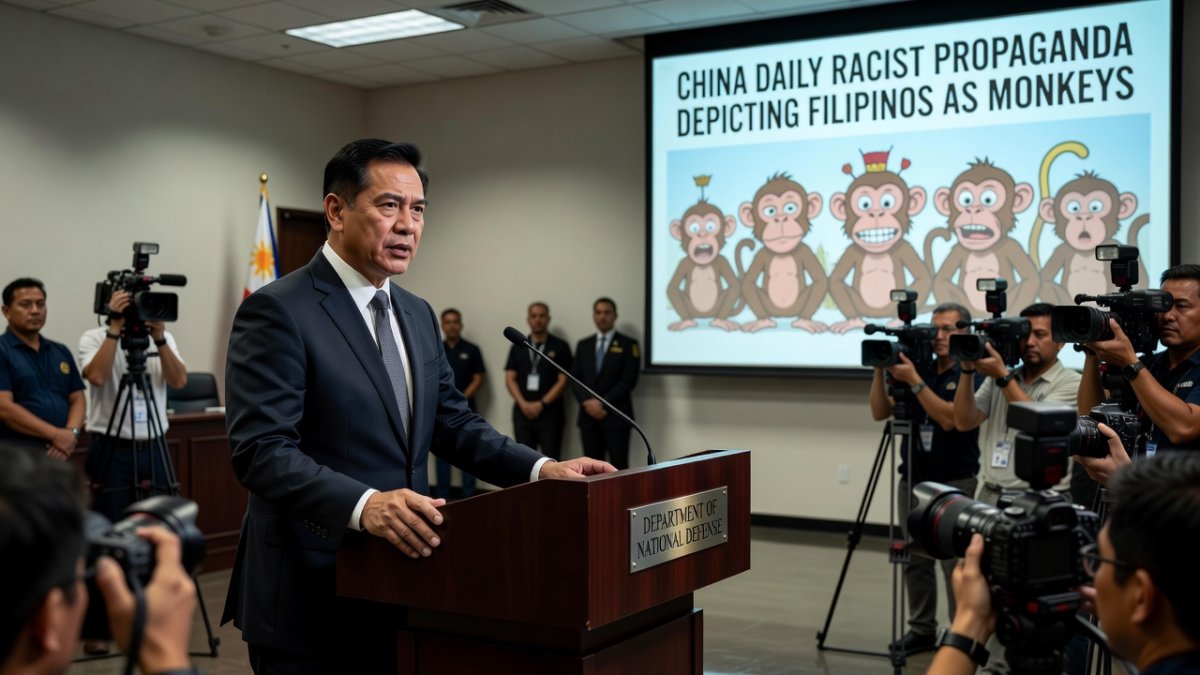
Defense Chief Slams Racist Propaganda Disguised as Journalism
Defense Secretary Gilbert Teodoro Jr. has condemned Chinese state-run media outlet China Daily in the strongest possible terms after it released an AI-generated video depicting Filipinos as monkeys — a racist attack that the defense chief says exposes the "moral and intellectual bankruptcy" of Beijing's propaganda machine.
The post, which appeared on China Daily's Facebook page on July 10, came just two days before the 10th anniversary of the landmark 2016 Permanent Court of Arbitration ruling that upheld the Philippines' exclusive economic zone and invalidated China's expansive claims in the West Philippine Sea.
"The post of China Daily depicting the Filipinos as monkeys is a revealing insight into what the Chinese communist apparatus thinks of the Filipino people," Teodoro said in a statement posted on the Department of National Defense's official Facebook page Thursday evening.
What the Video Showed
The AI-generated animation featured a monkey dressed in a barong tagalog and wearing a salakot — unmistakably intended to represent the Filipino people. In the video, the monkey character is shown being dictated to and controlled by characters representing the United States and Japan, implying that the Philippines is merely a puppet in the South China Sea dispute.
The video then depicts the monkey being sprayed with a water cannon on the high seas after receiving the arbitral award — a disturbing reference to actual confrontations between Philippine vessels and the Chinese Coast Guard in the West Philippine Sea, including the real-life 2023 incident at Ayungin Shoal where Filipino sailors were drenched by water cannons from Chinese ships.
"This mockery of the lawful 2016 Arbitral Award and the video's glorification of violence against the Filipino people and soldiers expose the moral and intellectual bankruptcy of China's propaganda machine," Teodoro said.
Philippine Coast Guard spokesperson for the West Philippine Sea, Rear Admiral Jay Tarriela, also condemned the video in a separate statement on X (formerly Twitter). "Racism has no place in this day and age — and racism meant to belittle another race deserves nothing but condemnation. Filipinos are not monkeys!" Tarriela declared.
Teodoro's Full Response: 'Schizophrenic Behavior'
Teodoro did not mince words in his condemnation. He described the China Daily post as "contemptible propaganda" that is "a disgrace to any state that claims to exercise responsible regional leadership."
"It reveals the weakness of a government that resorts to racism, threats, and manufactured hatred because it has utterly failed to defend its ridiculous claims through reason, evidence, or law," the defense chief said.
Teodoro went further, accusing the Chinese Communist Party of "schizophrenic behavior" and declared that the latest incident shows Beijing is "neither a secure and confident actor nor a trustworthy neighbor."
The defense chief also stated that the incident further justifies the Philippines' existing policy of suspending all ministerial-level and Armed Forces of the Philippines defense engagements with the Chinese Communist Party and its agencies.
"We are justified in our policy of no Ministerial or AFP defense engagements or contacts with the CCP or any of its agencies," Teodoro said.
He ended his statement with a stark warning to his fellow Filipinos: "Pilipinas huwag magpalinlang! Ang nalilinlang ay nasisiil." (Filipinos, do not be deceived! Those who are deceived are oppressed.)
10th Anniversary of the Arbitral Ruling: A Tense Milestone
The racist video was published amid heightened tensions surrounding the 10th anniversary of the Philippines' historic legal victory at The Hague. On July 12, 2016, the Permanent Court of Arbitration ruled in favor of the Philippines, declaring that China's nine-dash line claims had no legal basis under international law and affirming the Philippines' sovereign rights over its exclusive economic zone.
A decade later, China continues to reject the ruling outright. Beijing has labeled the decision "illegal and invalid" and has refused to recognize the tribunal's jurisdiction.
This year's anniversary was marked by a joint statement signed by 13 countries — including the United States and Japan — affirming that the 2016 award is legally binding under international law. Beijing fired back, calling the statement a "distortion of the facts" intended to vilify China.
The Philippines and several other nations also celebrated the anniversary by commemorating the ruling as a victory for the rules-based international order. President Ferdinand Marcos Jr. has consistently asserted the Philippines' rights under the award, while pursuing diplomatic channels to de-escalate tensions.
Not an Isolated Incident: A Pattern of Escalation
The China Daily video is far from an isolated incident. It is the latest in a series of escalations that have defined the increasingly tense relationship between Manila and Beijing over the past year.
Chinese Coast Guard and maritime militia vessels have continued to assert presence in the Philippines' exclusive economic zone, particularly around Ayungin Shoal (also known as Second Thomas Shoal), where the BRP Sierra Madre — a Philippine Navy vessel purposely grounded in 1999 — serves as a forward operating post. Filipino troops stationed there have faced repeated harassment, including ramming incidents and high-pressure water cannon attacks.
In recent months, the Philippines has diversified its security partnerships, signing new defense agreements with the United States, Japan, and Australia, and expanding access for American forces under the Enhanced Defense Cooperation Agreement. China has consistently protested these moves, accusing the Philippines of "introducing external forces" into the region.
The PCG's Tarriela has also been vocal about Chinese Ambassador to the Philippines Jing Quan's visits to local governments, warning local officials to exercise caution. Tarriela cited the controversy over Batanes — a strategically located province north of Luzon — which erupted weeks after the Chinese ambassador toured the area earlier this year.
"Racism has no place in this day and age," Tarriela emphasized, "and racism meant to belittle another race deserves nothing but condemnation."
What This Means: Beyond the Racist Image
The China Daily video represents more than just an offensive meme — it is a window into Beijing's escalating propaganda strategy as it faces growing diplomatic isolation over its maritime aggression in the region.
Analysts point out that the resort to racist imagery and dehumanization is a telltale sign of weakness, not strength. When a nation cannot win the argument through international law, evidence, or diplomacy, propaganda becomes the weapon of last resort. The video's attempt to portray Filipinos as puppets of the United States and Japan also reveals China's deepening anxiety over the Philippines' expanding network of security alliances.
For ordinary Filipinos, the racist imagery strikes a deeply personal chord. The Philippines has long valued its dignity on the world stage, from the days of overseas Filipino workers being celebrated as modern-day heroes to the nation's role as a founding member of ASEAN. To be depicted as monkeys in state-sponsored media is not just an attack on the government — it is an attack on every Filipino, from the jeepney driver in Manila to the OFW in Dubai to the farmer in the rice terraces of Banaue.
The video also serves as a reminder that in the age of AI-generated content, disinformation has become a tool of statecraft. China Daily's use of artificial intelligence to create racist propaganda raises serious questions about the ethical boundaries of state-sponsored media and the weaponization of content generation technologies.
"Such contemptible propaganda," Teodoro said, "is a disgrace to any State that claims to exercise responsible regional leadership."
International Reaction and What Happens Next
The international community has largely rallied behind the Philippines in condemning the video. The joint statement by 13 countries on the anniversary of the arbitral ruling signals that while China may try to rewrite the narrative, the international community has not forgotten the 2016 award.
However, with the ASEAN Foreign Ministers' Meeting scheduled to take place in Manila next week — where the foreign ministers of the United States, China, and Russia are all expected to attend — the video adds a volatile element to an already tense diplomatic gathering.
The question now is whether Beijing will distance itself from the video or double down. China Daily is a state-controlled outlet, meaning its content reflects, at minimum, tacit approval from the propaganda apparatus. If Chinese officials refuse to condemn or distance themselves from the video during the ASEAN meetings, it will further strain relations not just with the Philippines but with the entire region.
For the Philippines, the path forward remains clear: continue to assert sovereign rights under international law, strengthen alliances with like-minded nations, and — as Teodoro warned — never allow propaganda to erode the national spirit.
"Pilipinas huwag magpalinlang!"
By Bella Reyes, Staff Writer
This article was produced with AI-assisted research and editorial support. Reporting is based on sources cited in the article.
What's Your Reaction?
 Like
0
Like
0
 Dislike
0
Dislike
0
 Love
0
Love
0
 Funny
0
Funny
0
 Wow
0
Wow
0
 Sad
0
Sad
0
 Angry
0
Angry
0

Philippines/Southeast Asia Correspondent at Global1.News. Manila-based journalist covering Philippine politics, environment, maritime security, and social issues. Passionate about marine conservation and the communities protecting the Philippines' natural heritage.












Comments (0)