
Canada fires prompt US air quality alerts as smoke blankets major cities
More than 850 wildfires raging across Canada have blanketed major US and Canadian cities in hazardous smoke, forcing evacuations of First Nations communities and triggering air quality alerts from the Great Lakes to New York. With AQI levels exceeding 500 in several cities, authorities urge milli...
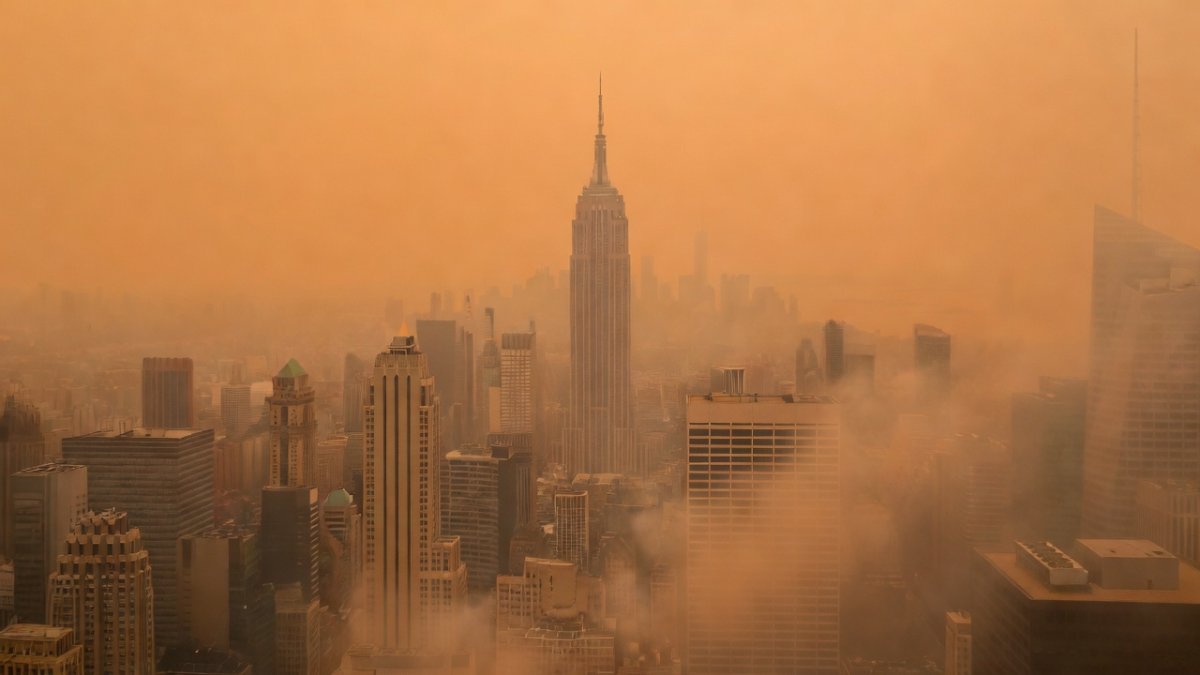
A Thick Orange Haze Descends on North America
More than 850 wildfires are burning ferociously across Canada, sending an apocalyptic blanket of smoke south across the border and into the heart of the United States. From Detroit to New York, Toronto to Chicago, skylines have been swallowed by an acrid orange haze that has transformed ordinary life into a public health emergency.
Air quality alerts stretch across a vast corridor of North America this week, with the US Air Quality Index programme registering "hazardous" readings in multiple major population centres. In cities like Toledo, Milwaukee, and Detroit, AQI levels have topped 500 — a threshold that makes outdoor air dangerous for anyone to breathe. In Marquette, Michigan, the index briefly touched an astonishing 1,008.
"We're in a very serious health situation right now," New York Governor Kathy Hochul said in an emergency announcement on Thursday. "This is bad news for every New Yorker. There will be great impacts."
The Scale of the Disaster: 858 Fires and Counting
According to the Canadian Wildland Fire Information System, 858 fires are currently active across the country, including 30 that sparked on Thursday alone. The vast majority remain out of control. The largest cluster of blazes is concentrated in northwestern Ontario, where high winds and dry conditions have created a perfect storm for fire propagation.
The Canadian Interagency Forest Fire Centre has confirmed that 838 of these fires are burning simultaneously — a staggering figure that has overwhelmed firefighting resources and prompted federal emergency management coordination. The smoke plumes are so vast they have been tracked by Nasa satellites, visible from space as they drift south-east across the Great Lakes basin and into the densely populated north-eastern United States.
The fires follow a relatively slow start to Canada's 2026 wildfire season, which picked up dramatically at the end of June as dry, warm conditions returned fire activity closer to the 25-year average. Scientists warn that a warming climate is creating the conditions for increasingly severe and prolonged wildfire seasons across the boreal forest.
First Nations Communities "Burnt to Ashes"
Among those hit hardest are the First Nations communities of northern Ontario, where mandatory evacuation orders have been issued as flames advance on remote settlements. One Indigenous chief told local media that her community has been "burnt to ashes" — a devastating personal toll that is being repeated across the region.
Residents of multiple communities in northwestern Ontario have been ordered to leave their homes as 128 active blazes burn in that province alone, according to Ontario Provincial Police. Some highways have been closed, and a restricted fire zone is now in effect. The evacuations have placed enormous strain on emergency accommodation in nearby cities like Thunder Bay, where hotels and shelters are rapidly filling with displaced families.
"We have communities that have lost everything," a spokesperson for the Canadian Red Cross told local media. "The scale of displacement this year is comparable to the worst seasons we have seen."
The federal government has deployed additional firefighting resources, but the sheer number of simultaneous fires has stretched capacity to its limits. Military assistance has been requested as crews struggle to contain blazes across multiple provinces.
American Cities Under a Toxic Cloud
South of the border, the impact has been dramatic and immediate. In New York City — the most populous city in the United States — residents have been seen wearing masks over their mouths and noses, a grim reminder of the Covid-19 pandemic. The iconic skyline, usually visible for miles, has been reduced to a shadowy silhouette behind a thick wall of smoke.
New York City has extended its heat emergency plans and activated its air quality emergency protocols, with hundreds of cooling centres opening across the five boroughs. The city is also distributing KN95 masks to residents, urging vulnerable populations — including the elderly, children, and those with respiratory conditions — to remain indoors.
Chicago has also been severely affected. An outdoor concert by the rock group The Black Keys has been rescheduled due to the dangerous air quality. Summer camps have cancelled outdoor activities, and beaches along the Great Lakes have been shuttered as officials warn that even short exposure to the air could be harmful.
In western New York state, air quality readings on Thursday were classified as "very unhealthy", while the New York City metro area was rated "unhealthy". The smoke is so thick that views of the Empire State Building and the Statue of Liberty — landmarks visible for miles on a clear day — have been completely obscured.
World Cup Final Under Threat
One of the most extraordinary consequences of the crisis is the potential impact on Sunday's World Cup final, due to take place in New Jersey. Officials are monitoring the smoke plume trajectory closely, with north-westerly winds continuing to push the haze south-east for the rest of this week and into the weekend.
"There are concerns that smoke could drift into New Jersey," BBC Weather's Chris Fawkes reported. "The wind direction is not favourable at the moment."
Organisers are reportedly preparing contingency plans, though no decision has been announced yet. A major sporting event being affected by wildfire smoke would mark a stark new milestone in the climate crisis — a reminder that no corner of modern life is immune from the consequences of environmental breakdown.
The good news, if it can be called that, is that forecasters expect a change in wind direction by Monday, which should steer the smoke across Quebec and bring some improvement to air quality in the northern US. But for this weekend, millions of people across the region will be living under a toxic haze.
The Health Crisis: What the Smoke Does to Your Body
Wildfire smoke contains a complex mixture of fine particulate matter (PM2.5), carbon monoxide, nitrogen oxides, and volatile organic compounds. The microscopic particles — roughly 30 times smaller than the width of a human hair — can penetrate deep into the lungs and enter the bloodstream, causing inflammation and triggering a cascade of health problems.
Short-term exposure can cause coughing, wheezing, chest tightness, and difficulty breathing. For people with asthma, chronic obstructive pulmonary disease, or cardiovascular conditions, the effects can be life-threatening. Prolonged exposure has been linked to increased rates of heart attacks, strokes, and respiratory infections.
The US Environmental Protection Agency has advised residents across affected areas to avoid all outdoor exertion, keep windows and doors sealed, run air purifiers where available, and wear N95 or KN95 masks if they must go outside. Pets should also be kept indoors.
Canadian health authorities have issued similar guidance, with Ontario's Chief Medical Officer of Health urging residents to "take this seriously — this is not a normal air quality event."
What This Means: A Climate Signal We Cannot Ignore
What is unfolding across North America this week is not an anomaly — it is a pattern. Canada's wildfire seasons have been growing more intense and more destructive with each passing year. The 2023 season was the worst on record, burning more than 18 million hectares. The 2026 season, while slower to start, is now following a disturbingly similar trajectory.
Climate scientists have been warning for decades that rising global temperatures would create the conditions for more frequent and severe wildfires. Hotter temperatures dry out vegetation, turning forests into tinderboxes. Earlier snowmelt extends the fire season. Drought conditions, exacerbated by changing weather patterns, leave landscapes primed to burn.
But what is particularly striking about this week's events is the transboundary nature of the crisis. Canadian fires are shutting down American cities. The smoke from Ontario's forests is drifting over the Statue of Liberty. A World Cup final — one of the most-watched sporting events on the planet — may have to be reconfigured because of air quality. The message could not be clearer: pollution, like climate change, does not respect borders.
For the United Kingdom, there are lessons here too. While the UK is unlikely to experience wildfires on this scale, the pattern of extreme weather events — record heatwaves, flash flooding, and increasingly volatile seasons — is a global phenomenon. The same climatic mechanisms driving Canada's fire season are reshaping weather patterns across Europe. The summer of 2022 saw the UK experience its first-ever 40°C temperature reading, and wildfires broke out across the country in areas unaccustomed to such threats.
The question is not whether these events will become more common — they already are. The question is whether our infrastructure, our emergency services, and our political will are prepared to meet the moment.
What Happens Next
Thunderstorms are forecast across parts of Ontario in the coming days, but meteorologists caution that the rain may not be enough to make a meaningful difference to the fires. Lightning from the storms could even spark new blazes. North-westerly winds will continue to push smoke into northern US states through the weekend, before an expected wind shift on Monday steers the plume north-east across Quebec.
For now, millions of people across Canada and the United States are being told to stay indoors, to wear masks, and to wait. The fires continue to burn. The smoke continues to drift. And the climate continues to change.
This is not a one-off crisis. This is the new reality — and we are not doing nearly enough to prepare for it.
Stay safe, stay inside, and stay informed. Check your local air quality index — Airnow.gov in the US, and the federal Air Quality Health Index in Canada — before stepping outside.
By Erica Thornton, Staff Writer
This article was produced with AI-assisted research and editorial support. Reporting is based on sources cited in the article.
What's Your Reaction?
 Like
0
Like
0
 Dislike
0
Dislike
0
 Love
0
Love
0
 Funny
0
Funny
0
 Wow
0
Wow
0
 Sad
0
Sad
0
 Angry
0
Angry
0

US Politics and Policy Correspondent at Global1.News. Based in Washington DC, covering American politics, policy, elections, and the courts. Knows how the system works and tells you what it actually means.













Comments (0)