
Government Weighs Fare Hikes and Subsidies as Fuel Prices Surge Amid US-Iran Tensions
The Philippine government is studying fare hikes and fuel subsidies as diesel prices surge P2.62-P4.62/L amid renewed US-Iran tensions. Transport group Pasang Masda seeks a P1 fare increase. President Marcos ordered a balancing act between supporting transport operators and preventing commodity price spikes that would burden ordinary Filipino families. The decision is expected in the coming days.
Government Weighs Fare Hikes and Subsidies as Fuel Prices Surge Amid US-Iran Tensions
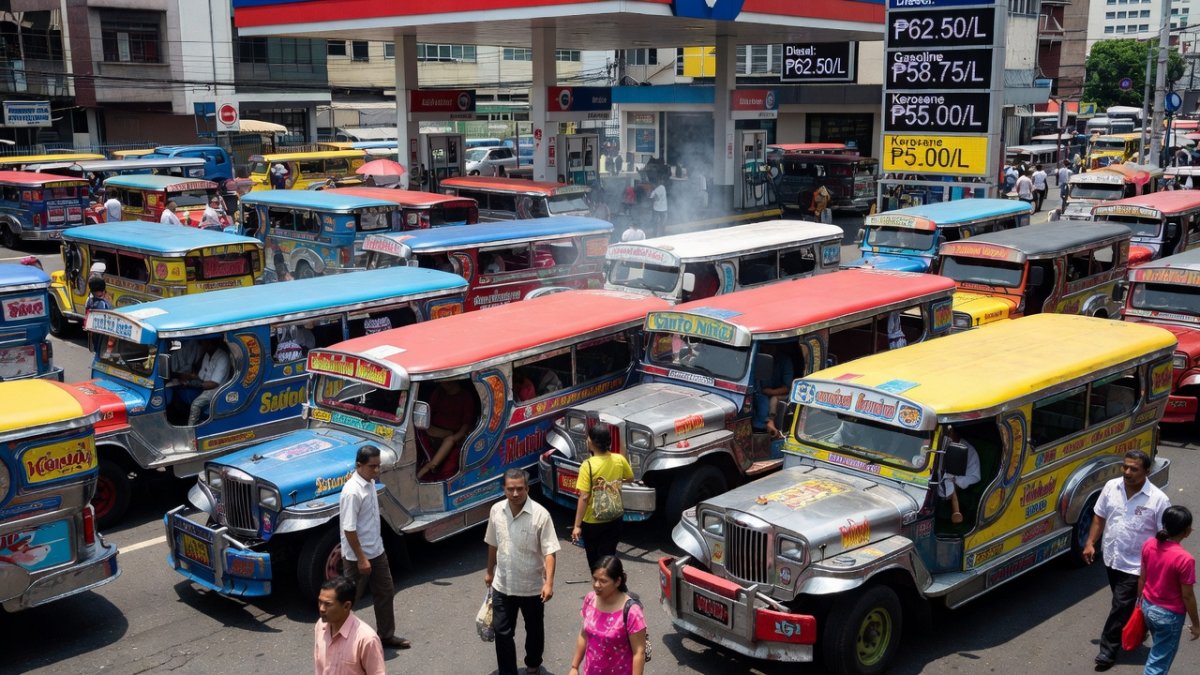
MANILA, Philippines — For millions of Filipino commuters and public utility vehicle drivers already feeling the pinch, the news hits hard: fuel prices have surged once again, and the government is now studying whether to raise fares or expand subsidies to cushion the blow. Presidential Communications Undersecretary Claire Castro confirmed Wednesday that President Ferdinand Marcos Jr. has instructed Transportation Secretary Giovanni Lopez to evaluate both options, as renewed hostilities between the United States and Iran continue to rattle global oil markets.
The situation puts ordinary Filipinos in an all-too-familiar bind — caught between rising costs of daily life and a government trying to balance the needs of transport workers against the risk of commodity price spikes that ripple through every sari-sari store, every palengke, and every family's budget.
The Latest Fuel Price Surge
Motorists were greeted with another painful round of increases this week. Diesel prices jumped by P2.62 to P4.62 per liter, while kerosene rose by P2.22 to P4.22 per liter. Gasoline also saw increases, though at a more modest pace. These mark the latest in a string of weekly hikes that have pushed fuel costs far beyond what many Filipino families budgeted for at the start of the year.
The cause, once again, traces back to global instability. The ongoing US-Iran conflict — which began earlier this year with joint US-Israeli military strikes on Iran — continues to send shockwaves through energy markets. The closure of the Strait of Hormuz, through which over 20 percent of the world's oil trade passes, has kept prices elevated even as Brent crude has settled back near $80 to $82 per barrel after spiking as high as $100 earlier in the crisis.
For a country like the Philippines that imports nearly all of its oil, every tremor in the Middle East translates directly into higher pump prices on Filipino roads.
Pasang Masda's Appeal for a P1 Fare Increase
At the center of the current debate is an appeal from transport group Pasang Masda, which is asking for a P1 fare increase for public utility vehicles. For jeepney drivers and operators already struggling with operating costs that have climbed steadily since the crisis began, that P1 represents a lifeline — a small but meaningful buffer against losses that threaten to push small operators out of business entirely.
"Kapit-bahay," as many drivers call their passengers, the relationship between operator and commuter is built on mutual understanding. But that understanding is being tested as fuel costs eat deeper into daily earnings. A jeepney driver who spends P1,500 a day on diesel now finds themselves taking home barely enough to feed their own family, let alone maintain their vehicle.
The Land Transportation Franchising and Regulatory Board had initially approved a provisional fare hike that was supposed to take effect on March 19, covering jeepneys, city and provincial buses, airport taxis, transport network vehicle services, and point-to-point buses. But President Marcos suspended that increase to ease the burden on commuters — a decision that protected passengers but left drivers caught in the squeeze.
What the Palace Is Saying
In a press briefing at Malacañang, Undersecretary Castro laid out the administration's delicate balancing act. President Marcos, she said, has made clear that "nobody should be left behind," and that every sector needs to be helped "in the correct manner, in the balanced manner."
"If fares increase, prices of commodities will definitely also rise," Castro warned, acknowledging the cascading effect that transport costs have on food, construction materials, and basic goods. A single increase in jeepney fare doesn't just affect the commuter — it affects the vendor who relies on that jeepney to bring their goods to market, the construction worker whose daily commute just got more expensive, and the family whose budget tightens just a little bit more.
The Transportation Secretary has been tasked with studying the numbers — looking at actual fuel cost data, the impact on transport operators, and the capacity of commuters to absorb any increase — before making a recommendation to the President.
Subsidies Already in Place — But Are They Enough?
The government has not been idle on this front. In April, the Marcos administration rolled out a P2.5 billion fuel subsidy program for public utility vehicle drivers nationwide, distributing P5,000 in cash assistance to qualified operators and drivers. The Department of Social Welfare and Development, under Secretary Rex Gatchalian, handled distribution to ensure the aid reached those who needed it most.
Additional measures have included cash assistance for farmers and fisherfolk, who have also been battered by rising fuel costs that affect everything from fishing boat operations to farm machinery. Fare discounts for students, senior citizens, and persons with disabilities have also been maintained.
But transport groups argue that these measures, while welcome, are not keeping pace with the scale of the crisis. With diesel prices rising week after week, a one-time P5,000 subsidy covers only a fraction of the additional costs drivers have incurred over the past several months. The call for a fare adjustment, they say, is not about profit — it's about survival.
What This Means for Ordinary Filipinos
This is where the story hits closest to home. For the average Filipino family, transportation is not a luxury — it is the thread that connects them to livelihood, education, healthcare, and community. A fare increase means mothers and fathers must make harder choices: do they spend more on commuting to work, or cut back on the family's ulam for dinner? Do they reduce the number of trips they make, or find ways to stretch every peso further?
For jeepney drivers — the backbone of Philippine public transport — the situation is equally dire. These are not corporate operators with deep pockets; they are small business owners, often operating a single vehicle that serves as their family's sole source of income. Many have relied on the bayanihan spirit of their communities, with regular passengers pooling fare adjustments or barangay captains organizing local support systems to keep routes running.
The route between fare hikes and commodity inflation is well understood. When transport costs go up, the price of rice, vegetables, fish, and other essentials follows. Every jeepney, tricycle, and bus that carries goods or workers feeds into a supply chain that ultimately determines what a family pays at the palengke. This is why the Palace approach of studying both options — fare adjustments and expanded subsidies — reflects the complexity of the challenge.
The Broader Context: A Global Fuel Crisis
The Philippines is far from alone in feeling these pressures. The 2026 Iran war has triggered a worldwide fuel crisis, with countries across Asia, Africa, and Europe scrambling to manage the fallout. Vietnam faced fuel shortages and panic buying in March. Indonesia has adjusted its fuel subsidy programs. Even oil-producing nations in the Gulf have felt the impact of disrupted shipping lanes and damaged infrastructure.
For the Philippines, the challenge is compounded by its status as a net oil importer. Every dollar increase in global crude prices flows directly into the domestic economy, with minimal缓冲 from local production. The Department of Energy has been monitoring the situation closely, tracking Dubai crude prices and their effect on local pump prices week by week.
The conflict's impact on the Strait of Hormuz remains the wild card. While Brent crude has eased from its crisis peaks, analysts warn that any escalation in the Middle East could send prices soaring again. A sustained disruption at the Strait would represent a step-change for global energy markets, potentially pushing oil into triple-digit territory and deepening the crisis for import-dependent nations like the Philippines.
What Comes Next
The coming days and weeks will be critical. Transportation Secretary Lopez is expected to present his findings to the President soon, and the decision will shape the economic landscape for millions of Filipinos. Several scenarios are on the table:
Scenario 1: Partial fare adjustment with continued subsidies. The government could approve a smaller increase than the P1 requested by Pasang Masda, paired with an extension or expansion of the fuel subsidy program. This would spread the burden more evenly between passengers and operators.
Scenario 2: No fare increase, expanded government assistance. The Palace could decide to keep fares frozen and allocate additional funds for direct subsidies to transport operators, drawing from contingency funds or seeking supplemental budget approval from Congress.
Scenario 3: Phased implementation. A staggered fare increase rolled out over several months, with built-in review periods to assess the impact on inflation and commuter welfare. This approach would give households time to adjust their budgets while providing relief to transport operators.
Whatever path the administration chooses, one thing is clear: the ripple effects of distant geopolitical conflicts are being felt in every barangay, every jeepney terminal, and every Filipino kitchen table. The crisis is not just about oil prices — it is about how a nation protects its most vulnerable when forces beyond its control shake the foundations of daily life.
As the government weighs its options, Filipinos are once again showing the resilience that defines them. Barangay-level carpool initiatives, community-organized shuttle services, and the timeless practive of helping a kapitbahay get to work are reminders that in times of hardship, the Filipino spirit of bayanihan endures. But resilience, while powerful, is not a substitute for policy that puts people first. The families waiting at jeepney stops across Metro Manila and beyond are hoping the numbers add up in their favor.
By Bella Reyes, Staff Writer
This article was produced with AI-assisted research and editorial support. Reporting is based on sources cited in the article.
What's Your Reaction?
 Like
0
Like
0
 Dislike
0
Dislike
0
 Love
0
Love
0
 Funny
0
Funny
0
 Wow
0
Wow
0
 Sad
0
Sad
0
 Angry
0
Angry
0

Philippines/Southeast Asia Correspondent at Global1.News. Manila-based journalist covering Philippine politics, environment, maritime security, and social issues. Passionate about marine conservation and the communities protecting the Philippines' natural heritage.













Comments (0)