
Venezuela Earthquake Death Toll Nears 5,000 as 50,000 Remain Missing, UN Says
Venezuela's June 24 double earthquake death toll has reached 4,930, with 50,000 missing and 17,000 wounded. US sanctions blocking $11 billion in frozen assets hamper relief as UN estimates $37 billion needed for recovery. 14 Democratic lawmakers urge sanctions easing.
Venezuela Earthquake Death Toll Nears 5,000 as 50,000 Remain Missing, UN Says
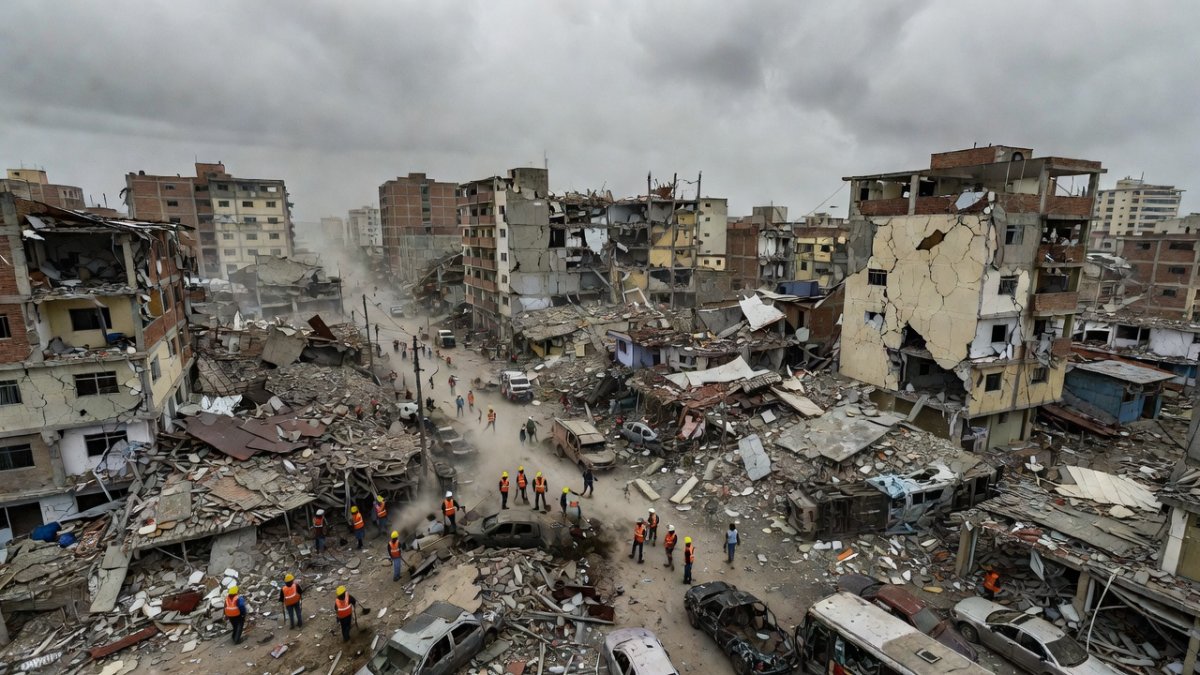
A month after twin earthquakes shattered northwestern Venezuela, the human toll continues to climb with devastating new figures. The confirmed death count has now reached 4,930, lawmaker Jorge Rodriguez announced Thursday, while the United Nations estimates that as many as 50,000 people remain missing — many of them feared buried beneath the rubble of collapsed buildings.
The June 24 disaster struck Venezuela with a one-two punch that seismologists are calling a "doublet": a magnitude 7.2 foreshock followed just 39 seconds later by a magnitude 7.5 mainshock. The epicenters were located in the Veroes Municipality west of San Felipe, Yaracuy, approximately 160 kilometers (100 miles) west of Caracas. The near-simultaneous nature of the quakes left virtually no time for evacuation, compounding the catastrophe.
Nearly 17,000 people have been wounded, and over 21,000 are currently living in shelters. Authorities and humanitarian organizations have described the scale of destruction as among the worst natural disasters to hit Latin America in decades.
What Happened: The Double Earthquake That Broke Venezuela
At 18:04 local time on June 24, 2026, the first tremor struck — a magnitude 7.2 earthquake originating from a strike-slip fault in Yaracuy state. Before residents could react, the main shock hit 39 seconds later at magnitude 7.5, with the US Geological Survey classifying it as a "high-casualty, widespread damage" event.
The twin earthquakes caused catastrophic damage across Venezuela's northern coastline. The coastal state of La Guaira was hit hardest, with entire neighborhoods reduced to piles of concrete and twisted metal. Major cities including Caracas, the capital, and Valencia — Venezuela's third-largest city — suffered significant structural damage. Hundreds of buildings collapsed, and thousands more were rendered uninhabitable.
The USGS initially warned of potential fatalities reaching up to 10,000. While the confirmed death toll has not reached that upper estimate, the staggering number of missing persons suggests the final figure may be far higher than current records show.
A Civilian-Led Rescue Effort in a State Slow to Respond
In the chaotic hours and days after the earthquake, formal state-led rescue operations were conspicuously absent. Instead, it was ordinary Venezuelans who took charge — digging through rubble with bare hands, pulling survivors from collapsed structures, and transporting the injured on pickup trucks and motorcycles.
"From the very first moment, from when the earthquake happened, there was an immediate response, but from civilians. Civilians and independent people," Cinthia Pulido, a Venezuelan displaced by the earthquakes, told Al Jazeera. "The state's response is only being seen now. We're watching and waiting for some kind of answer."
International rescue teams that arrived in the immediate aftermath of the disaster have since departed as the focus shifts from search-and-rescue to humanitarian relief. For displaced survivors like Louismarez Paez, the transition has been jarring. "The little I can get is just for me to survive, support my children, and help my mum," she said. Her elderly mother, she added, receives no assistance beyond what Paez herself can provide.
Sanctions Severely Hampering Relief and Reconstruction
Venezuela has been under tight United States sanctions since 2015, and experts say those restrictions are becoming a deadly obstacle to the country's recovery. "Venezuela has crucial resources that it is not being allowed to access," said Mark Weisbrot, senior economist and co-director at the Center for Economic and Policy Research.
According to Weisbrot, approximately $11 billion belonging to Venezuela remains blocked by the US and European countries — funds that the country "should legally have" access to for disaster relief. The economic stranglehold has prevented the government from purchasing heavy equipment, construction materials, and medical supplies needed for the recovery.
Earlier this week, a group of 14 Democratic lawmakers in the United States sent a letter to the White House urging the Biden administration to ease economic sanctions on Venezuela to facilitate recovery efforts. The sanctions, they wrote, are "severely hampering urgent relief efforts" and have "severely undermined the country's response and reconstruction efforts."
The United States did issue a temporary sanctions waiver on June 26, allowing transactions linked to humanitarian relief, and has committed over $300 million in aid. However, critics argue that temporary measures fall far short of what is needed. The UN estimates that full recovery could cost $37 billion — a sum that dwarfs the aid pledged so far.
50,000 Missing: A Crisis of Uncertainty
The UN's estimate of 50,000 missing persons represents one of the largest such figures from any natural disaster in recent history. For comparison, the 2010 Haiti earthquake — which killed an estimated 160,000 people — had far fewer officially listed as missing at the 30-day mark.
The challenge of accounting for the missing is compounded by Venezuela's existing humanitarian crisis. Years of economic collapse, hyperinflation, and mass emigration had already strained the country's civil registration systems. Many families have been unable to report missing loved ones because they lack transportation to reach government offices, phone service, or even identification documents that may have been destroyed in the quake.
In La Guaira's devastated neighborhoods, families continue to dig through rubble nearly a month later, hoping to find remains of loved ones or at least personal belongings to remember them by. Reuters photographs have captured heart-wrenching scenes of survivors clutching ashes of relatives at cemeteries in Tarmas, La Guaira, burying victims who could finally be identified.
Recovery Price Tag: $37 Billion and Counting
The scale of reconstruction needed is staggering. The UN estimates that recovery efforts in Venezuela could cost $37 billion — a figure that exceeds the country's entire annual GDP in some recent years. More than 200,000 structures are believed to have been damaged or destroyed across five states, including critical infrastructure such as hospitals, schools, water treatment plants, and power stations.
Nearly 17,000 people remain hospitalized with injuries ranging from crush wounds to spinal trauma. The health system — already devastated by years of economic crisis, medicine shortages, and medical worker emigration — is struggling to cope with the surge in demand. Relief organizations warn that disease outbreaks in crowded shelter conditions pose the next major threat.
The United Nations has appealed for $300 million in emergency funding, but only a fraction of that amount has been pledged so far by international donors.
What This Means: A Perfect Storm of Natural Disaster and Political Strangulation
The Venezuela earthquake disaster is not simply a geological tragedy — it is a case study in how political and economic policies can transform a natural disaster into a human catastrophe of far greater magnitude.
The double earthquake on June 24 would have been devastating under any circumstances. Two major seismic events within 39 seconds is a scenario that would strain the emergency response capabilities of even the wealthiest nations. But in Venezuela — a country already reeling from years of economic collapse, political isolation, and crippling international sanctions — the disaster has become exponentially worse.
The $11 billion in frozen Venezuelan assets represents the single largest source of immediate funding the country could access for recovery. That it remains blocked while bodies are still being pulled from rubble is a moral question that the international community has not adequately confronted.
There is also a geopolitical dimension that cannot be ignored. The US-Iran conflict currently dominating global headlines has pushed Venezuela's earthquake out of the news cycle, reducing international pressure for meaningful sanctions relief. With the US military engaged in ongoing strikes against Iran and midterm elections approaching, Venezuela's suffering has become a secondary concern for Washington — a fact not lost on Venezuelans watching their loved ones die from a distance.
What Comes Next
As international attention wanes and rescue teams depart, the long and difficult work of reconstruction lies ahead. The immediate priorities are clear: shelter for the displaced, medical care for the wounded, and recovery of the missing. But the deeper question — whether Venezuela will be allowed to access its own resources to rebuild — remains unanswered.
For the families still searching the rubble, for the 21,000 living in makeshift shelters, and for the millions watching from abroad, the earthquake was not a single moment of destruction. It is a slow-moving catastrophe that continues to unfold, one day at a time, long after the ground stopped shaking.
As Cinthia Pulido put it, watching from a displacement camp: "We're watching and waiting for some kind of answer."
— Jessica Ali, Global 1 News
This article was produced with AI-assisted research and editorial support. Reporting is based on sources cited in the article.
What's Your Reaction?
 Like
0
Like
0
 Dislike
0
Dislike
0
 Love
0
Love
0
 Funny
0
Funny
0
 Wow
0
Wow
0
 Sad
0
Sad
0
 Angry
0
Angry
0

Editor-in-Chief at Global1.News. Atlanta-based journalist who cuts through the BS and tells it like it is. Lead anchor, host, and the voice you hear when the spin stops and the truth starts.










Comments (0)