
Xi's WAIC 2026 Push Tests India's AI Strategy
Xi Jinping's first in-person WAIC appearance signals China's AI dominance push — $177B market, 43,000+ patents, 602M users. Analysis of implications for India's AI strategy, semiconductor policy, and global governance positioning amid US-China rivalry.
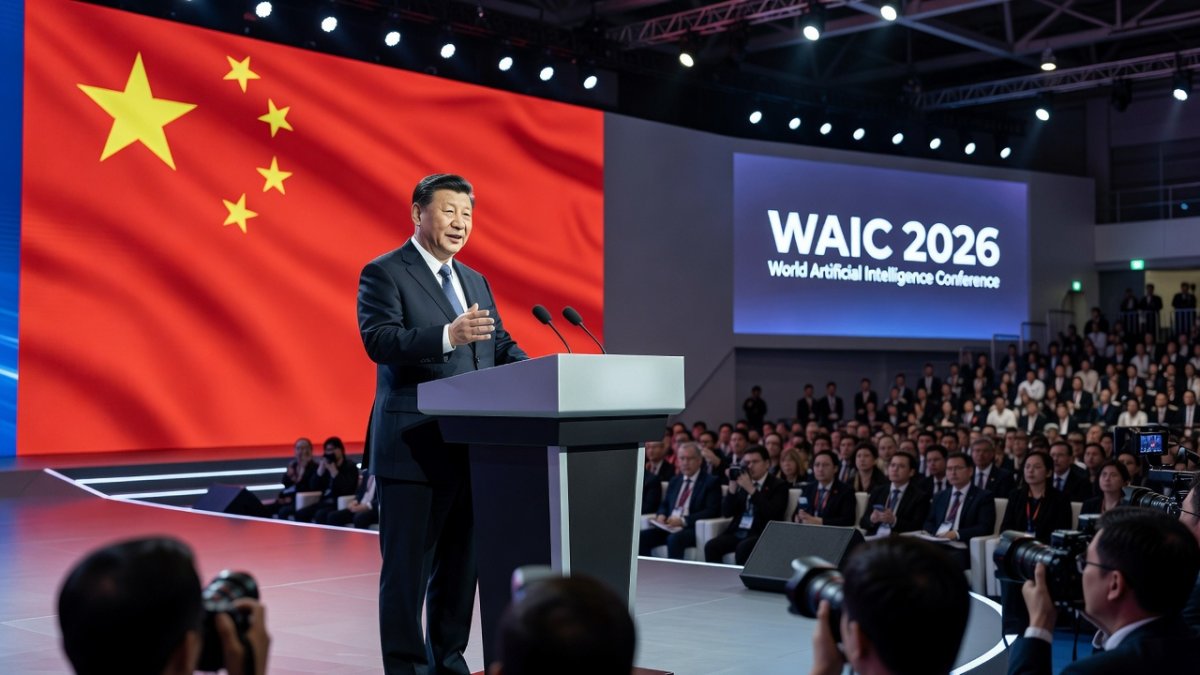
As Chinese President Xi Jinping takes the stage at the World Artificial Intelligence Conference in Shanghai, his first in-person appearance since the event launched in 2018 signals Beijing's aggressive bid to lead global AI development. With China's AI market already at 1.2 trillion yuan and over 602 million generative AI users, the implications reach far beyond bilateral rivalry to nations like India navigating technological sovereignty amid US-China tensions. This convergence of scale, patents, and governance offers urgent benchmarks for New Delhi's own AI roadmap.
Xi's WAIC 2026 Push Tests India's AI Strategy
New Delhi – July 17, 2026 — President Xi Jinping will outline China's vision for artificial intelligence development and regulation at the World Artificial Intelligence Conference (WAIC) in Shanghai, a gathering running July 17-20 that features 140-plus forums, 1,400-plus guests, and 1,100-plus exhibitors displaying over 3,000 products.
Strategic Significance of Xi's In-Person Presence
Xi Jinping's physical presence at WAIC 2026 signals a deliberate escalation in Beijing's AI diplomacy amid intensifying US-China technology decoupling. Washington's October 2022–2025 export controls on advanced semiconductors, enforced through the Bureau of Industry and Security and the Entity List targeting SMIC and Huawei, have slowed China's access to sub-7nm nodes. In response, Beijing has accelerated domestic lithography via the National Integrated Circuit Industry Investment Fund, committing over $50 billion since 2023. India has leveraged this friction through its Production Linked Incentive scheme for semiconductors, approving ₹76,000 crore in projects including Tata-PSMC and Micron's Gujarat assembly plant, allowing New Delhi to position itself as a neutral node in the global supply chain without fully aligning with either bloc. This balancing act appears in India's participation in both US-led Chip 4 alliance discussions and continued imports of Chinese telecom equipment under the 2023 PLI revisions. While the US restricts Nvidia A100/H100 shipments to Chinese entities, Indian data centres operated by Yotta and CtrlS continue sourcing alternative Chinese accelerators, illustrating New Delhi's pragmatic hedging strategy that prioritises cost and availability over ideological alignment.
Scale and Innovation on Display at WAIC 2026
The conference showcases Huawei's Atlas 950 supernode and MiniMax's M3 model among thousands of exhibits across 140-plus forums and 1,100-plus exhibitors. Huawei's Atlas 950 supernode integrates 1,024 Ascend 910B chips with a claimed 2.1 exaflops of FP16 performance, employing a hierarchical ring-mesh architecture that enables in-network collective communication for both training and inference workloads. Complementing this, MiniMax's M3 model and the newly unveiled autonomous smartphone agent — built on a distilled 7B-parameter reasoning engine — demonstrate on-device multi-step task execution, including calendar management and cross-app API calls without cloud round-trips. Daily token consumption in China has risen 1,000 times over two years, surging from roughly 2 billion tokens in mid-2024 to over 2 trillion by early 2026, outpacing global averages where OpenAI and Anthropic together process an estimated 1.2 trillion tokens daily. These figures reflect concentrated infrastructure build-out in Shanghai's Lingang AI zone and Shenzhen's Nanshan district, where state-backed data-centre capacity has grown 340 percent since 2023. Indian observers note that such scale remains difficult to replicate domestically given power and cooling constraints in existing hyperscale facilities.
Market Growth and Corporate Ecosystem
China's AI sector reached 1.2 trillion yuan ($177 billion) in 2025 and is projected to expand more than 30 percent in 2026. This expansion is propelled by a tightly coordinated ecosystem anchored in Beijing's Zhongguancun Science Park, Shanghai's Zhangjiang AI Corridor, and Shenzhen's Greater Bay Area cluster. Baidu's Ernie Bot has processed over 200 million daily queries since its 2023 launch, while Alibaba's Tongyi Qianwen powers cloud services for 1.2 million SMEs; ByteDance's Doubao and Tencent's Hunyuan similarly integrate into Douyin and WeChat ecosystems, creating a de-risked domestic market supported by state subsidies and procurement preferences. Over 6,000 AI companies operate nationwide, with the 2026 government work report calling for a "new form of intelligent economy."
In contrast, India's model relies on private capital and global linkages: Bengaluru's AI startups raised $1.8 billion in 2025, led by Sarvam and Krutrim, while the IndiaAI Mission allocates ₹10,372 crore through public-private partnerships rather than direct equity stakes. Chinese generative-AI adoption — 602 million users, or 43 percent of the population — has accelerated e-commerce conversion rates by 18 percent and digital-finance inclusion in tier-3 cities. For India, this scale creates both competitive pressure and opportunity: Indian IT majors such as TCS and Infosys now embed Chinese-trained models into client offerings, yet face data-localization barriers when bidding for Chinese contracts. Analysts at the Observer Research Foundation note that India's 900-million-strong digital population could replicate China's adoption curve only if the proposed Digital Personal Data Protection Rules are implemented swiftly, enabling domestic foundation-model training on Indian-language corpora. Without comparable state-directed data aggregation, India risks remaining a downstream integrator rather than a primary innovator in the global generative-AI value chain.
Patent Dominance and Global Model Competition
China filed more than 43,000 generative AI patents between 2024 and 2025, the highest total recorded by WIPO, dominated by open-weight releases such as DeepSeek-V3 and Alibaba's Qwen2.5-72B. These models offer permissive licensing and inference costs 60–70 percent below GPT-4o equivalents. Siemens' adoption of Qwen for industrial predictive maintenance underscores the appeal of transparent weights for regulated sectors. In contrast, OpenAI and Anthropic maintain closed APIs with usage-based pricing that Indian startups frequently cite as prohibitive at scale. For Bengaluru and Hyderabad enterprises, this price-performance gap creates both opportunity and risk. Companies like Krutrim and Sarvam AI are already fine-tuning DeepSeek derivatives on Indic corpora, yet face uncertainty over potential future export controls or licensing changes from Chinese developers. Policy analysts recommend that MeitY establish a sovereign model registry and subsidised GPU credits under the IndiaAI Mission to reduce over-reliance on either US or Chinese foundation models.
International Governance and Diplomatic Framing
The Global AI Governance Initiative, unveiled by China in 2023 and reaffirmed at WAIC 2025, advocates a UN-centric regime emphasizing sovereign equality and technology-transfer obligations, explicitly rejecting "ideologically motivated" export controls. This stance collides with the EU AI Act's risk-based classification, the 2023 Bletchley Declaration's focus on frontier-model safety among like-minded democracies, and President Biden's 2023 Executive Order mandating safety testing for models exceeding specific computational thresholds. Beijing's preference for the UN framework allows it to leverage numerical majorities in the General Assembly, where India holds influence through the Global Partnership on AI and its 2023 G20 presidency outcomes.
New Delhi has so far pursued a "multi-alignment" posture — participating in the Quad's AI working group while engaging the UN High-Level Advisory Body on AI — but faces pressure to clarify its position ahead of the 2026 High-Level Meeting on Global AI Governance. Expected deliverables include a voluntary code of conduct for military AI and a technology-transfer facility for Global South members; Indian officials have signaled interest in the latter provided intellectual-property safeguards are strengthened. With UN Secretary-General Antonio Guterres and leaders from Cambodia and Thailand attending, WAIC 2026 reinforces multipolar governance discussions that challenge Western-centric frameworks. Experts at the Centre for Policy Research argue that India's ability to shape these norms will depend on demonstrating credible domestic regulation via the forthcoming National AI Mission guidelines, positioning New Delhi as a bridge between Beijing's sovereignty-first approach and Washington's standards-led coalition.
Implications for India's AI Strategy
India released its AI Governance Guidelines in February 2026 and hosted the India AI Summit the same month to signal fresh investment. The IndiaAI Mission's ₹10,372 crore outlay, announced in 2024 and operationalised through the IndiaAI Innovation Centre, includes a 10,000-GPU public cloud and a dedicated ₹500 crore startup fund. TCS, Infosys and Wipro have begun offering "China-model migration" services, helping clients optimise DeepSeek and Qwen deployments while maintaining data-residency compliance under the DPDP Act. However, these firms risk margin compression if Chinese open-source stacks commoditise routine coding and support tasks currently billed at $25–40 per hour. India's large pool of engineering graduates offers a competitive edge, yet the 43 percent generative AI adoption rate among China's population highlights the urgency of updating curricula in institutions across Chennai and Pune. Without targeted upskilling, Indian taxpayers funding the national AI mission risk seeing returns diluted by faster-moving competitors.
New Delhi should prioritise three measures: mandating model-audit requirements for critical infrastructure, expanding the Semiconductor Mission's design-linked incentive to cover AI accelerator tape-outs, and negotiating reciprocal compute-sharing agreements with both US and EU partners to avoid single-source dependency. Bengaluru's software corridors and Hyderabad's emerging GPU clusters stand to gain most if these guardrails are implemented swiftly.
Outlook for Balanced Global AI Leadership
For Indian tech firms and students, the conference data on patents, users, and market growth provide clear benchmarks for measuring progress against both Chinese scale and American innovation. Policymakers must accelerate the IndiaAI initiative to avoid talent and infrastructure gaps that could widen if Chinese models continue gaining cost and adoption advantages. The multipolar discussions at WAIC 2026 ultimately underscore the need for India to carve an independent path that leverages its strengths while mitigating external dependencies — a strategy that will determine whether New Delhi becomes a rule-maker or a rule-taker in the defining technology of this decade.
— By Dr. Raj Patel, Staff WriterThis article was produced with AI-assisted research and editorial support. Reporting is based on sources cited in the article.
What's Your Reaction?
 Like
0
Like
0
 Dislike
0
Dislike
0
 Love
0
Love
0
 Funny
0
Funny
0
 Wow
0
Wow
0
 Sad
0
Sad
0
 Angry
0
Angry
0

India/South Asia Correspondent at Global1.News. Analytical voice with a background in science and health journalism. Based in New Delhi, covering Indian politics, education, healthcare, technology, and policy. Breaks down complex data into clear, actionable reporting.















Comments (0)