
Trump Dedicates Theodore Roosevelt Presidential Library in North Dakota Badlands
Medora, North Dakota, baked under a July sun that felt like it was daring the whole country to pay attention. President Trump touched down this morning on the new Air Force One, its fresh paint gleaming as it rolled to a stop on the small runway outside town. The crowd that lined the fences waved flags and held signs mixing Roosevelt quotes with Trump slogans. This was not some
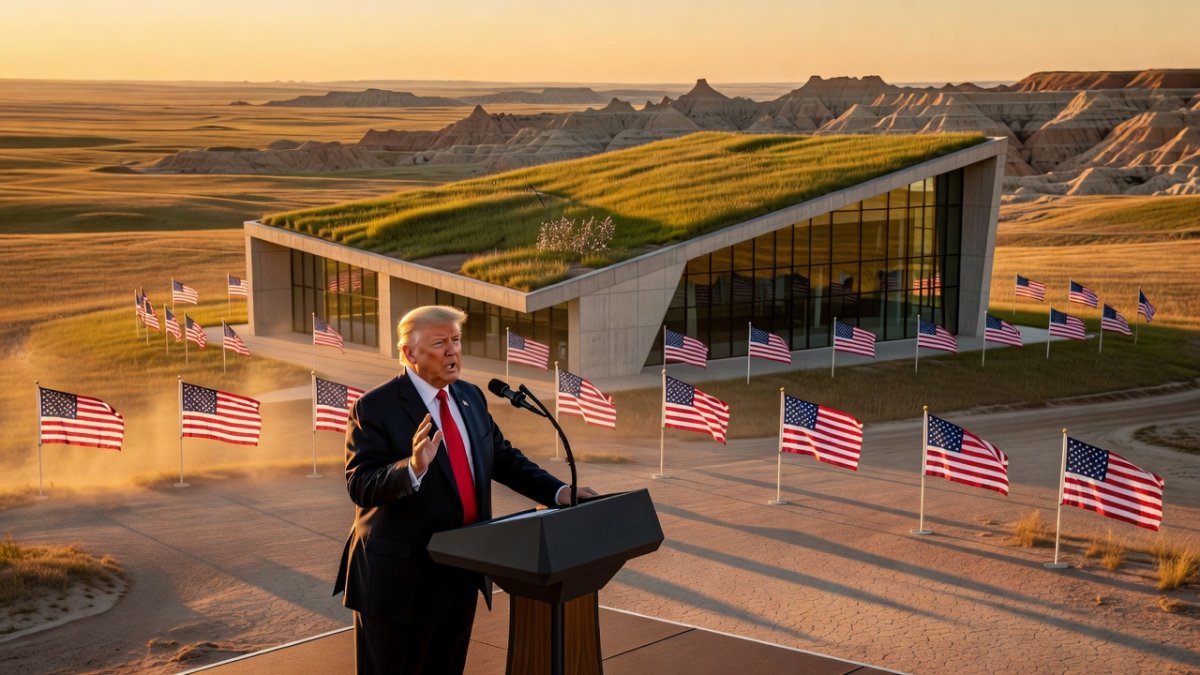
Medora, North Dakota, baked under a July sun that felt like it was daring the whole country to pay attention. President Trump touched down this morning on the new Air Force One, its fresh paint gleaming as it rolled to a stop on the small runway outside town. The crowd that lined the fences waved flags and held signs mixing Roosevelt quotes with Trump slogans. This was not some quiet ribbon-cutting. This was the opening act of Freedom 250, and the president made sure every camera caught the moment he stepped onto the prairie that once shaped Theodore Roosevelt himself.
The timing is no accident. Today marks the formal dedication of the Theodore Roosevelt Presidential Library. The doors swing open to the public on July 4, exactly when the nation marks its 250th birthday. Trump flew in with Governor Kelly Armstrong at his side, both men shaking hands like old ranch hands closing a deal. The 93,000-square-foot building sits on 93 acres of restored Badlands prairie, a deliberate echo of Roosevelt’s own time here in the 1880s when he came west as a sickly young man and left tougher than the land itself.
Trump wasted no time drawing the line between the two men. He spoke about Roosevelt charging up San Juan Hill and then charging through Washington to protect 230 million acres of public land. The president’s voice carried across the open space as he compared his own fights to Roosevelt’s. Some in the crowd cheered. Others shifted, already sensing the political temperature rising even before the first exhibit opened.
Behind the stage, the restored prairie stretched out in every direction, bison grazing in the distance like they had never left. The library stands as the first presidential library built entirely with private money, more than 200 million dollars raised without a single tax dollar. That fact alone drew nods from the locals who have watched federal projects stall for years. Today, though, the focus stayed on the man who once ranched here and the man who flew in to honor him.
The $200M Library That Rose from the Prairie
The building itself feels like it grew out of the Badlands rather than being dropped onto them. Snøhetta, the same firm that designed the 9/11 Memorial Pavilion, shaped every angle so the structure blends into the rolling prairie. From a distance the roofline disappears into the horizon. Up close, the materials catch the light the way Roosevelt would have seen it when he first rode these ridges in the 1880s. The 93,000 square feet spread across 93 acres of restored grassland, a number chosen on purpose to match Roosevelt’s conservation legacy.
Every dollar came from private donors. No federal money touched the project. That detail matters in a state where people still remember how long it took to get basic infrastructure funded. The money bought seven immersive galleries, a research center, and enough space to host the Freedom 250 events running July 2 through 5. Local workers who poured the foundations and hung the steel beams talk about the pride of building something that will outlast any single administration.
Governor Kelly Armstrong welcomed the president with a short speech that stayed focused on Roosevelt’s time in the Badlands. He reminded everyone that Roosevelt came here as a young man recovering from personal losses and left with a vision that later protected millions of acres. Armstrong kept the tone steady, avoiding the sharper comparisons Trump would make later. The governor’s message was simple: this library belongs to the country, not to any one party.
Critics watching from Washington have already started calling the timing political. They point out that the library board stayed bipartisan through years of planning, yet the dedication lands squarely inside Trump’s Freedom 250 tour. The building itself does not take sides. Its design honors Roosevelt’s life on the land and his later work in the White House. The politics arrive with the speeches, not with the bricks and prairie grass.
Seven Galleries — From Sickly Child to Rough Rider to Conservation President
Step inside and the first gallery drops you into Roosevelt’s childhood sickroom. Dim lighting and sound design let visitors hear the labored breathing of a boy who could barely climb stairs. Then the scene shifts to the Badlands in 1884. You stand on a recreated ranch porch while wind machines and projected storms show what Roosevelt faced when he arrived after the deaths of his wife and mother on the same day. The exhibit does not soften the grief. It shows how the prairie forced him to toughen up or leave.
The next rooms track his return east, his time with the Rough Riders, and the charge that made him a national figure. Artifacts sit behind glass while large screens replay the moment he stepped into the presidency after McKinley’s assassination. The conservation gallery takes up the most space. Maps light up to show the 230 million acres Roosevelt protected through national parks, forests, and monuments. Visitors can trace the decisions that created the modern public-land system while audio plays Roosevelt’s own words on why future generations deserved clean air and open space.
The final two galleries focus on his post-presidency years and the lasting arguments he left behind. One room lets people sit at a digital table and debate the same questions Roosevelt faced about land use and federal power. The last space projects his later speeches calling for national service and civic duty. The design keeps the tone educational rather than partisan, letting Roosevelt’s record speak without modern narration layered on top.
Staff members say the goal was to make visitors feel the physical transformation Roosevelt went through. They want people to leave understanding that the man who protected so much land first had to survive the land himself. The exhibits run on a loop so crowds during Freedom 250 can move through without bottlenecks. By July 4 the lines are expected to stretch across the restored prairie.
Trump, Roosevelt, and the Politics of Legacy
Trump stood at the podium and laid out the comparisons directly. He spoke about Roosevelt taking on the political bosses of his day and said he had done the same. He pointed to the land protections and claimed his own administration had moved faster on energy production while still keeping public access. The crowd responded with a mix of applause and uneasy silence, depending on which line landed. The president did not mention the library board’s bipartisan makeup or the years of planning that happened before he took office.
Some critics watching the feed from Washington called the event an attempt to politicize a project that was never meant to carry one man’s branding. They noted that the library’s mission statement focuses on Roosevelt’s life and the idea of citizenship, not on any living politician. Yet the timing, the new Air Force One on the tarmac, and the Freedom 250 branding made it hard to separate the dedication from the campaign trail. Trump’s team pushed back, saying the president was simply honoring a fellow New Yorker who also loved the West.
Local ranchers who remember Roosevelt’s stories from family histories stayed mostly quiet during the speeches. They have seen presidents come and go. What matters to them is that the building now sits on the land and the exhibits tell the full story without cutting corners. The private funding helped keep the project out of the usual Washington fights, but the dedication itself pulled it right back in.
The tension is real. Roosevelt’s record on conservation still draws praise from both parties. Trump’s decision to highlight the similarities between the two men guarantees that the library will be discussed in political terms for months. The building itself stays neutral. The speeches do not.
Freedom 250: A Nation's Birthday in the Badlands
Freedom 250 runs July 2 through 5 with concerts, ranch demonstrations, and nighttime light shows across the prairie. The library opens to the public on July 4, the day the country turns 250. Organizers booked country artists and military flyovers to match the scale of the moment. Medora’s small downtown has already filled with visitors who booked rooms months ago, turning the usual summer tourist flow into something larger.
The events keep a balance between celebration and education. Daytime programs focus on Roosevelt’s ranch life and the bison restoration work still happening on the land. Evening shows project historical footage onto the hills while live music plays. The library stays open late on the Fourth so families can walk the galleries after watching fireworks over the Badlands.
Governor Armstrong said the goal is to let people experience the same landscape that changed Roosevelt. He wants visitors to leave with a clearer sense of why one man’s time in North Dakota mattered to the entire country. The private funding means the site can run these events without waiting for federal approvals or budget fights.
By the time the last fireworks fade on July 5, the library will have welcomed its first wave of public visitors. The building will stay, long after the tour buses leave and the political arguments move to the next stop.
What You Can Do Next
Book a visit before the summer crowds peak. The library’s website lists timed tickets for the first month after opening, and spots are filling fast. If you cannot travel, the digital exhibits go live July 4 so anyone with a screen can walk the galleries from home. Share the conservation maps with students or local groups that still debate land use today.
Write to your representatives about protecting the public lands Roosevelt set aside. The numbers are still 230 million acres, and those places need ongoing attention. Attend one of the Freedom 250 events if you are already in the region, or follow the live streams to see how the Badlands look under the July sky. The library stands ready. The rest is up to the people who show up.
By Jessica Ali, Staff Writer
This article was produced with AI-assisted research and editorial support. Reporting is based on sources cited in the article.
What's Your Reaction?
 Like
0
Like
0
 Dislike
0
Dislike
0
 Love
0
Love
0
 Funny
0
Funny
0
 Wow
0
Wow
0
 Sad
0
Sad
0
 Angry
0
Angry
0

Editor-in-Chief at Global1.News. Atlanta-based journalist who cuts through the BS and tells it like it is. Lead anchor, host, and the voice you hear when the spin stops and the truth starts.











Comments (0)