
Trump administration wants to raise North American auto content to 82%, with half from U.S.
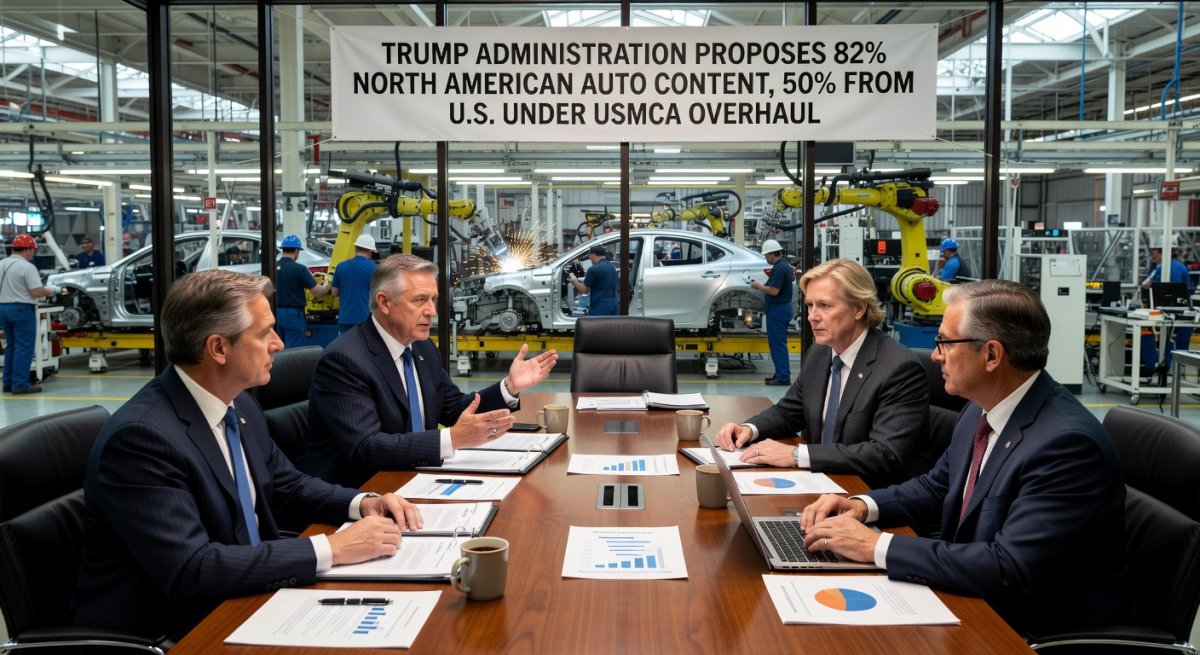
The Trump administration’s push to overhaul auto trade rules under the U.S.-Mexico-Canada Agreement comes at a pivotal moment for North American manufacturing. During bilateral talks that concluded on Friday, officials presented automakers with a plan to raise the required North American content threshold for vehicles to 82 percent, with half of that content required to originate in the United States. The proposal signals a sharper focus on domestic production at a time when supply chains remain strained by shifting global demand and ongoing technological transitions in vehicle manufacturing.
This adjustment would mark a significant tightening of existing regional-value-content rules and could force manufacturers to rethink sourcing strategies across the continent. Because the automotive sector accounts for substantial cross-border trade among the three nations, any change in content requirements carries immediate consequences for investment decisions, factory utilization, and long-term competitiveness.
Details of the Proposed Thresholds
The new framework disclosed in the talks would require vehicles to meet an 82 percent North American content level overall, while mandating that 50 percent of that content be sourced specifically from the United States. These figures were shared directly with industry representatives over the two-day negotiating session. The emphasis on a higher U.S.-specific share reflects an effort to anchor more value creation inside American borders, particularly in components and assembly processes that support advanced vehicle technologies. Automakers have been evaluating how these percentages would apply across different vehicle segments, including internal-combustion models and emerging electrified platforms. Because content calculations typically encompass parts, labor, and certain overhead costs, the higher bar would likely require deeper integration of U.S. suppliers into existing North American networks. The bilateral format of the discussions allowed negotiators to address these technical details without the full trilateral machinery, potentially accelerating the exchange of data between governments and industry.Evolution of Regional Trade Rules
The U.S.-Mexico-Canada Agreement replaced its predecessor framework several years ago, introducing updated rules of origin designed to reflect modern manufacturing realities. The current revision talks continue that iterative process, responding to changes in production footprints and the growing importance of high-value components such as batteries, electronics, and software. Raising content thresholds is one lever governments can use to influence where companies locate engineering, stamping, and final assembly operations. Industry analysts note that previous adjustments to regional content rules prompted incremental shifts in supplier locations rather than wholesale relocation of plants. The proposed increase to 82 percent, paired with the explicit U.S. share requirement, would test whether those gradual adaptations remain sufficient or whether more substantial reconfiguration becomes necessary. Because many powertrain and electronics suppliers already operate integrated facilities across the three countries, the new percentages would require careful tracing of value added at each stage.Implications for Manufacturers and Supply Chains
Automakers face difficult choices in meeting stricter content rules while maintaining cost competitiveness. A higher North American content mandate could encourage additional capital spending on U.S. facilities, yet it might also raise input costs if alternative suppliers outside the region currently provide lower-priced components. Companies with extensive Mexican and Canadian operations would need to verify that their existing footprints still satisfy the revised criteria, particularly for vehicles destined for the U.S. market. The technology dimension adds another layer of complexity. Modern vehicles increasingly rely on sophisticated modules whose origin can be difficult to pinpoint when semiconductors and specialized materials cross multiple borders during production. The 50 percent U.S.-content stipulation would place greater weight on domestic engineering and final integration steps, areas where American firms have traditionally held advantages. At the same time, suppliers in Mexico and Canada would need to demonstrate sufficient regional value to keep vehicles eligible for preferential tariff treatment.Outlook for Negotiations and Implementation
With the bilateral round now concluded, attention turns to how the three governments will incorporate the new thresholds into a revised agreement text. Further consultations with industry stakeholders are expected before any formal changes take effect, giving manufacturers time to model different compliance scenarios. The timeline for implementation will depend on legislative approval processes in each country and the pace at which updated certification procedures can be established. Looking ahead, the proposed rules could influence broader investment patterns in North American automotive technology. Facilities focused on next-generation components may see accelerated funding if they can demonstrate strong U.S. content contributions, while marginal operations risk losing eligibility. Continued monitoring of parts flows and value-added calculations will be essential for both policymakers and companies as the revised framework moves from proposal to practice.By Kenji Tanaka, Staff Writer
This article was produced with AI-assisted research and editorial support. Reporting is based on sources cited in the article.
What's Your Reaction?
 Like
0
Like
0
 Dislike
0
Dislike
0
 Love
0
Love
0
 Funny
0
Funny
0
 Wow
0
Wow
0
 Sad
0
Sad
0
 Angry
0
Angry
0

Kenji Tanaka
Japan Correspondent at Global1.News. Tokyo-based voice covering Japanese politics, technology, economy, and culture. Tracks the intersection of tradition and innovation in one of the world's most dynamic societies.














Comments (0)