
Thai police unit bans 6 postures in uniform, citing public trust
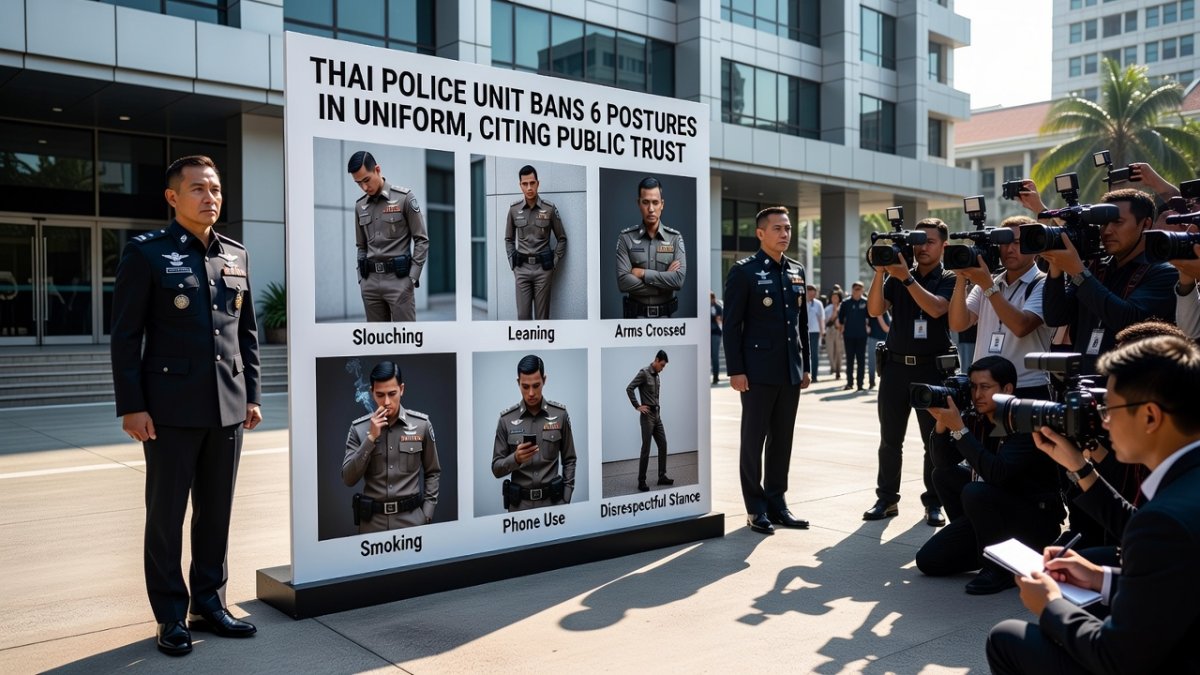
Thai Royal Protection Police Ban Six Casual Postures in Uniform to Strengthen Public Trust
In a move that highlights Thailand’s deep cultural emphasis on decorum and respect, the Royal Protection Police Sub-Division 1 has formally prohibited six specific body postures for officers while in uniform. The directive, shared on the unit’s official Facebook page this week, underscores how physical presentation directly influences public confidence in law enforcement. Bangkok residents, accustomed to seeing officers at traffic posts, royal events, and community checkpoints, now face clearer expectations on how authority should appear.
The Six Forbidden Postures
The list targets relaxed or casual stances that officers must avoid during duty hours. These include standing with both hands inserted into trouser pockets, leaning against walls or vehicles with one shoulder, crossing arms tightly over the chest, placing one foot on a curb or low barrier while the other remains flat, tilting the head downward while scrolling a phone, and adopting a wide-legged stance with hands resting on the belt in a manner suggesting impatience. Each prohibition comes with brief illustrations and explanations that the postures undermine the solemn image expected of those safeguarding the monarchy and public order.
Officers are reminded that even brief moments of these positions, captured on social media or witnessed by passersby, can erode the quiet respect Thai society traditionally extends to uniformed personnel. The guidelines stress that correct posture—feet together or at a measured angle, hands clasped behind the back or resting lightly at the sides—reflects inner discipline and honors the uniform’s symbolic weight.
Why Appearance Shapes Trust in Thai Communities
Thailand’s social fabric places considerable value on visible harmony and respectful presentation, concepts rooted in Buddhist teachings and centuries-old court traditions. When an officer appears at ease in ways that suggest indifference, residents may interpret it as a lack of seriousness toward their safety. Sub-Division 1 Commander Colonel Somchai Rattanapong explained in the Facebook post that “the body speaks before words; our posture must convey readiness and reverence at all times.”
This approach resonates particularly in Bangkok’s dense neighborhoods, where daily interactions between citizens and police often occur at markets, temples, and school zones. A 2023 survey by the National Institute of Development Administration found that 62 percent of Bangkok respondents cited “professional demeanor” as the top factor influencing their willingness to approach officers for assistance. The new rules directly address that metric.
Background on Police Image Reforms
Thailand’s police force has undergone several image-focused initiatives over the past decade. Following public discussions around the 2014–2019 period, various units introduced training modules on etiquette and non-verbal communication. The Royal Protection Police, tasked with safeguarding key royal sites and high-profile events, has long maintained stricter standards than general patrol units. The latest directive builds on those earlier efforts, responding to viral videos from 2022 and 2023 that showed officers in relaxed poses during festivals, prompting online commentary about declining standards.
Official data from the Royal Thai Police headquarters indicates that complaints related to “unprofessional conduct” dropped 18 percent in units that had previously rolled out posture guidelines. Sub-Division 1 hopes to replicate this trend, noting that its officers frequently appear in photographs shared during royal ceremonies and state visits.
Community Voices from Bangkok
Market vendor Somying Thanasuk, who operates a flower stall near the Grand Palace, welcomed the clarity. “When officers stand tall and attentive, I feel safer asking them questions about lost items or traffic rules,” she said. “Small things like where they put their hands matter to us.”
University student Nattapong Sae-lee, however, voiced a measured view: “I understand the goal, but I hope training includes why these postures matter rather than only punishment. Young officers might feel more motivated if they see the connection to community respect.” Both perspectives reflect the gentle balance many Thais seek between tradition and practical understanding.
Expert Perspectives on Non-Verbal Authority
Chulalongkorn University sociologist Dr. Priya Suksawat noted that posture rules tap into longstanding Thai concepts of “face” and social hierarchy. “In Thai culture, the body is an extension of one’s role,” she explained. “An officer slouching can unintentionally signal that the public’s concerns are not urgent.” Dr. Suksawat added that similar etiquette standards exist in other hierarchical institutions, such as the civil service and monastic orders, making the police directive culturally consistent.
Former police instructor Major General (ret.) Wichai Promsiri emphasized practical benefits: “Good posture improves situational awareness. Officers who keep hands visible and bodies balanced respond faster to unexpected events.” He suggested the rules could reduce minor disciplinary incidents that arise from perceived casualness.
Broader Implications for Law Enforcement and Society
The policy arrives at a time when public trust metrics remain central to ongoing national conversations about safety and governance. With tourism rebounding—Thailand welcomed over 28 million visitors in 2024—officers at popular sites represent the country’s first impression for many international guests. Consistent posture standards may quietly support the “Amazing Thailand” hospitality narrative by projecting calm reliability.
Training academies are expected to incorporate the six postures into daily drills, using mirrors and peer feedback rather than solely punitive measures. This aligns with Thailand’s community-oriented policing philosophy, which encourages officers to serve as approachable guardians rather than distant enforcers. Over time, the directive could influence neighboring units, creating a ripple effect across the 200,000-strong Royal Thai Police force.
Residents are encouraged to observe and gently remind officers if needed, fostering a two-way sense of mutual respect. As one community leader in Dusit district put it, “When we all care about how we present ourselves, the whole neighborhood feels more secure.”
This is Ann Srisawat for Global1 News, reporting from Bangkok. 🇹🇭
This is Ann Srisawat for Global1 News, reporting from Bangkok. 🇹🇭
This article was produced with AI-assisted research and editorial support. Reporting is based on sources cited in the article.
What's Your Reaction?
 Like
0
Like
0
 Dislike
0
Dislike
0
 Love
0
Love
0
 Funny
0
Funny
0
 Wow
0
Wow
0
 Sad
0
Sad
0
 Angry
0
Angry
0

Southeast Asia Correspondent at Global1.News. Based in Bangkok, covering Thai and Southeast Asian politics, economy, technology, and culture. Deep regional perspective on one of the world's most dynamic regions.










Comments (0)