
The Quad's Maritime Turn: South Korea's Strategic Calculations in an Evolving Indo-Pacific
The Quad's Maritime Turn: South Korea's Strategic Calculations in an Evolving Indo-Pacific The Quad's Institutional Trajectory Since 2024 The Quad Foreign Ministers' Meeting held in New Delhi on May 26, 2026, produced concrete announcements on port infrastructure development in Fiji, cooperation on critical minerals supply chains, and enhanced maritime domain awareness initiati
The Quad's Institutional Trajectory Since 2024
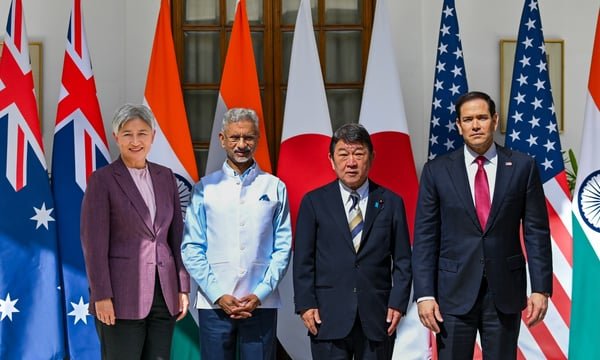
The Quad Foreign Ministers' Meeting held in New Delhi on May 26, 2026, produced concrete announcements on port infrastructure development in Fiji, cooperation on critical minerals supply chains, and enhanced maritime domain awareness initiatives. These outcomes occurred against the backdrop of no leaders' summit since September 2024, raising questions about the grouping's political momentum. Working-level activities have nevertheless persisted across multiple domains, demonstrating a pattern of functional continuity even without high-profile summits.
This trajectory reflects a deliberate shift toward operational substance over declarative symbolism. South Korean analysts at institutions such as the Asan Institute for Policy Studies have noted that the absence of summit-level engagement since 2024 does not equate to institutional collapse. Instead, it highlights the Quad's adaptation to a phase where sustained, lower-visibility coordination may prove more durable than episodic leader-driven announcements.
Maritime Security as the Central Operational Focus
Participants in the February 2026 Quad Track 1.5 Leadership Dialogue in Sydney identified maritime security as the grouping's most significant potential contribution to regional stability. Discussions emphasized the long-term goal of rendering logistics and capabilities sharing "utterly unremarkable," framing this as a decades-long project of building grassroots interoperability among the four navies and coast guards. The first collaborative coast guard efforts conducted in June 2025 and the inaugural Field Training Exercise of the Quad Indo-Pacific Logistics Network represent early steps in this direction.
From Seoul's vantage point, these maritime initiatives carry direct implications for the security of sea lines of communication traversing the Indian Ocean and Western Pacific. South Korea's heavy dependence on energy imports and export markets makes any enhancement of collective maritime domain awareness relevant to its economic resilience. The Korea Institute for National Unification has examined how such Quad activities intersect with Seoul's own naval modernization efforts and its participation in existing multilateral maritime exercises.
Working-Level Mechanisms and Functional Continuity
Despite the lack of a leaders' summit, the Quad has advanced several practical workstreams. Coordinated humanitarian assistance following the March 2025 Myanmar earthquake, the launch of the Quad Critical Minerals Initiative in July 2025, the third meeting of the Quad Counterterrorism Working Group, and a Quad HADR Tabletop Exercise in December 2025 illustrate ongoing operational engagement. These activities suggest that bureaucratic and technical networks among the four countries have developed sufficient momentum to proceed without constant political direction from the top.
South Korea's Ministry of Foreign Affairs and National Security Office have monitored these developments closely. While Seoul remains outside Quad membership, its officials participate in overlapping multilateral frameworks that address similar functional issues, including critical minerals governance and disaster response coordination. This parallel engagement allows Seoul to observe Quad processes without formal accession, preserving flexibility in its diplomatic positioning.
South Korea's Indo-Pacific Strategy and Quad Alignment
The Yoon administration and subsequent acting government articulated an Indo-Pacific Strategy centered on a "free, peaceful, and prosperous Indo-Pacific." This framework emphasizes rules-based order, economic connectivity, and security cooperation while navigating the constraints imposed by historical tensions with Japan and the overriding priority of managing North Korean threats. South Korea's pursuit of security cooperation with Japan, despite periodic diplomatic frictions, mirrors the Quad's own requirement for sustained trilateral coordination among the United States, Japan, and Australia.
Analyses from the Asan Institute underscore that Seoul's strategic space overlaps substantially with Quad activities even without membership. Participation in the ROK-US alliance provides a primary channel for alignment on maritime security and supply chain resilience, allowing South Korea to benefit indirectly from Quad initiatives on critical minerals and logistics interoperability. This arrangement reflects a calculated approach that maximizes strategic options without triggering unnecessary reactions from Beijing.
The ROK-US Alliance in the Context of Minilateral Trends
The ROK-US alliance remains the cornerstone of South Korea's defense posture, yet it increasingly operates within a denser network of minilateral arrangements. Quad working-level cooperation on maritime surveillance and logistics networks complements alliance objectives by strengthening collective capacity to respond to contingencies in the Indo-Pacific. Seoul's defense planners have examined how enhanced interoperability among Quad partners could support contingency planning scenarios involving both Korean Peninsula and regional maritime challenges.
Historical precedent from the post-Cold War period shows that South Korea has periodically adjusted its multilateral engagement to complement bilateral alliance commitments. The current pattern of observing Quad developments while deepening trilateral security ties with the United States and Japan follows this established logic. It allows Seoul to reinforce alliance credibility without formally expanding the Quad's membership, thereby managing alliance expectations alongside regional diplomatic sensitivities.
Future Prospects and Implications for Seoul
External commentary, including an Australian analyst's November 2025 assessment that the Quad appeared "on life support," and earlier Chinese predictions of dissipation, has not prevented continued functional work. The grouping's emphasis on making interoperability routine suggests a long-term institutionalization strategy that may prove resilient to fluctuations in summit diplomacy. For South Korea, this trajectory presents both opportunities and constraints in calibrating its Indo-Pacific engagement.
Policy implications for Seoul include the need to sustain close coordination with Washington on maritime security priorities while exploring selective participation in Quad-adjacent initiatives on critical minerals and humanitarian assistance. Such an approach would align with the ROK-US alliance's evolving regional role without requiring formal Quad accession. The coming years will test whether working-level momentum can generate sufficient strategic substance to shape South Korea's security environment in measurable ways.
By Prof. David Park, Staff WriterThis article was produced with AI-assisted research and editorial support. Reporting is based on sources cited in the article.
What's Your Reaction?
 Like
0
Like
0
 Dislike
0
Dislike
0
 Love
0
Love
0
 Funny
0
Funny
0
 Wow
0
Wow
0
 Sad
0
Sad
0
 Angry
0
Angry
0

East Asia/Technology Correspondent at Global1.News. Seoul-based voice covering Korean politics, technology, business, and culture. Analyzes how technology and geopolitics intersect across East Asia.













Comments (0)