
ICC Judge Warns Lawyers on Duterte Case Media Statements
In a recent ANC 24/7 report, the International Criminal Court's Trial Chamber III held its second status conference in The Hague where Presiding Judge Joanna Korner delivered a stern warning to all counsel involved in the case of former President Rodrigo Duterte — trials are decided in the courtroom, not through media statements. The June 23, 2026, proceeding in The Hague direc
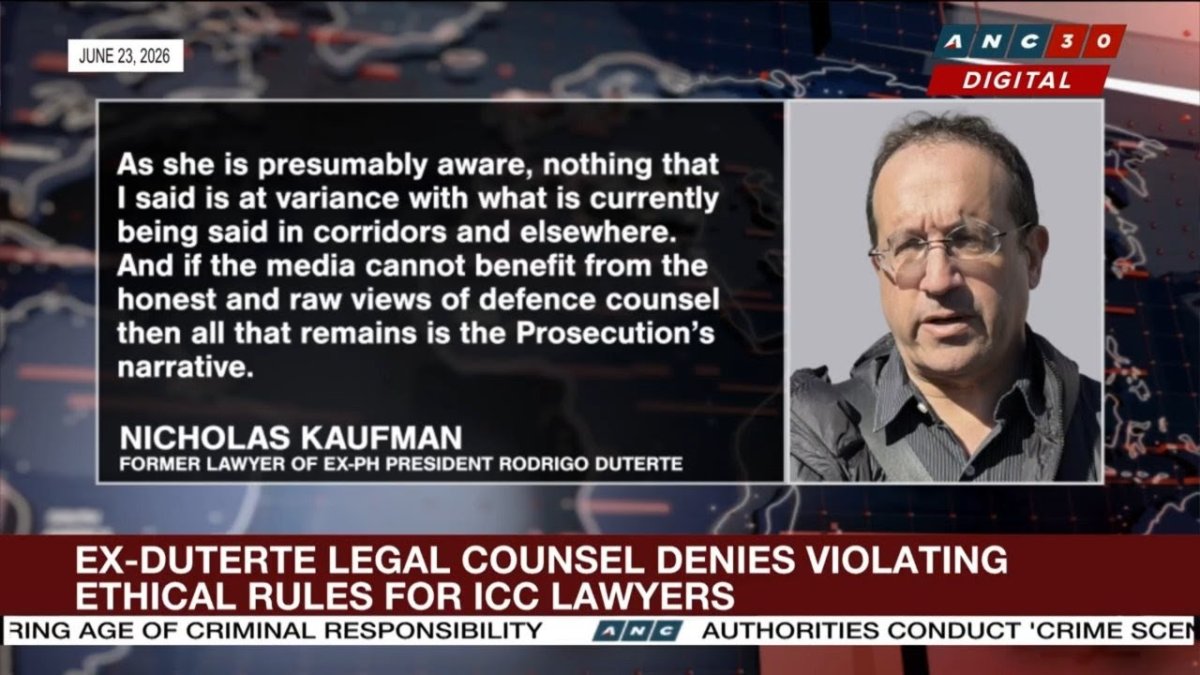
In a recent ANC 24/7 report, the International Criminal Court's Trial Chamber III held its second status conference in The Hague where Presiding Judge Joanna Korner delivered a stern warning to all counsel involved in the case of former President Rodrigo Duterte — trials are decided in the courtroom, not through media statements. The June 23, 2026, proceeding in The Hague directly referenced earlier media coverage that was not assisted by comments made by previous defense counsel Nicholas Kaufman to the media. Judge Korner specifically cited former lead defense counsel Atty. Nicholas Kaufman's public remarks during the session attended by representatives from the Office of the Prosecutor and defense teams.
ICC Judge Warns Lawyers Against Media Statements in Duterte Case as Kaufman Denies Ethical Violations
Manila, Philippines — Judge Korner continued with a broader caution to all counsel, declaring, "In the light of this previous history, this Trial Chamber feels incumbent to repeat the reminder or warning to all counsel in the case… We see no reason why counsel should feel it necessary to make any comment to the media." She emphasized that the appropriate forum for counsel to raise matters is in the courtroom. Trials are not conducted by the court of public opinion but by this court, during the course of the proceedings. These statements directly addressed the history of public remarks that had drawn scrutiny from human rights groups in the Philippines.
The June 23, 2026, conference also touched on scheduling for the trial set to begin November 30, 2026, on charges of crimes against humanity involving murder tied to the war on drugs. Duterte, who turned 81 while held at the ICC detention facility in Scheveningen since March 2025, remains in custody as the proceedings advance. The chamber's focus on media conduct underscores the need to protect the integrity of evidence from the 2011-2019 period when the Philippines remained a Rome Statute member before withdrawing in 2019.
Filipino communities in Manila and Davao City have followed these developments closely because the restrictions on media statements affect how information reaches families still seeking accountability for the drug war operations conducted by the Philippine National Police. The judge's words reinforce that legal outcomes will rest on documented evidence presented in The Hague rather than statements issued from law offices in London or Jerusalem.
Nicholas Kaufman's Withdrawal and Earlier Ethical Concerns
Nicholas Kaufman served as lead defense counsel for Duterte until he requested to withdraw in February 2026, a request that Trial Chamber III granted. His departure followed the October 3, 2025, formal reminder from the court regarding professional conduct. Human rights groups in the Philippines had previously called for disciplinary action against Kaufman after his public remarks appeared to contradict positions taken inside the courtroom.
ICC Deputy Prosecutor Mame Mandiaye Niang told the Pre-Trial Chamber that Kaufman's public remarks contradicted the defense's stated concerns about jurisdiction. This observation came after the April 26, 2026, media interviews in which Kaufman discussed the Appeals Chamber ruling. The sequence of events shows how statements made outside the courtroom can influence perceptions among observers in the Philippines, particularly in areas like Cebu and Negros Occidental where drug war operations occurred between 2011 and 2019.
The withdrawal of Kaufman shifted the defense team dynamics ahead of the November 30, 2026, trial start date. Court records confirm that the chamber viewed the pattern of media engagement as unnecessary and potentially disruptive to orderly proceedings. Philippine lawyers monitoring the case note that such reminders align with standard ICC practice when counsel from multiple jurisdictions participate.
Residents in Quezon City who lost relatives during the drug war period have expressed frustration that external commentary can delay focus on the actual evidence. The court's actions demonstrate its commitment to keeping all arguments within the formal record rather than allowing parallel narratives to develop in international media outlets.
Philippine Sovereignty and the 2019 Rome Statute Withdrawal
The Philippines withdrew from the Rome Statute in 2019, yet the ICC maintains jurisdiction over alleged crimes against humanity committed between 2011 and 2019. This legal reality creates ongoing tension between Manila and The Hague, especially as Congress and the Office of the Ombudsman continue to face scrutiny over the completeness of domestic drug war investigations. The June 23, 2026, status conference highlighted how procedural rules at the ICC operate independently of that withdrawal.
Judge Korner's emphasis on courtroom conduct carries direct implications for Philippine sovereignty debates. Government officials in Malacañang have argued that the case represents foreign interference, while victims' advocates in the Senate point to the lack of successful prosecutions at the national level. The trial beginning November 30, 2026, will test whether evidence gathered from Philippine National Police operations can withstand international examination.
Communities in Mindanao, particularly in Duterte's political stronghold, view the proceedings through the lens of national pride and external pressure. At the same time, families in urban poor areas of Metro Manila see the ICC process as one of the few remaining avenues for acknowledgment of the thousands of lives lost according to human rights organizations. The media restrictions announced in The Hague aim to prevent further polarization of these viewpoints.
Legal analysts in the Philippines note that the chamber's warnings to counsel reflect broader concerns about how public statements can affect witness safety and evidence preservation. The case continues to shape discussions about future human rights accountability mechanisms within the country.
Human Impact on Families and Communities Across the Philippines
The detention of Duterte at the Scheveningen facility since March 2025 has left many Filipino families without closure while they await the November 30, 2026, trial. In Tondo, Manila, relatives of individuals killed during anti-drug operations have formed support groups that meet weekly to share updates from The Hague. These gatherings often reference the judge's statements about keeping proceedings inside the courtroom.
Human rights organizations documenting the drug war have recorded thousands of deaths, with many cases concentrated in provinces such as Bulacan and Cavite. The public debate intensified after Kaufman's media appearances, prompting calls from groups in these areas for stricter adherence to ICC protocols. The October 3, 2025, reminder to Kaufman and the June 23, 2026, warning both underscore the court's effort to shield these families from additional public controversy.
Communities in Davao City, where Duterte served as mayor before becoming president, have experienced divided reactions. Some residents defend his leadership record, while others quietly support the ICC process as a means of examining the broader pattern of operations. The national debate continues to affect local elections and community relations in these regions.
Children who grew up without parents due to the drug war now attend schools in areas like Caloocan City, where the long-term social effects remain visible. The ICC's insistence on courtroom-focused arguments offers these young people a clearer path toward documented justice rather than ongoing media disputes.
National Debate and Future Accountability Mechanisms
The case has divided Philippine public opinion, with some citizens regarding the ICC as essential justice for drug war victims and others viewing it as foreign interference in domestic affairs. This split influences discussions in Congress about potential new legislation on human rights investigations. The June 23, 2026, status conference and Judge Korner's quotes have become reference points in these conversations.
Philippine National Police records and congressional inquiries into the drug war remain under review as the November 30, 2026, trial date approaches. The Office of the Ombudsman has faced repeated questions about the pace of its own cases. The ICC's media restrictions aim to ensure that these domestic processes are not overshadowed by external commentary.
Advocates in the Cordillera region and Visayas islands have organized forums to explain how the Trial Chamber III proceedings connect to local experiences of accountability. The emphasis on respectful conduct by counsel resonates with calls for similar standards in Philippine courts handling related matters.
The broader implications extend to future human rights cases that may arise after the 2011-2019 jurisdictional window. Filipino civil society groups continue to monitor how the Duterte proceedings shape international perceptions of the country's commitment to justice.
Looking Ahead to the November 2026 Trial Start
As the ICC prepares for the November 30, 2026, opening of the crimes against humanity trial, all parties must adhere to the chamber's directives on media engagement. The June 23, 2026, warnings from Judge Joanna Korner serve as a clear boundary that protects the integrity of evidence related to the war on drugs. Duterte's continued detention in Scheveningen keeps the focus on the formal record.
Filipino journalists and legal observers in Manila will continue to report on developments while respecting the private session rules highlighted by the presiding judge. The national conversation about sovereignty, accountability, and victim recognition will persist through the trial period and beyond.
The human stories from families in provinces across the archipelago remain central to why these procedural rules matter. The court's commitment to conducting proceedings inside the courtroom rather than in the court of public opinion offers a structured path forward for all involved.
By Bella Reyes, Staff Writer
This article was produced with AI-assisted research and editorial support. Reporting is based on sources cited in the article.
What's Your Reaction?
 Like
0
Like
0
 Dislike
0
Dislike
0
 Love
0
Love
0
 Funny
0
Funny
0
 Wow
0
Wow
0
 Sad
0
Sad
0
 Angry
0
Angry
0

Philippines/Southeast Asia Correspondent at Global1.News. Manila-based journalist covering Philippine politics, environment, maritime security, and social issues. Passionate about marine conservation and the communities protecting the Philippines' natural heritage.













Comments (0)