
Proposed new US funding rules: We can cancel any grant at any time
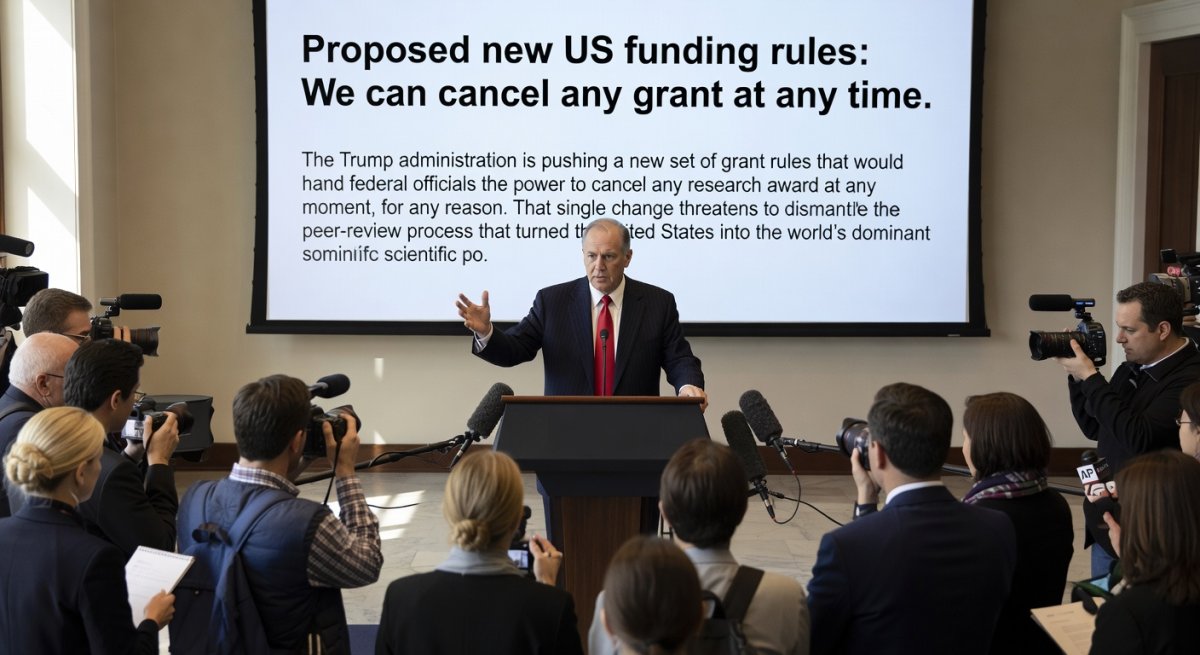
The Trump administration is pushing a new set of grant rules that would hand federal officials the power to cancel any research award at any moment, for any reason. That single change threatens to dismantle the peer-review process that turned the United States into the world’s dominant scientific power. Issued last August through an executive order, the directive targets how agencies like the National Institutes of Health and the National Science Foundation award and manage billions in research dollars each year. If finalized, it replaces expert scientific judgment with political discretion and opens the door to abrupt terminations that could halt projects midstream.
This is not a minor administrative tweak. It is a structural rewrite of the compact between the government and the research community. Under the old system, independent scientists evaluated proposals on merit, feasibility, and potential impact. Funding decisions followed those rankings. The new framework inserts the Office of Management and Budget as the ultimate arbiter and explicitly preserves the government’s right to revoke support without notice. Researchers who have built careers on multi-year grants now face the prospect that their work could be shut down by a memo rather than by failed experiments or exhausted budgets.
The mechanics of the proposed overhaul
The Office of Management and Budget has circulated draft guidance that would apply across all federal grant-making agencies. The language is blunt: agencies must retain the unilateral authority to terminate awards “at any time.” No requirement exists for scientific review, progress milestones, or even advance warning. Existing grants could be clawed back if they no longer align with shifting administration priorities, regardless of peer-review scores or ongoing data collection.
This replaces the merit-based filter that has operated for decades. Previously, a panel of outside experts scored proposals; program officers then funded the highest-ranked work within available budgets. Termination occurred only when investigators failed to meet stated objectives or violated terms. The new rules remove that firewall. An agency director, or even an OMB examiner, could simply decide a line of inquiry is no longer desirable and end the funding stream.
Why the old system produced results
The United States became the global leader in basic research because funders trusted scientists to set the agenda. Peer review, while imperfect, insulated decisions from day-to-day political pressure. It rewarded proposals that survived scrutiny from competitors who had no stake in the outcome other than advancing the field. That insulation allowed long-horizon projects in particle physics, genomics, and materials science to mature without constant fear of cancellation.
Removing that protection introduces a new risk calculus. Investigators will face pressure to frame their work in ways that survive political review rather than scientific review. Early-career researchers, who already operate on thin margins, may avoid entire disciplines that lack immediate political favor. The pipeline of talent that has kept American labs at the frontier could narrow quickly.
Consequences for universities and labs
Major research universities rely on federal grants for roughly half of their research expenditures. A rule that allows sudden termination forces institutions to decide whether to backstop projects with their own endowments or abandon them. Neither choice is sustainable at scale. Mid-sized state universities with smaller reserves would be hit hardest; many would simply stop submitting proposals in vulnerable fields.
Equipment purchases, graduate student stipends, and collaborative agreements across institutions all rest on the assumption that funding, once awarded, will last for the stated period. When that assumption collapses, labs will stockpile cash rather than spend it on experiments. Productivity drops. Data collection slows. International partners, who already worry about U.S. reliability, will shift collaborations to Europe or Asia.
What happens next
The draft guidance remains open for public comment, but the administration has signaled it intends to move forward. Agencies are already rewriting internal policies to match the new termination language. Congress could intervene through appropriations riders or oversight hearings, yet the underlying executive order remains in force unless courts intervene or a future administration reverses course.
Researchers are now weighing whether to restructure proposals into shorter, lower-risk segments that can be completed before political winds shift. That defensive posture is the opposite of the ambitious, high-impact science the old system was designed to encourage. The United States built its scientific edge by betting on people and ideas, not by reserving the right to walk away without explanation. The current proposal bets on control instead. The difference will show up in laboratories long before it appears in official statistics.
By Jessica, Staff Writer
This article was produced with AI-assisted research and editorial support. Reporting is based on sources cited in the article.
What's Your Reaction?
 Like
0
Like
0
 Dislike
0
Dislike
0
 Love
0
Love
0
 Funny
0
Funny
0
 Wow
0
Wow
0
 Sad
0
Sad
0
 Angry
0
Angry
0

Jessica Ali
Editor-in-Chief at Global1.News. Atlanta-based journalist who cuts through the BS and tells it like it is. Lead anchor, host, and the voice you hear when the spin stops and the truth starts.















Comments (0)