
No deal announced after Trump meeting to make 'final determination' on Iran
No deal announced after Trump meeting to make 'final determination' on Iran US President Donald Trump met senior aides on Friday in the White House Situation Room to reach a final determination on a proposed framework for extending the ceasefire with Iran, yet the session ended without any announced agreement or clear path forward. The outcome leaves unresolved the conditions T
No deal announced after Trump meeting to make 'final determination' on Iran
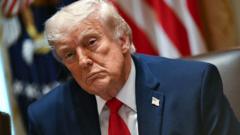
US President Donald Trump met senior aides on Friday in the White House Situation Room to reach a final determination on a proposed framework for extending the ceasefire with Iran, yet the session ended without any announced agreement or clear path forward. The outcome leaves unresolved the conditions Trump set for any extension, including Iran’s permanent renunciation of nuclear weapons, the reopening of the Strait of Hormuz to unrestricted shipping in both directions, and the destruction of any mines in the waterway.
The meeting followed an agreement reached on Thursday between the two sides on a memorandum of understanding that would extend the ceasefire for 60 days while launching talks on Iran’s nuclear programme. US officials had described the document as pending final approval from both Trump and Iranian leadership. A White House official told CBS News, the BBC’s US news partner, that President Trump will only make a deal that is good for America and satisfies his red lines, emphasising that Iran can never possess a nuclear weapon.
Conditions outlined by the US side
Trump specified three core requirements in public statements on Friday. Iran must commit never to acquire a nuclear weapon or bomb. The Strait of Hormuz must be reopened for unrestricted shipping traffic in both directions. Any mines placed in the waterway must be destroyed. In a social media post earlier that day, Trump indicated he was prepared to lift the US naval blockade, allowing ships caught in the strait to begin the process of heading home. He also insisted that Iran allow the US to remove and destroy its enriched uranium stockpile, adding that no money will be exchanged until further notice and that other items of far less importance have been agreed to.
These demands build on long-standing US positions. The United States has repeatedly called for Iran to halt production of highly enriched uranium and to dispose of its existing stockpile, which could theoretically be used to produce nuclear weapons. Iran maintains that its nuclear programme is entirely for civilian purposes and denies any intention to develop nuclear weapons.
Iranian positions and responses
Iranian officials rejected the notion that nuclear issues are on the table. Iran’s foreign ministry spokesman Esmaeil Baqaei told state television that the focus remains on ending the war and that there are no negotiations on the nuclear issue. Iran’s Fars news agency, citing informed sources, described Trump’s latest comments as a mixture of truth and lies. The agency reported that the memorandum of understanding contained no provision for the destruction of nuclear materials.
Iran’s chief negotiator Mohammad Baqer Qalibaf stated on Friday that the country has no trust in guarantees or words, only actions. He added that no action will be taken before the other side acts and that the winner of any agreement is the one who is better prepared for war the day after. Earlier, Iran had said it was not negotiating on its nuclear programme.
Background to the current ceasefire
The ceasefire took effect on 8 April after the United States and Israel launched strikes against Iran on 28 February. Iran responded by attacking Israel and US-allied states in the Gulf and effectively closed the Strait of Hormuz. In normal times, roughly 20 percent of the world’s energy supplies pass through the strait, and the closure contributed to a sharp rise in global oil prices.
Since the ceasefire began, Trump has repeatedly suggested that the United States and Iran are close to a deal and that negotiations are progressing, although no substantive results have materialised. On Thursday, US Vice-President JD Vance said negotiators were going back and forth on a couple of language points, including the question of enrichment. He noted that the sides were not there yet but were very close and would keep working at it.
Military and diplomatic context
US Secretary of Defense Pete Hegseth addressed the possibility of recommencing strikes during a security summit in Singapore. He stated that US stockpiles are more than suited for that purpose, both in the region and around the globe, because of how the United States balances exquisite and more plentiful munitions. He added that the country is in a very good place.
Both sides have accused each other of violating the ceasefire in recent days. On Thursday, Iran’s Islamic Revolutionary Guard Corps said it targeted a US air base in Kuwait that was the source of earlier incidents.
Next steps and outstanding issues
A White House official later confirmed to the BBC that the Situation Room meeting had concluded but provided no further details. The absence of an announced outcome leaves the 60-day extension framework in limbo and keeps open the question of whether the two sides will return to the table on the specific language points still under discussion.
Iranian statements have stressed that any agreement must be judged by concrete actions rather than assurances. US statements have reiterated that any final deal must meet the red lines set by the president, particularly the permanent exclusion of a nuclear weapon. The combination of these positions suggests that further exchanges will be required before clarity emerges on whether the memorandum of understanding can move from draft to implementation.
By Jessica, Staff Writer
This article was produced with AI-assisted research and editorial support. Reporting is based on sources cited in the article.
What's Your Reaction?
 Like
0
Like
0
 Dislike
0
Dislike
0
 Love
0
Love
0
 Funny
0
Funny
0
 Wow
0
Wow
0
 Sad
0
Sad
0
 Angry
0
Angry
0

Jessica Ali
Editor-in-Chief at Global1.News. Atlanta-based journalist who cuts through the BS and tells it like it is. Lead anchor, host, and the voice you hear when the spin stops and the truth starts.














Comments (0)