
Botnet of more than 17 million devices dismantled
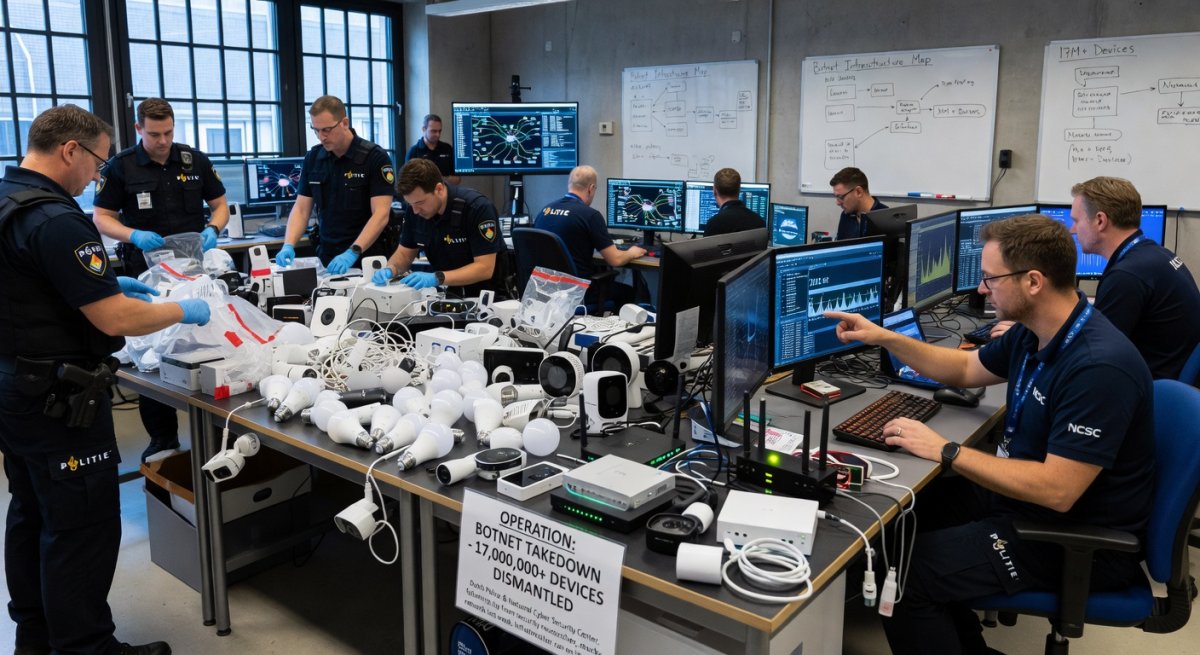
The takedown of a 17-million-device botnet by Dutch authorities exposes how everyday connected gadgets have become weapons of mass disruption. Police and the National Cyber Security Center struck the network last week after a security researcher flagged its activity. The infrastructure ran on 200 servers and controlled more than 17 million compromised devices worldwide. This single operation removed one of the largest known botnets from circulation, yet the underlying problem—millions of poorly secured machines—remains untouched.
The scale alone demands attention. Seventeen million devices can generate traffic volumes capable of knocking major online services offline for hours or days. When that power sits in the hands of criminals, the risk extends beyond one company’s downtime to supply chains, hospitals, and financial systems that depend on constant connectivity. The Dutch action shows governments can still act decisively when evidence surfaces early, but it also highlights how rare such successes remain.
The Joint Operation and Its Trigger
Dutch police worked directly with the National Cyber Security Center to seize control of the command servers and cut off the operators. The effort began after an independent security researcher reported unusual traffic patterns that pointed to a centralized management layer of roughly 200 servers. Once authorities confirmed the size and activity of the network, they moved to dismantle it rather than monitor it further. This approach reflects a shift in law-enforcement tactics. Instead of waiting for visible damage, agencies now prioritize early disruption when the infrastructure footprint becomes clear. The announcement on Thursday marked the public confirmation that the servers had been taken down and that the botnet’s controllers no longer had reliable access to the infected devices.Why 17 Million Devices Matter
A botnet of this size is not a niche curiosity. It represents a standing army of compromised routers, cameras, and other internet-connected hardware that can be rented or directed at will. Even short bursts of traffic from millions of endpoints can overwhelm protective filters at major internet exchanges. Longer campaigns can force entire regions offline or serve as cover for data theft and ransomware deployment. The 200-server backbone gave operators redundancy and geographic spread, making the network harder to dismantle through conventional takedown requests. By targeting the servers themselves, Dutch authorities removed the central nervous system rather than chasing individual infected devices. That decision limited the operators’ ability to regroup quickly, though it left the 17 million endpoints still vulnerable to reinfection by other actors.Background: The Persistent IoT Weakness
Most devices recruited into large botnets share the same structural flaws: default passwords, unpatched firmware, and internet exposure that was never intended by their manufacturers. Once infected, these machines rarely receive updates or monitoring. Owners remain unaware they have joined a criminal network until downstream effects appear in logs or service disruptions. This pattern has repeated across multiple high-profile incidents over the past decade. Each time, the lesson is identical: convenience and low cost in consumer hardware translate directly into offensive capability for adversaries. The Dutch case simply demonstrates the upper end of what remains possible when those incentives stay unchanged.Implications for Companies and Governments
For network operators and enterprises, the operation underscores the need for aggressive traffic filtering and rapid sharing of indicators with law enforcement. Waiting for a third-party researcher to surface the problem is not a sustainable defense. Governments, meanwhile, must decide whether current legal authorities and international cooperation mechanisms are sufficient when command infrastructure crosses multiple borders. The Netherlands action also carries a quiet warning to botnet operators: centralized management remains a point of failure. Moving to fully decentralized models raises technical barriers and reduces profitability, yet the lure of easy money from rented firepower keeps the ecosystem alive. Regulators could accelerate change by imposing liability on manufacturers that ship devices without basic security controls, but such rules have yet to gain widespread traction.What Happens Next
The immediate effect is a temporary reduction in available attack capacity. Over the longer term, the same devices will likely be targeted again unless owners take steps to isolate or replace them. Security researchers will continue scanning for new management servers, while operators will attempt to rebuild with lessons learned from this disruption. Users and organizations can reduce their exposure by disabling remote access on consumer devices, applying firmware updates promptly, and segmenting networks so that a single compromised camera cannot reach critical systems. None of these steps eliminate the broader risk, but they shrink the pool of easily recruitable machines. Until manufacturers treat security as a non-negotiable baseline rather than an optional feature, operations like the Dutch takedown will remain necessary but insufficient.By Jessica, Staff Writer
This article was produced with AI-assisted research and editorial support. Reporting is based on sources cited in the article.
What's Your Reaction?
 Like
0
Like
0
 Dislike
0
Dislike
0
 Love
0
Love
0
 Funny
0
Funny
0
 Wow
0
Wow
0
 Sad
0
Sad
0
 Angry
0
Angry
0

Jessica Ali
Editor-in-Chief at Global1.News. Atlanta-based journalist who cuts through the BS and tells it like it is. Lead anchor, host, and the voice you hear when the spin stops and the truth starts.














Comments (0)