
Mae Sot-Myawaddy border crossing shut by Myanmar conflict reopens after 10 months
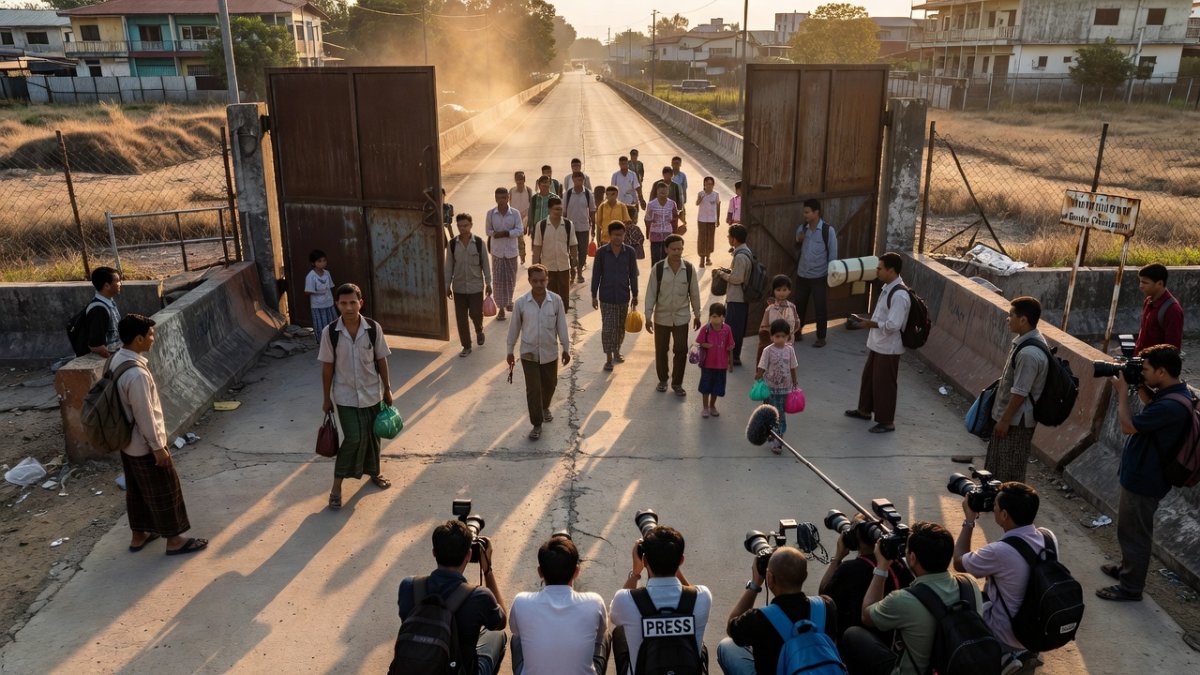
Mae Sot-Myawaddy Border Crossing Shut by Myanmar Conflict Reopens After 10 Months
TAK — 28 May 2026 — The second Thai-Myanmar Friendship Bridge and its permanent border checkpoint at Mae Sot reopened on Thursday for the first time in more than 10 months, as security officials from both sides cleared the way for trade to resume across one of Southeast Asia’s busiest land crossings.
The Long-Awaited Reopening
At 8 a.m. local time, Thai and Myanmar officials jointly raised the barriers on the 420-metre bridge that links Mae Sot in Tak province with Myawaddy in Myanmar’s Kayin State. A convoy of 47 trucks carrying Thai rice, construction materials and medical supplies crossed into Myanmar within the first hour, while returning vehicles brought Myanmar agricultural produce and garments destined for Thai markets. The moment marked the end of a closure that began on 15 July 2025 after intense fighting between Myanmar armed forces and ethnic armed organisations spilled into Myawaddy town.
Background of the Closure
The border point had already faced intermittent disruptions since the 2021 military coup in Myanmar, but the July 2025 clashes proved decisive. Artillery exchanges near the bridge forced Thai authorities to seal the crossing for safety. Local traders reported daily losses exceeding ฿180 million (approximately US$5.2 million) during the shutdown. Families on both sides of the Moei River, which the bridge spans, were separated for nearly a year, with many unable to visit elderly relatives or attend cross-border religious ceremonies.
Economic Data and Trade Recovery
Before the closure, the Mae Sot-Myawaddy corridor handled an average of US$1.8 billion in annual two-way trade, representing roughly 35 percent of all Thailand-Myanmar border commerce. Key commodities included Thai exports of fuel, pharmaceuticals and electronics, alongside Myanmar imports of rice, beans, sesame and jade. Thai customs data show that the ten-month shutdown cost Thai exporters an estimated US$620 million in lost revenue, while Myanmar communities dependent on cross-border wages saw household incomes drop by an average of 40 percent. Economists at Chulalongkorn University project that full normalisation could restore 80 percent of pre-closure volumes within six months, provided security remains stable.
Community Voices and Human Stories
“My daughter has not hugged her grandmother in Myawaddy since last Songkran,” said 52-year-old Mae Sot resident Somchai Wongsa, who sells fresh produce at the border market. “Today I will carry her favourite mangoes across and we will eat together again.” On the Myanmar side, 34-year-old garment worker Aye Thinzar waited with her two children for the bridge to open so she could resume her job at a Thai-owned factory that had temporarily relocated operations to Mae Sot. “We need this bridge not only for money but for dignity,” she said softly, clutching a small Buddha amulet given to her by Thai neighbours during the closure.
Security and Bilateral Cooperation
Thai army and Myanmar border guard officials conducted joint patrols along the riverbank overnight to ensure no residual threats remained. Both governments agreed to maintain a 24-hour hotline and increase surveillance cameras along the bridge. “This reopening reflects our shared commitment to the well-being of border communities,” stated Colonel Prasert Mahawan of Thailand’s 3rd Army Region. His Myanmar counterpart, Lt-Col Zaw Min Oo, echoed the sentiment: “Peace at the border begins with trust between neighbours.”
Regional and Cultural Implications
The reopening carries wider significance for ASEAN connectivity. Mae Sot sits on the Asian Highway Network route that links Thailand with Myanmar’s deep-sea ports and ultimately to India. Cultural exchanges, including annual merit-making ceremonies at the riverside temples, are expected to resume within weeks. Local monks on both banks have already planned a joint alms-giving event next month to mark the return of normal life.
Challenges Ahead and Expert Analysis
Analysts caution that sustained stability depends on continued dialogue between Myanmar’s military and ethnic armed groups. Dr. Nattaya Thanasiri, a regional security specialist at Thammasat University, noted: “The bridge is a lifeline, yet it remains vulnerable to any renewed flare-up. Thailand must balance economic interests with humanitarian preparedness.” Thai public health officials have also prepared mobile clinics at the checkpoint to screen returning workers for common border-area illnesses, reflecting lessons learned during earlier pandemic-related closures.
Looking Forward
As the sun set over the Moei River on Thursday evening, the steady rumble of trucks replaced the silence that had lingered for ten months. For the communities of Mae Sot and Myawaddy, the reopened bridge represents more than commerce; it symbolises the quiet resilience of neighbours who share history, language and the simple hope of daily bread. Trade will continue under heightened monitoring, but the human connections severed by conflict are slowly being rewoven, one crossing at a time.
This is Ann Srisawat for Global1 News, reporting from Bangkok. 🇹🇭
This article was produced with AI-assisted research and editorial support. Reporting is based on sources cited in the article.
What's Your Reaction?
 Like
0
Like
0
 Dislike
0
Dislike
0
 Love
0
Love
0
 Funny
0
Funny
0
 Wow
0
Wow
0
 Sad
0
Sad
0
 Angry
0
Angry
0

Southeast Asia Correspondent at Global1.News. Based in Bangkok, covering Thai and Southeast Asian politics, economy, technology, and culture. Deep regional perspective on one of the world's most dynamic regions.











Comments (0)