
Is Shortening Thailand’s Visa-Free Stay More About Appearances Than Action?
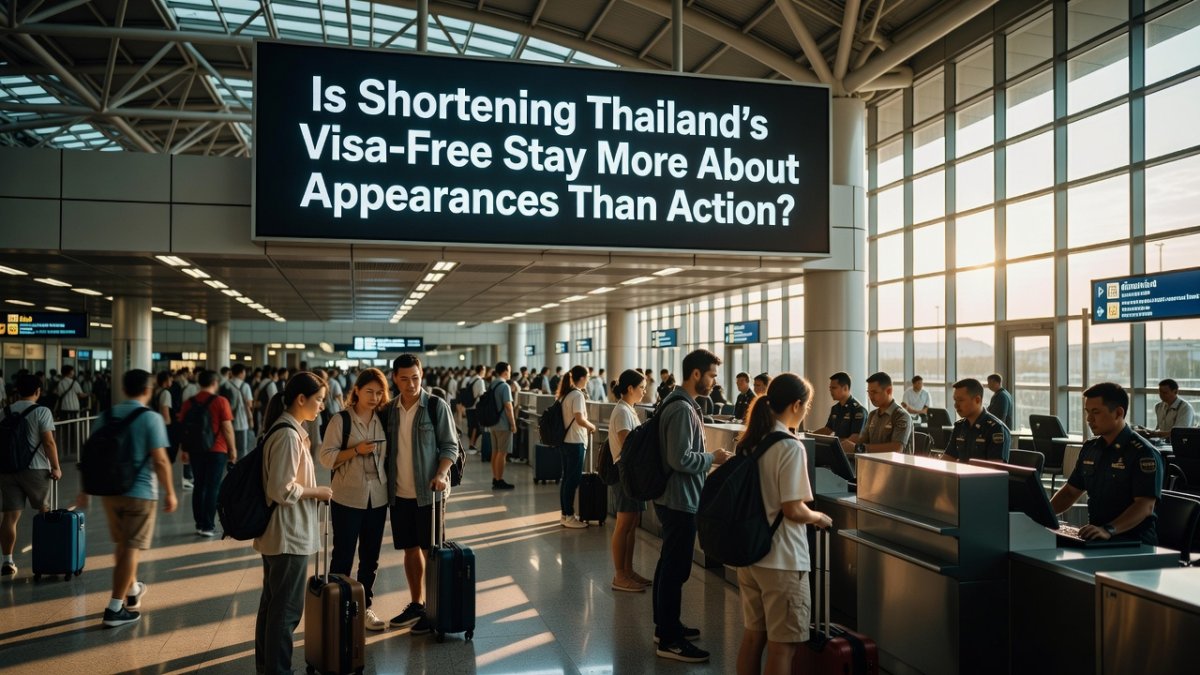
Is Shortening Thailand’s Visa-Free Stay More About Appearances Than Action?
In the gentle hum of Bangkok’s morning markets, where vendors arrange fragrant mangoes and the scent of lemongrass drifts through narrow sois, news of the latest visa policy shift has sparked quiet conversations. Last week, the Anutin Charnvirakul government announced the abrupt cancellation of the extended visa-free entry scheme that permitted many visitors a 60-day stay instead of the standard 30. Framed officially as a measure to bolster national security, curb transnational crime, and deter exploitation of Thailand’s open policies, the decision has left many wondering whether the move delivers substantive protection or primarily serves as a visible signal of resolve.
The Policy Reversal in Context
Thailand’s visa-free arrangements have long formed a cornerstone of its post-pandemic tourism recovery. In 2023, the previous administration extended the allowance to 60 days for citizens of 93 countries, aiming to attract longer-stay visitors who contribute more deeply to local economies through extended hotel bookings, cultural workshops, and community interactions. Official tourism data from the Ministry of Tourism and Sports recorded 28.1 million arrivals in 2024, with the extended stays accounting for an estimated 18 percent increase in average visitor expenditure in provinces such as Chiang Mai and Phuket.
The reversal, effective immediately, restores the 30-day limit. Deputy Prime Minister and Interior Minister Anutin Charnvirakul cited rising incidents of foreign-linked criminal networks operating under longer visa windows. Government briefings pointed to a 14 percent uptick in cases involving online scam syndicates and money laundering rings traced to visitors who overstayed or cycled through visa exemptions. Yet the data remains aggregated without granular breakdowns separating genuine tourists from suspected offenders.
Security Justifications and Their Limits
Proponents argue the change closes a loophole that transnational groups exploited. Colonel Somchai Rattanapong of the Royal Thai Police’s Immigration Bureau noted in a recent briefing that certain networks used the 60-day window to establish temporary bases for cryptocurrency fraud and illegal gambling operations targeting regional victims. “We have seen cases where individuals enter under visa exemption, then coordinate with local facilitators before moving funds offshore,” he stated.
However, independent analysts question the direct causal link. Dr. Nattaya Srisawat, a security researcher at Chulalongkorn University’s Institute of Security and International Studies, observes that most documented transnational crimes involve Thai nationals or long-term residents rather than short-term visa-free entrants. “The 60-day extension primarily benefited digital nomads and cultural enthusiasts who rent homes in rural communities and enroll in Thai language classes,” she explains. “Tightening entry without parallel investment in intelligence sharing or financial tracking risks inconveniencing the very visitors who sustain village homestays and temple restoration projects.”
Tourism Numbers and Economic Ripple Effects
Thailand’s tourism sector contributes approximately 12 percent to GDP, with extended-stay visitors playing an outsized role in secondary cities. Data from the Bank of Thailand shows that 60-day travelers spent an average of ฿72,000 per person in 2024, compared with ฿41,000 for 30-day visitors. Hotels in Pai and Hua Hin reported occupancy drops of up to 22 percent in the first days following the announcement as bookings were adjusted or canceled.
Local business owners express measured concern. “Our guesthouse in Sukhothai relies on guests who stay long enough to join our weekend cooking classes and support nearby farms,” says Khun Malee, a community tourism operator. “Thirty days feels rushed for families wanting to experience Songkran with us or volunteer at the elephant sanctuary.” Such voices highlight how policy shifts reverberate beyond Bangkok’s ministries into the daily rhythms of Thai community life.
Expert Perspectives on Appearances Versus Substance
Political observers suggest the timing aligns with domestic political signaling ahead of upcoming parliamentary sessions. “This decision projects firmness on sovereignty at a moment when coalition partners seek to demonstrate control over borders,” notes political commentator Somporn T. from Thammasat University. Yet he adds that enforcement capacity remains unchanged; immigration officers at Suvarnabhumi Airport already possess authority to deny entry based on suspected intent, regardless of the nominal stay length.
Comparative data from neighboring countries reinforces skepticism. Singapore maintains a 90-day visa-free period for many nationalities while employing sophisticated risk-profiling algorithms. Malaysia recently extended its visa-free window to 30 days with enhanced e-visa options for longer stays. Thailand’s reversion appears reactive rather than calibrated against these regional benchmarks.
Community and Cultural Implications
Beyond economics, the change touches Thailand’s cultural fabric. Temples and community centers that host mindfulness retreats report fewer international participants interested in month-long immersion programs. In Chiang Rai’s hill-tribe villages, where homestay cooperatives have fostered respectful cultural exchange, operators worry about reduced opportunities for mutual learning.
Meanwhile, expat communities in Bangkok’s Ari district and on Koh Samui have begun sharing practical adaptations on social platforms, including guidance on obtaining 60-day tourist visas through embassies. These conversations reveal a resilient adaptability among long-term visitors who value Thailand’s warmth and spiritual heritage.
Looking Ahead: Balancing Security and Openness
The government has indicated it may introduce a new long-stay visa category later this year, potentially requiring proof of accommodation and financial means. Such a framework could address security concerns while preserving the economic and cultural benefits of deeper engagement. Until then, the shortened visa-free period stands as a test of whether visible policy adjustments translate into measurable reductions in crime or merely reshape traveler itineraries.
As dusk settles over the Chao Phraya River and temple bells echo softly, many Thais continue to welcome visitors with characteristic hospitality, hoping future measures will reflect both protective wisdom and the generous spirit that defines Thai communities.
This is Ann Srisawat for Global1 News, reporting from Bangkok. 🇹🇭
This article was produced with AI-assisted research and editorial support. Reporting is based on sources cited in the article.
What's Your Reaction?
 Like
0
Like
0
 Dislike
0
Dislike
0
 Love
0
Love
0
 Funny
0
Funny
0
 Wow
0
Wow
0
 Sad
0
Sad
0
 Angry
0
Angry
0

Southeast Asia Correspondent at Global1.News. Based in Bangkok, covering Thai and Southeast Asian politics, economy, technology, and culture. Deep regional perspective on one of the world's most dynamic regions.















Comments (0)