
London Activists Protest Israeli Settlement Real Estate Event
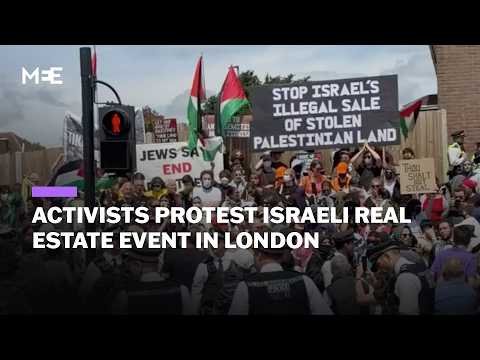
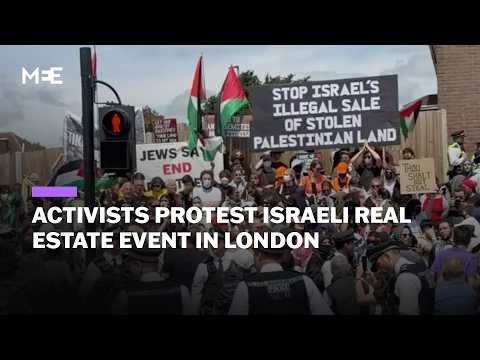
In a recent Middle East Eye report, activists gathered outside the Edgware United Synagogue in northwest London to challenge the "Great Israeli Real Estate Event," a fair organized by the agency My Home in Israel that promoted properties in occupied Palestinian territories. The demonstration on June 14, 2026, highlighted ongoing efforts to market land taken through settlement e
In a recent Middle East Eye report, activists gathered outside the Edgware United Synagogue in northwest London to challenge the "Great Israeli Real Estate Event," a fair organized by the agency My Home in Israel that promoted properties in occupied Palestinian territories. The demonstration on June 14, 2026, highlighted ongoing efforts to market land taken through settlement expansion, drawing attention to the daily realities faced by Palestinians under occupation.
Confrontation at the Synagogue
Hundreds of pro-Palestine demonstrators assembled to oppose the sale of homes in areas such as French Hill and Ramat Eshkol in East Jerusalem, as well as other sites in the West Bank. Organizers from the Palestinian Youth Movement and the International Jewish Anti-Zionist Network coordinated the action, citing the event's role in normalizing displacement. Metropolitan Police recorded around 1,000 participants in total when including pro-Israel counter-protesters, and officers made 14 to 15 arrests on public order grounds.
The real estate companies featured included Jerusalem Real Estate, which advertised units in East Jerusalem settlements, along with Africa Israel and Shapir, both listed by the United Nations Human Rights Office for activities tied to illegal settlements. Although event organizers stated that properties from the occupied West Bank were not included, Middle East Eye reporters documented brochures that explicitly offered such land.
Legal Framework and Government Positions
Israeli settlements in the occupied West Bank and East Jerusalem remain unlawful under international law, a position reinforced by the International Court of Justice ruling in 2024 that declared the occupation itself unlawful. The United Kingdom has maintained consistent opposition to such activity. A Foreign Office spokesperson stated that the government "completely oppose the advertisement of property for sale in illegal settlements."
On June 9, the UK government updated its business guidance to discourage economic engagement with settlement enterprises. London Mayor Sadiq Khan held discussions with the Metropolitan Police regarding the event, while a legal notice was issued to the Edgware United Synagogue for hosting it. A letter addressed to Home Secretary Yvette Cooper, signed by Layla Moran MP and additional parliamentarians, urged further scrutiny of the gathering.
Counter-Protest Dynamics and Reported Incidents
Pro-Israel counter-demonstrators responded with chants including "there is no Palestine, we flattened it," while some children directed insults such as "whores" and "prostitutes" toward the pro-Palestine side. Middle East Eye observed at least one instance of a pro-Israel supporter throwing punches at a pro-Palestine activist. These exchanges occurred against the backdrop of the synagogue hosting the real estate fair.
Organizers of the event described the protests as "motivated by anti-Israeli and terrorist supporters," framing opposition as external interference rather than a response to settlement policy. The presence of uniformed police and the arrests reflected the charged atmosphere outside the venue.
Personal Accounts from Participants
Journalist and activist Andrey Khrzhanovskiy, present at the demonstration, described the scene to Middle East Eye: "We are surrounded by a bunch of Zionists who are counter-protesting and attacking people... This is very reminiscent of everything that I've seen in the West Bank I feel like I've been here before." His remarks connected the London confrontation to patterns of intimidation documented in Palestinian communities under settlement pressure.
Activists from the Palestinian Youth Movement emphasized that such real estate events extend the reach of occupation policies into European cities, allowing settlement developers to seek buyers while Palestinian families continue to face home demolitions and land loss. The International Jewish Anti-Zionist Network highlighted the involvement of groups that reject the legitimacy of settlement expansion on human rights grounds.
Human Impact and Regional Context
Settlement construction in the West Bank and East Jerusalem has displaced Palestinian residents, restricted access to resources, and fragmented communities over decades. Properties marketed at events like the one in London represent land taken through processes that international bodies have ruled violate the Fourth Geneva Convention. Families in areas such as the Jordan Valley and around Hebron report repeated evictions tied to settlement growth.
The June 14 protest illustrated how these policies generate responses far from the occupied territories. Participants linked the real estate promotion to broader questions of accountability, noting that companies listed by the UN continue to operate without restriction in many markets. The UK advisory update on June 9 signaled an attempt to limit British commercial involvement, yet enforcement remains limited.
Looking Ahead
The demonstration outside Edgware United Synagogue forms part of sustained civil society efforts to draw attention to settlement-related commerce. With the International Court of Justice having addressed the occupation's legality and the UK government issuing updated guidance, the event underscores ongoing tensions between commercial promotion of occupied land and international legal standards. Palestinian communities continue to experience the direct consequences of settlement expansion, while protests in cities such as London reflect wider calls for policy alignment with human rights obligations.
By Fatima Al-Rashid, Staff Writer
This article was produced with AI-assisted research and editorial support. Reporting is based on sources cited in the article.
What's Your Reaction?
 Like
0
Like
0
 Dislike
0
Dislike
0
 Love
0
Love
0
 Funny
0
Funny
0
 Wow
0
Wow
0
 Sad
0
Sad
0
 Angry
0
Angry
0
Gulf/MENA Correspondent at Global1.News. Based in Doha, covering Gulf politics, energy markets, diplomacy, and development across the Middle East and North Africa. Tracks the economic transformation of the Gulf states.










Comments (0)