
Lee Jae-myung Ember of Hope Speech Rome Peace Efforts
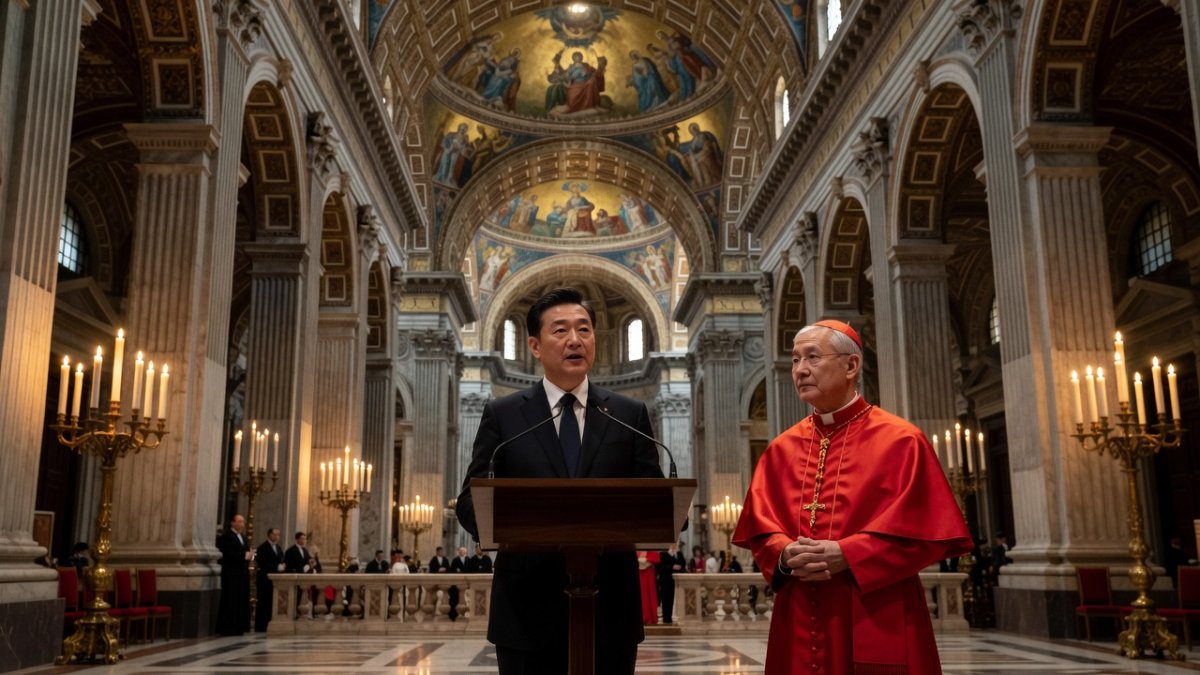
South Korean President Lee Jae-myung delivered a significant address on peace and inter-Korean relations during a special Mass at the Basilica of Saint Paul Outside the Walls in Rome. The event, celebrated by South Korea-born Cardinal Lazzaro You Heung-sik, centered on the theme of peace and solidarity. Speaking on June 14, Lee emphasized his belief that an "ember of hope" rema
South Korean President Lee Jae-myung delivered a significant address on peace and inter-Korean relations during a special Mass at the Basilica of Saint Paul Outside the Walls in Rome. The event, celebrated by South Korea-born Cardinal Lazzaro You Heung-sik, centered on the theme of peace and solidarity. Speaking on June 14, Lee emphasized his belief that an "ember of hope" remains for reviving dialogue and cooperation with North Korea despite persistent hostilities.
President Lee Jae-myung Addresses Peace at Roman Basilica
Seoul, South Korea – June 16, 2026 — This appearance formed part of Lee's first European trip since assuming office in June 2025. The remarks came ahead of the 26th anniversary of the June 15 North-South Joint Declaration and reflected the administration's consistent approach to engagement with Pyongyang.
Reference to the 2000 Joint Declaration as Historic Turning Point
Lee invoked the June 15, 2000 inter-Korean joint statement as a historic turning point that opened possibilities for overcoming tensions. That declaration facilitated family reunions for those separated by the 1950-53 Korean War and enabled humanitarian cooperation along with other exchanges. "I firmly believe the ember of that hope is still alive," Lee stated, according to Yonhap News reporting from Rome.
The 2000 declaration established a precedent for direct dialogue between Seoul and Pyongyang. Lee's reference underscores continuity in South Korean policy frameworks that prioritize incremental trust-building measures over abrupt shifts. In the current Northeast Asian context, where great-power competition between the United States and China shapes regional dynamics, such historical anchors provide analytical grounding for assessing prospects for reduced friction on the peninsula.
Concrete Measures to Reduce Tensions
The president outlined specific steps already implemented by his administration. These include the suspension of propaganda loudspeaker campaigns directed toward North Korea and restrictions on activist groups sending anti-North Korea leaflets across the border. Lee further clarified that Seoul will not pursue unification by absorption or unilateral ideological competition.
Additional commitments involve efforts to prevent accidental conflicts and restore military trust. "We plan to do everything we can to overcome the ceasefire and build a peace system," Lee said. These measures align with the administration's "END" initiative, which focuses on Exchange, Normalisation, and Denuclearisation while balancing engagement with alliance security requirements.
Such policies carry direct implications for daily life in South Korea, where border communities have long experienced the effects of loudspeaker broadcasts and leaflet campaigns. By scaling back these activities, the Lee government seeks to lower immediate risks of escalation along the demilitarized zone.
North Korean Responses and Persistent Challenges
Pyongyang has remained unresponsive to Seoul's overtures. North Korea has revised its constitution to remove references to reunification with South Korea and continues to develop its nuclear and ballistic missile programs. The North's Foreign Ministry recently rejected denuclearization as "an issue that has been finally and irreversibly concluded," according to UPI reporting.
Lee noted that the Korean Peninsula has returned to an era of rupture and severed dialogue amid broader international crises such as the Russia-Ukraine war and Middle East conflicts. Distrust and tensions persist. Last week, Lee and European Union leaders issued a joint statement condemning North Korea's military cooperation with Russia and expressing grave concern over its nuclear and ballistic missile activities.
Seoul and Washington reaffirmed the shared goal of denuclearizing North Korea during a meeting of the bilateral Nuclear Consultative Group. These developments illustrate the structural constraints facing any renewed engagement policy in Northeast Asia.
Vatican Support and Global Peace Linkages
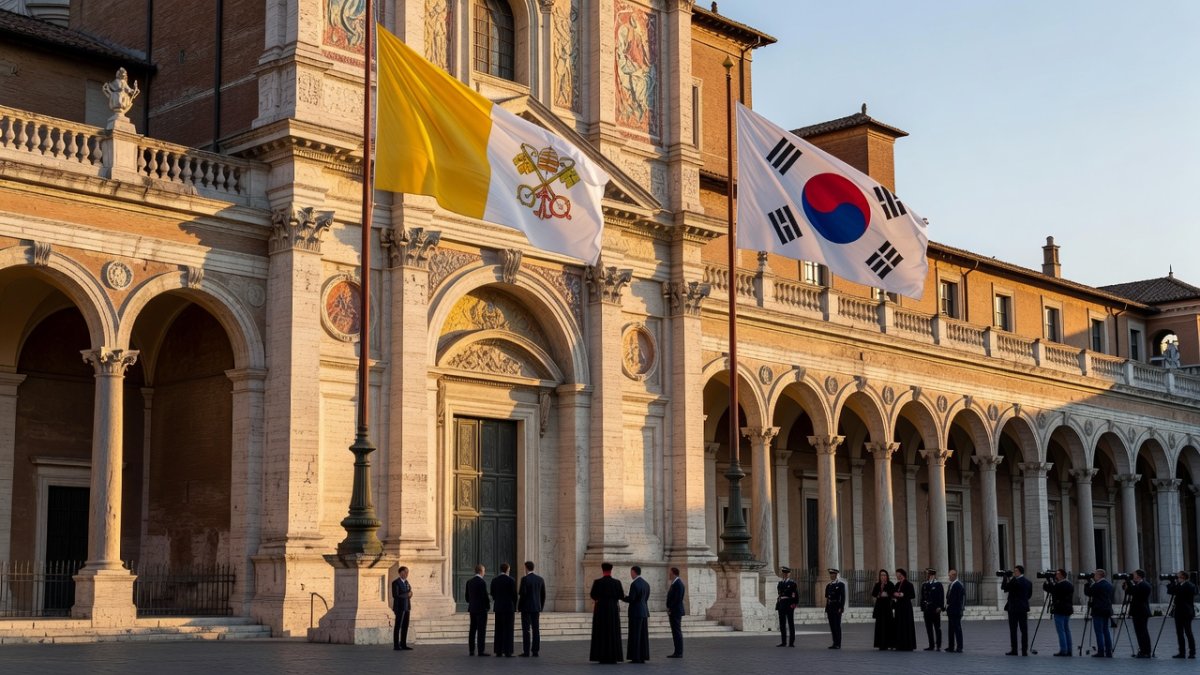
Lee expressed gratitude for Vatican support of Seoul's peace efforts and suggested that peace on the Korean Peninsula could contribute to global stability. He also invited young people worldwide to attend the 2027 World Youth Day in Seoul, describing the event as a potential symbol of reconciliation beyond borders and conflict. "I hope young people from around the world will be able to gather in Seoul beyond the constraints of front lines, barbed-wire fences and national borders," Lee said, per Korea Herald coverage.
The 2027 gathering, awarded to Seoul by the Vatican, will mark the first time World Youth Day is held in South Korea. It is expected to draw hundreds of thousands of young pilgrims. This initiative connects South Korea's domestic religious and civic landscape with international Catholic networks, offering a platform for soft-power diplomacy alongside traditional security channels.
Strategic Implications for Inter-Korean Relations and Regional Order
Lee's Rome address occurs against a backdrop of North Korea's firm commitment to retaining its nuclear weapons and its adoption of hostile policies that frame inter-Korean relations as those between two "hostile" countries. The administration's approach seeks pragmatic engagement while maintaining the long-term security requirements of the South Korea-United States alliance.
Lee is scheduled to attend the Group of Seven summit in France following his Vatican visit with Pope Leo XIV. These multilateral engagements highlight South Korea's positioning within broader Western frameworks on non-proliferation and regional stability. Historical precedents, including past inter-Korean summits and family reunion programs, demonstrate that sustained, low-profile measures can occasionally produce limited openings even when high-level dialogue remains stalled.
The speech therefore serves both as a reaffirmation of policy continuity and an analytical signal of the constraints inherent in Northeast Asian geopolitics. While immediate breakthroughs appear unlikely given Pyongyang's current posture, the emphasis on preserving an ember of hope reflects a calculated strategy aimed at maintaining channels for future de-escalation.
By Prof. David Park, Staff Writer
This article was produced with AI-assisted research and editorial support. Reporting is based on sources cited in the article.
What's Your Reaction?
 Like
0
Like
0
 Dislike
0
Dislike
0
 Love
0
Love
0
 Funny
0
Funny
0
 Wow
0
Wow
0
 Sad
0
Sad
0
 Angry
0
Angry
0
East Asia/Technology Correspondent at Global1.News. Seoul-based voice covering Korean politics, technology, business, and culture. Analyzes how technology and geopolitics intersect across East Asia.













Comments (0)