
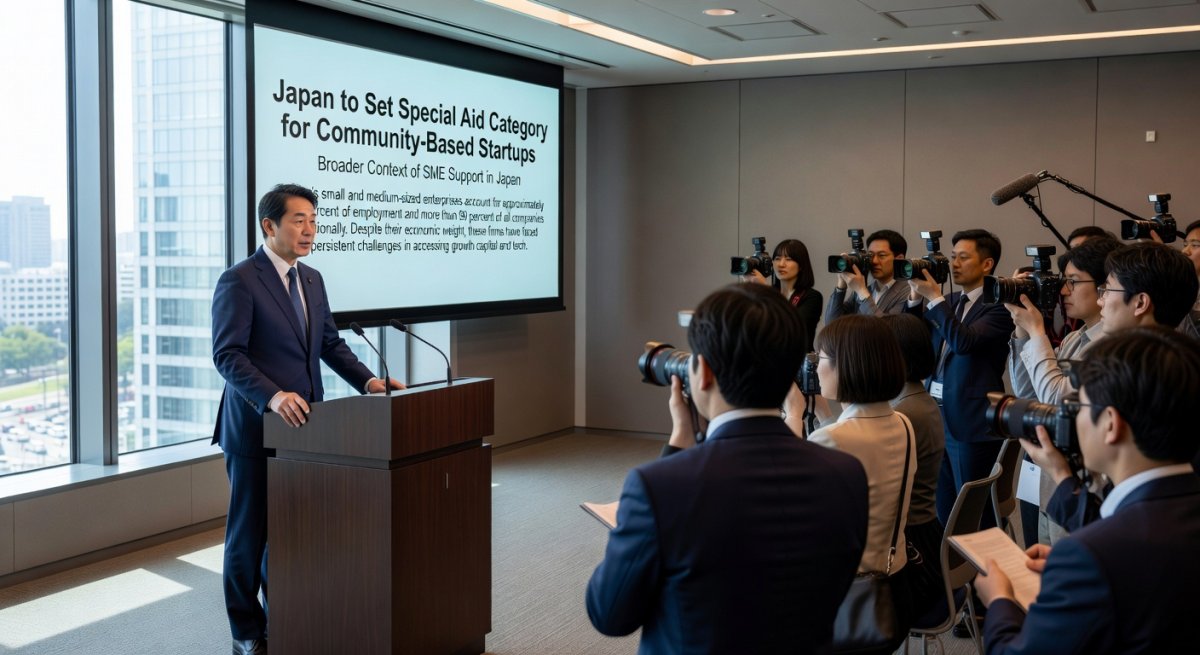
Japan to Set Special Aid Category for Community-Based Startups
Broader Context of SME Support in Japan Japan's small and medium-sized enterprises account for approximately 70 percent of employment and more than 99 percent of all companies nationally. Despite their economic weight, these firms have faced persistent challenges in accessing growth capital and technology upgrades. Community-based startups, in particular, operate with thinner m
Broader Context of SME Support in Japan
Japan's small and medium-sized enterprises account for approximately 70 percent of employment and more than 99 percent of all companies nationally. Despite their economic weight, these firms have faced persistent challenges in accessing growth capital and technology upgrades. Community-based startups, in particular, operate with thinner margins and fewer connections to the venture capital networks concentrated in Tokyo.
The internal affairs ministry's initiative follows a pattern of targeted interventions aimed at strengthening regional economies outside major metropolitan areas. Previous programs have focused on subsidies for digital adoption and co-working space development, though the ministry has noted that take-up rates among very small businesses have remained below expectations. The new AI transformation category attempts to address this shortfall by creating a clearer entry point for firms whose primary contribution is local rather than scalable in the traditional venture sense.
What the New Category Would Entail
Based on the Japan Times reporting, the new classification will function as a subcategory within the existing SME aid framework rather than as a standalone program. This structural choice suggests that the ministry aims to minimize administrative complexity for applicants while still directing resources toward businesses that demonstrate local economic impact.
The focus on AI transformation aligns with Japan's national digital strategy, which has prioritized artificial intelligence adoption across both public and private sectors. Community-based applications under consideration include inventory management systems for small retailers, automated scheduling tools for agricultural cooperatives, and customer data analysis platforms for local service providers.
Impact on Local Economies and Startup Ecosystems
For community-based startups across Japan, the new category could address a structural gap in the current support system. Many local businesses that would qualify for the program operate in sectors with thin profit margins, where even modest efficiency gains can meaningfully affect sustainability.
The initiative also responds to a demographic challenge facing rural and suburban Japan. As the national population contracts, local economies are under increasing pressure to maintain service levels with fewer workers. AI-driven efficiency improvements offer one pathway for sustaining operations without proportional increases in staffing.
Challenges and Limitations
The success of the new aid category will depend on several factors that remain unresolved in the current announcement. Take-up rates among eligible businesses will be influenced by the simplicity of the application process and the level of technical assistance available to firms with limited AI expertise.
Funding allocation also presents a question. The internal affairs ministry has not yet specified budget levels for the new category, and competition with other spending priorities could affect the scale of assistance available.
Outlook
The internal affairs ministry's decision to create a dedicated AI transformation category for community-based startups represents a pragmatic adjustment of existing policy tools. Full program details are expected in the coming months as the ministry finalizes eligibility criteria and funding parameters.
By Kenji Tanaka, Staff Writer
This article was produced with AI-assisted research and editorial support. Reporting is based on sources cited in the article.
What's Your Reaction?
 Like
0
Like
0
 Dislike
0
Dislike
0
 Love
0
Love
0
 Funny
0
Funny
0
 Wow
0
Wow
0
 Sad
0
Sad
0
 Angry
0
Angry
0

Japan Correspondent at Global1.News. Tokyo-based voice covering Japanese politics, technology, economy, and culture. Tracks the intersection of tradition and innovation in one of the world's most dynamic societies.















Comments (0)