
India 'Commits' To Buying $500 Billion Worth Of US Goods. What Experts Said
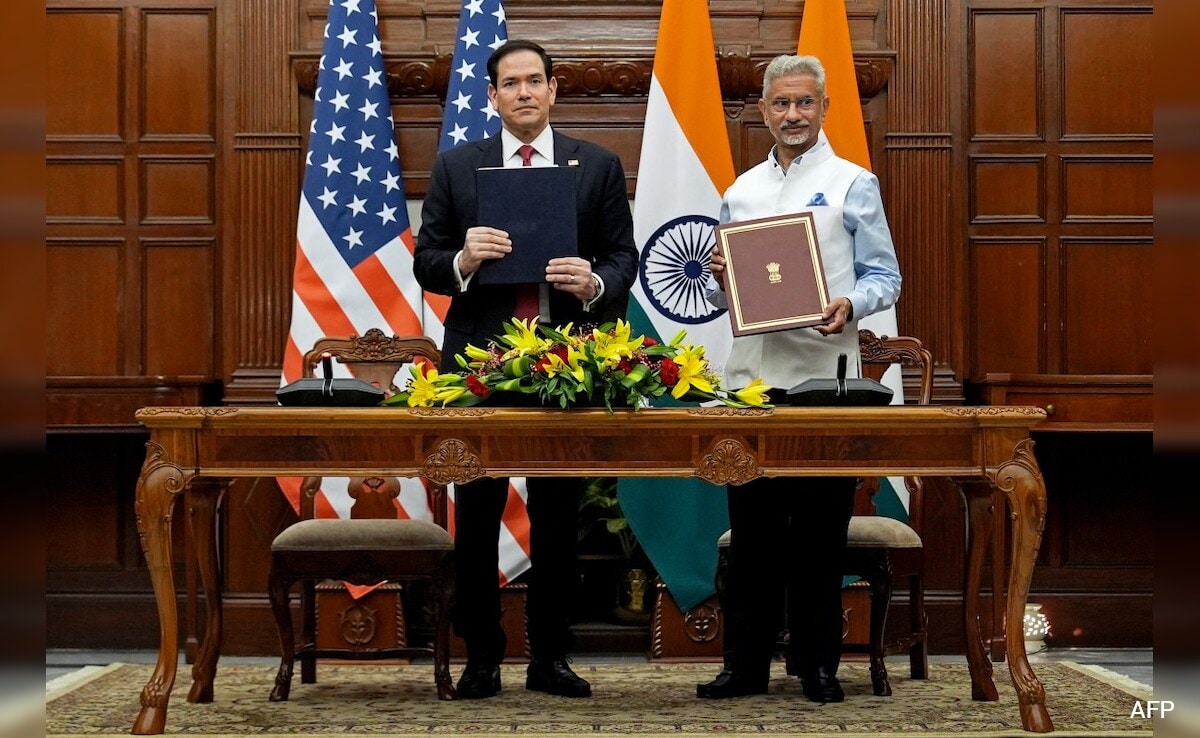
India Commits to $500 Billion US Goods Purchases Amid Forex Strain and Rising Oil Costs
In a development that has sent ripples through economic circles, India has signaled a firm commitment to procure approximately $500 billion worth of goods from the United States over the next five years. The announcement, framed as a strategic trade realignment, comes at a precarious moment for the Indian economy, already grappling with depleting foreign exchange reserves, a depreciating rupee, and surging crude oil prices triggered by escalating tensions in the US-Iran conflict.
The Scale of the Commitment
Officials in New Delhi described the pledge as part of broader efforts to narrow the bilateral trade gap, which stood at $27 billion in favor of the US in fiscal year 2023-24. The $500 billion figure encompasses energy products, defense equipment, aircraft, semiconductors, and agricultural commodities. Specific allocations reportedly include $180 billion in liquefied natural gas and crude oil, $95 billion in commercial aircraft and components, and $75 billion in advanced electronics and medical devices. This represents a near-doubling of current annual import levels from the US, which averaged $42 billion over the past three years.
Commerce Ministry sources indicated that the commitment emerged from high-level talks in Washington last month, where Indian negotiators sought concessions on tariffs for Indian textiles and pharmaceuticals in exchange for accelerated purchases. The rupee's slide to 84.5 against the dollar this week has amplified scrutiny over whether such large-scale outflows can be sustained without further eroding reserves, currently hovering near $612 billion after a $18 billion drawdown in the last quarter.
Forex Vulnerabilities and Oil Price Shock
India's import dependence on crude remains a critical vulnerability. With Brent crude climbing above $92 per barrel amid US-Iran hostilities disrupting Strait of Hormuz shipments, the country's oil import bill is projected to exceed $140 billion this fiscal year, up 22 percent from 2023-24. Analysts note that every $10 increase in oil prices widens the current account deficit by roughly 0.8 percent of GDP. The additional $500 billion commitment compounds these pressures, potentially requiring $100 billion in annual hard currency outflows once fully ramped up.
Reserve Bank of India data shows that reserves have already fallen below the import cover threshold of 10 months for the first time since 2022. The weakening rupee has raised imported inflation risks, with wholesale price indices for fuel and lubricants surging 14.7 percent year-on-year in the latest reading. Health sector imports, including active pharmaceutical ingredients and diagnostic equipment from the US, could face cost escalations that ultimately affect domestic drug pricing and public health programs.
Expert Perspectives on Feasibility
Dr. Ananya Sharma, senior economist at the Indian Council for Research on International Economic Relations, cautioned that the timeline appears ambitious given structural constraints. "India's export earnings to the US are unlikely to scale proportionally in the short term," she stated. "Our merchandise exports to America grew only 4.2 percent last year, while services exports, though robust at $38 billion, cannot offset the capital goods surge envisioned here."
Former RBI deputy governor R. Subramanian echoed these concerns in a Mumbai seminar, emphasizing reserve adequacy metrics. "Maintaining import cover above nine months is non-negotiable for external stability," he noted. "Redirecting $500 billion toward US suppliers risks crowding out diversified sourcing from Russia and the Middle East, where discounted crude has helped moderate costs." Subramanian added that defense offsets under the agreement might provide some relief through technology transfers, yet these typically materialize over 8-10 years.
Health economist Dr. Priya Malhotra highlighted potential upsides in medical technology imports. "Access to advanced US imaging systems and biologics could strengthen India's tertiary care infrastructure," she said. "However, without parallel investments in domestic manufacturing under the Production Linked Incentive scheme, we risk deepening import dependence in critical health supply chains."
Trade Balance and Sectoral Implications
Bilateral trade data reveals asymmetry that the new commitment aims to address. While Indian IT and pharmaceutical exports to the US reached $32 billion in 2023, non-tariff barriers on generics and H-1B visa restrictions continue to limit gains. The $500 billion pledge includes provisions for increased purchases of American almonds, pistachios, and ethanol, sectors where US exporters have long sought greater Indian market access.
Automotive and electronics manufacturers in India expressed mixed reactions. Tata Motors indicated plans to expand sourcing of US-origin semiconductors for its electric vehicle lineup, yet warned of margin compression if currency volatility persists. Semiconductor imports alone are expected to constitute 15 percent of the total commitment value, aligning with India's semiconductor mission targets but raising questions about technology absorption capacity.
Geopolitical and Long-Term Outlook
The commitment unfolds against the backdrop of India's strategic autonomy in energy procurement, including continued Russian crude imports at discounted rates. US officials have signaled willingness to accommodate this flexibility, provided overall purchase volumes meet targets. This balancing act could influence upcoming Quad and G20 discussions on supply chain resilience.
Data from the Ministry of Petroleum shows that US LNG cargoes have already increased 37 percent in the first half of 2024, offering a cleaner alternative to coal. Yet analysts project that full realization of the $500 billion target would necessitate reserve replenishment strategies, possibly through accelerated foreign direct investment inflows or sovereign bond issuances.
Public health linkages remain underexplored. Rising costs for imported medical devices could strain Ayushman Bharat allocations, which already face a 12 percent funding gap. Conversely, collaboration on US-origin vaccine platforms and cold-chain technologies offers avenues for strengthening pandemic preparedness.
As negotiations proceed, the coming quarters will test India's ability to reconcile ambitious trade realignment with macroeconomic stability. The $500 billion commitment underscores deepening US-India economic ties, yet its execution hinges on prudent reserve management and diversified sourcing strategies that safeguard long-term external sector health.
This is Dr. Raj Patel for Global1 News, reporting from Mumbai. 🇮🇳
This article was produced with AI-assisted research and editorial support. Reporting is based on sources cited in the article.
What's Your Reaction?
 Like
0
Like
0
 Dislike
0
Dislike
0
 Love
0
Love
0
 Funny
0
Funny
0
 Wow
0
Wow
0
 Sad
0
Sad
0
 Angry
0
Angry
0

India/South Asia Correspondent at Global1.News. Analytical voice with a background in science and health journalism. Based in New Delhi, covering Indian politics, education, healthcare, technology, and policy. Breaks down complex data into clear, actionable reporting.














Comments (0)