
Can China and the US Avoid the Thucydides Trap? Xi's Challenge to Trump
Can China and the US Avoid the Thucydides Trap? Xi's Challenge to Trump In a recent CGTN analysis program examining the mid-May 2026 Trump-Xi Beijing summit, experts dissected President Xi Jinping's opening question to President Donald Trump on whether China and the United States can avoid the Thucydides Trap. The discussion drew directly from Harvard political scientist Graham
In a recent CGTN analysis program examining the mid-May 2026 Trump-Xi Beijing summit, experts dissected President Xi Jinping's opening question to President Donald Trump on whether China and the United States can avoid the Thucydides Trap. The discussion drew directly from Harvard political scientist Graham Allison's framework, which documents that rising powers have challenged established hegemons in 12 of 16 historical cases since 1500, resulting in war in most instances. Xi's framing positioned the Taiwan question as a potential trigger for conflict, while Trump emphasized prospects for an improved bilateral relationship without engaging the Trap concept head-on.
This exchange was not merely rhetorical. It represented a deliberate strategic communication from Beijing — an attempt to frame US-China competition within a historical narrative that warns of catastrophic outcomes while simultaneously signaling China's willingness to seek a different path. Understanding the full implications of this diplomatic moment requires examining the Thucydides Trap framework, the specific leverage each side possesses, the flashpoints that could trigger escalation, and the institutional mechanisms available to manage what may be the defining geopolitical relationship of the twenty-first century.
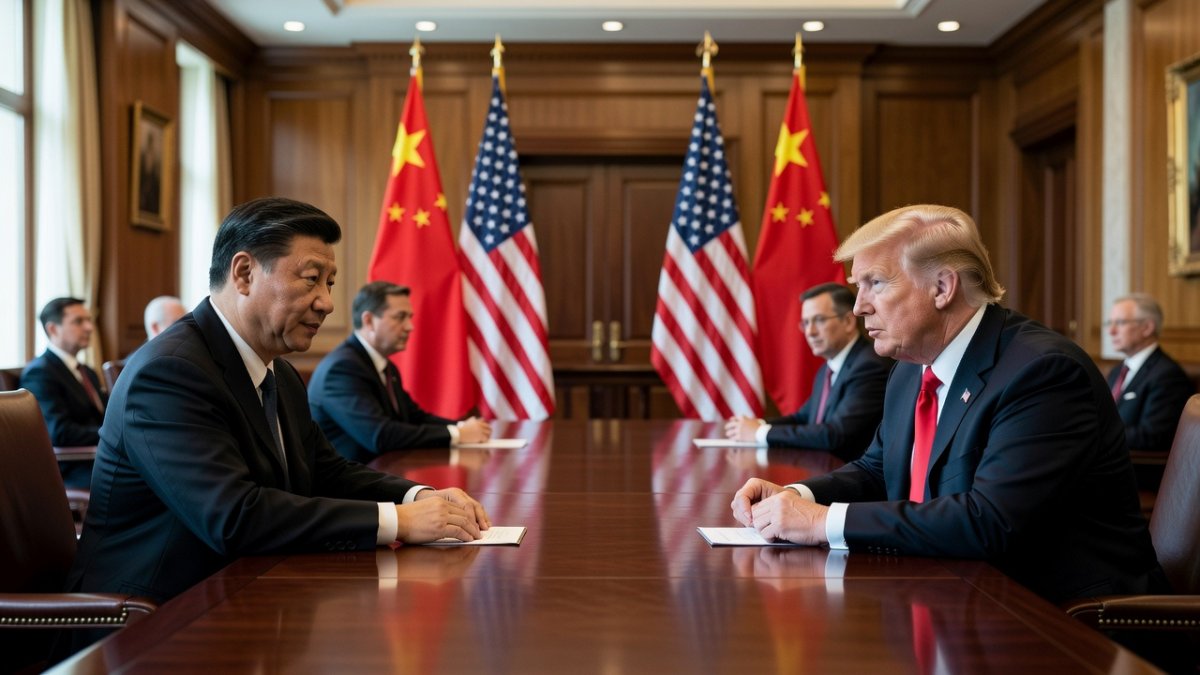
Xi Jinping meets Donald Trump in Beijing, May 2026. (Global 1 News)
The Thucydides Trap Framework and US-China Competition
Graham Allison's Thucydides Trap framework, drawn from his examination of sixteen historical power transitions since 1500, identifies twelve cases that ended in war when a rising power challenged an established hegemon. In the CGTN video "Can China and the US avoid the Thucydides Trap?", analysts applied this record directly to contemporary US-China dynamics, noting that structural stresses arise when the rising state's growing capabilities alter the balance of power. Chinese strategic thinkers, however, reject the inevitability of conflict and instead emphasize that the framework reflects Western historical patterns rather than universal laws. Beijing's approach draws on the 14th Five-Year Plan and the Dual Circulation strategy to pursue technological self-reliance while expanding influence through the Belt and Road Initiative and RCEP, thereby reshaping the economic environment without direct military confrontation. This perspective allows Chinese policymakers to frame competition as manageable through deliberate statecraft rather than predetermined tragedy.
Second-order effects of this framing appear in how both capitals interpret each other's military modernization and alliance behavior. The United States views China's naval expansion and gray-zone activities in the South China Sea as evidence of hegemonic intent, while China sees US Indo-Pacific partnerships as containment designed to preserve unipolar dominance. MFA spokespeople have repeatedly stated that the Thucydides Trap is not an objective condition but a narrative that can be avoided if Washington accommodates China's legitimate development interests. Such statements reveal Beijing's calculation that acknowledging the trap publicly can pressure the United States into restraint without conceding ground on core sovereignty issues.
Xi Jinping's Strategic Message at the Beijing Summit
President Xi Jinping's opening question at the mid-May 2026 Beijing summit deliberately invoked the Thucydides Trap to place Taiwan at the center of any discussion about bilateral stability. By linking the historical warning to the Taiwan question, Xi signaled that Beijing regards any move toward formal independence or enhanced US security commitments as a potential trigger for conflict. This framing allowed China to present itself as the party seeking to avoid catastrophe while placing the onus on Washington to demonstrate restraint. President Trump, by contrast, focused on economic and technological cooperation without endorsing the Trap concept, indicating a preference for transactional engagement over structural historical analysis.
The exchange illustrated differing strategic time horizons. Chinese diplomacy, coordinated through the MFA and led by figures such as Wang Yi, treats the Taiwan issue as non-negotiable and uses historical analogies to underscore long-term risks. US responses, shaped by alliance commitments and domestic politics, tend to address immediate economic or security concerns without accepting the premise that structural power transition must dominate the agenda. Xi's choice to raise the Trap therefore served both as a warning and as an invitation to negotiate new terms of coexistence.
Sources of Leverage: US Advantages and Chinese Counterweights
The United States retains significant advantages in advanced semiconductors, alliance networks, and financial system centrality, which it has used to impose export controls and coordinate technology restrictions with partners. China counters these measures through its dominance in rare earth processing, manufacturing scale, and expanding influence across the Global South via the Belt and Road Initiative. These counterweights create second-order effects on ASEAN economies, which must balance participation in RCEP with pressure from both Washington and Beijing over supply-chain alignment. European Union members similarly face divided incentives, as Chinese investment in critical infrastructure competes with US calls for coordinated export controls.
Under the Dual Circulation strategy, Beijing has accelerated domestic substitution in key sectors while leveraging MOFCOM and NDRC planning to reduce vulnerability to external shocks. This approach limits the long-term effectiveness of US technology restrictions but also raises costs for Chinese firms and complicates relations with technology-dependent partners. The resulting dynamic produces a fragmented economic order in which neither side can fully isolate the other without incurring substantial self-harm.

The Taiwan Strait remains the most probable flashpoint in US-China relations. (Global 1 News)
The Taiwan Flashpoint and the Risk of Miscalculation
Taiwan remains the most probable trigger for direct US-China conflict because it combines sovereignty claims, military deployments, and alliance credibility issues. China's red lines, articulated consistently by MFA spokespeople and senior leadership, treat any formal Taiwanese independence declaration or large-scale US military presence on the island as unacceptable. US commitments under the Taiwan Relations Act and subsequent assurances create parallel obligations that could force rapid escalation if cross-strait tensions rise. Current dynamics show increased Chinese military activity around the island alongside continued US arms sales, raising the danger that routine exercises could be misread as preparations for decisive action.
Both sides recognize that uncontrolled escalation would damage their broader strategic interests, yet neither has established reliable mechanisms to prevent accidents from spiraling. The absence of robust crisis communication protocols increases the possibility that a localized incident could activate alliance responses and force leaders into binary choices. Managing this flashpoint therefore requires sustained attention to signaling and restraint rather than reliance on deterrence alone.
Institutional Guardrails and Pathways to Managed Competition
Existing military-to-military dialogues and crisis hotlines provide limited but useful channels for deconfliction, though their effectiveness has varied with political cycles. Wang Yi has emphasized the need for institutionalized communication to prevent miscalculation, particularly on maritime and air safety issues. Additional mechanisms could build on agreements already reached in areas such as climate cooperation and public health, extending similar formats to nuclear risk reduction and cyber norms. The MFA continues to advocate for regular senior-level meetings that separate Taiwan from other functional topics, allowing incremental progress on less sensitive issues.
Prospects for new guardrails depend on whether both capitals can accept managed competition as a durable condition rather than a temporary phase. Without such acceptance, existing channels risk becoming instruments of signaling rather than genuine risk reduction. Sustained engagement through established diplomatic and military structures remains the most practical route to lowering the probability of unintended conflict.
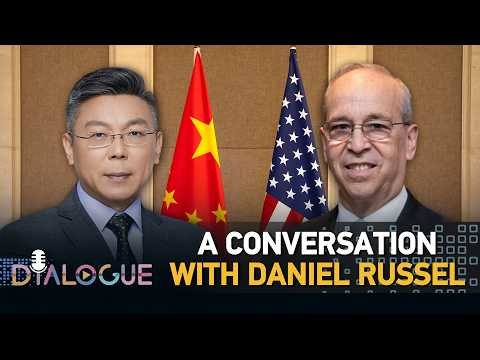
CGTN's analysis program explored Xi Jinping's Thucydides Trap challenge to Trump. (CGTN)
Regional Implications: ASEAN, the EU, and the Global South
ASEAN member states such as Vietnam, Indonesia, and the Philippines navigate the Thucydides Trap dynamics exposed at the mid-May 2026 Beijing summit by deepening participation in China’s Belt and Road Initiative while simultaneously expanding security cooperation under the U.S.-led Quad and AUKUS frameworks. Vietnam has accelerated infrastructure projects funded through the Asian Infrastructure Investment Bank alongside joint maritime patrols with Washington in the South China Sea, reflecting a deliberate hedging strategy that preserves economic access to Chinese markets without ceding sovereignty claims. Indonesia leverages its G20 presidency and Regional Comprehensive Economic Partnership commitments to extract concessional financing from Beijing while courting U.S. technology transfers under the CHIPS and Science Act to diversify its semiconductor supply chains. The Philippines, under the Enhanced Defense Cooperation Agreement, has granted American forces rotational access to bases even as Chinese state-owned enterprises dominate its nickel processing sector, illustrating the persistent tension between economic interdependence and alliance commitments. These calibrated approaches demonstrate how middle powers exploit summit-induced stability signals to avoid entrapment in great-power rivalry.
The European Union confronts fractured incentives between preserving market access to China’s vast consumer base and aligning with U.S. technology export controls tightened after the Beijing summit’s failure to resolve semiconductor disputes. Germany’s automotive sector continues to rely on rare-earth imports and joint ventures with Chinese firms despite the EU’s adoption of the Anti-Coercion Instrument, whereas the Netherlands has enforced stricter curbs on ASML lithography exports at Washington’s urging, revealing intra-European divergences over economic security policy. France and Italy have pursued selective engagement through the EU-China Comprehensive Agreement on Investment revival talks, seeking regulatory concessions that offset losses from the U.S. Inflation Reduction Act’s domestic-content requirements. This bifurcation risks undermining the EU’s strategic autonomy doctrine articulated in the 2023 European Economic Security Strategy, as member states weigh Chinese retaliatory tariffs against American security guarantees extended via NATO. Consequently, Brussels must reconcile these competing pressures to prevent secondary sanctions from eroding its collective bargaining position in future U.S.-China negotiations.
Global South nations capitalize on the competitive financing environment intensified by the 2026 summit to secure infrastructure commitments under both China's Belt and Road Initiative and the U.S.-led Partnership for Global Infrastructure and Investment, yet they face heightened risks of proxy competitions over critical minerals and technical standards. Countries in Africa and Latin America have extracted debt-relief packages and port-development loans from Beijing while attracting U.S. and EU blended-finance vehicles targeting green hydrogen and digital connectivity projects. Such bidding wars, however, threaten to fragment global governance architectures, as seen in competing 5G and data-localization regimes promoted by Huawei and Western vendors respectively. Stable U.S.-China relations remain indispensable for predictable development financing, because renewed escalation would trigger capital flight from emerging markets and disrupt multilateral institutions such as the World Bank and Asian Development Bank. Without sustained dialogue, the Global South risks becoming an arena for zero-sum standard-setting contests that undermine long-term economic resilience.
What to Watch in the Coming Months
Implementation of commitments from the Beijing summit will be tested first in the pace of military confidence-building measures and the handling of Taiwan-related legislation in Washington. Observers will also monitor whether China advances new proposals under the 14th Five-Year Plan that affect technology standards or supply chains relevant to US firms. Progress on Dual Circulation targets and RCEP utilization rates will indicate whether Beijing is prioritizing resilience over deeper integration with Western economies.
The decisive variable remains whether senior officials on both sides treat the Thucydides Trap as a manageable diplomatic frame rather than an inescapable structural force. Deliberate statecraft, supported by regular high-level contact and clear red-line communication, offers the clearest path to avoiding the historical pattern Allison documented. Continued reference to these mechanisms in official statements will reveal whether the recent summit produced lasting procedural improvements or merely rhetorical positioning.
By Prof. Marcus Chen, Staff WriterThis article was produced with AI-assisted research and editorial support. Reporting is based on sources cited in the article.
What's Your Reaction?
 Like
0
Like
0
 Dislike
0
Dislike
0
 Love
0
Love
0
 Funny
0
Funny
0
 Wow
0
Wow
0
 Sad
0
Sad
0
 Angry
0
Angry
0

Editor-in-Chief at Global1.News. Atlanta-based journalist who cuts through the BS and tells it like it is. Lead anchor, host, and the voice you hear when the spin stops and the truth starts.













Comments (0)