
Belfast Riots: Police Deploy Water Cannon as Violence Erupts
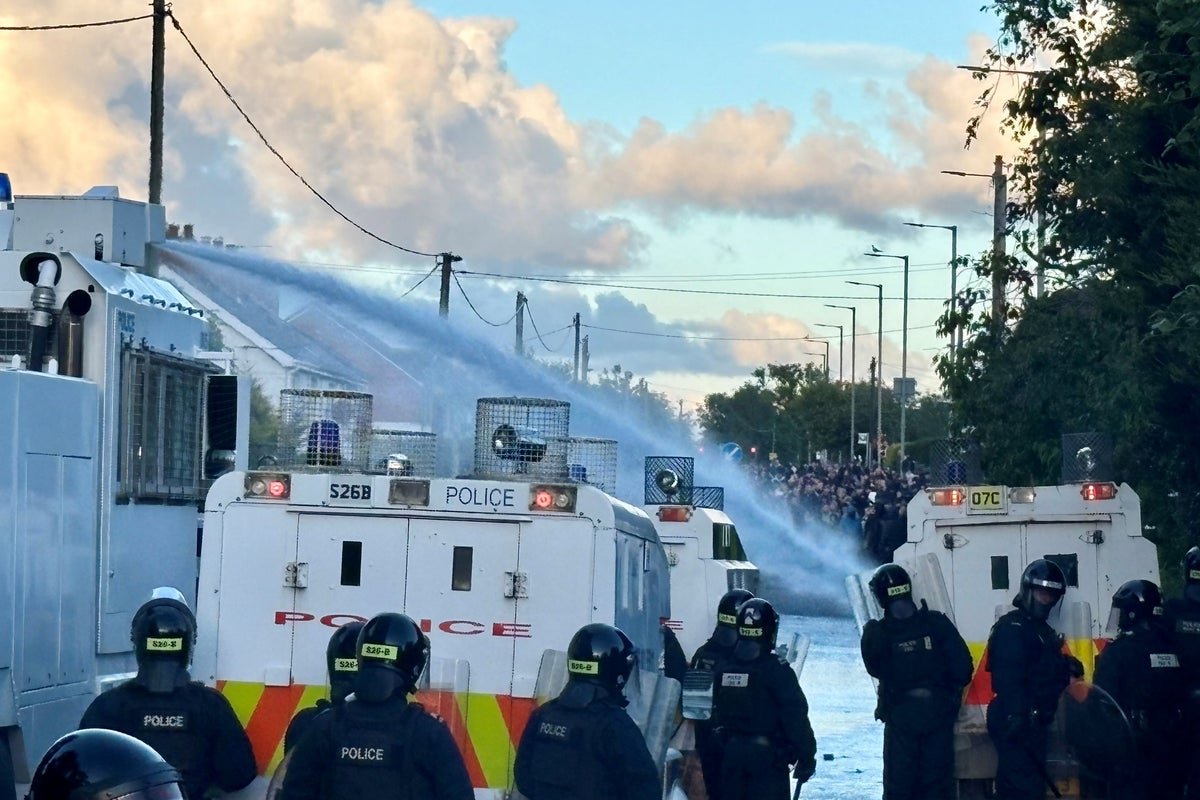
Scene on the Ground Tonight in Belfast police deployed water cannon to repel groups of masked youths who hurled bricks fashioned from broken pavements and the walls of private homes. The disorder followed violent protests on Tuesday after a Sudanese man was charged over a knife attack. A vehicle was set alight, sending thick black smoke into the night sky while a row of burning
Scene on the Ground
Tonight in Belfast police deployed water cannon to repel groups of masked youths who hurled bricks fashioned from broken pavements and the walls of private homes. The disorder followed violent protests on Tuesday after a Sudanese man was charged over a knife attack. A vehicle was set alight, sending thick black smoke into the night sky while a row of burning bins blocked roads and created further hazards for officers. Two hundred extra police officers had been deployed across the city after residents were forced to flee properties set alight during Tuesday night disturbances.
In Newtownabbey on the northern outskirts of Belfast a crowd of several hundred gathered in a stand-off with police lines. Young men in black tracksuits and face coverings broke up sections of suburban pavements and garden walls to create missiles. Rioters advanced along Antrim Road, kicking at police vehicles before retreating once water cannon were brought into action. The response soaked the hard core of demonstrators who had positioned themselves directly in front of armoured vehicles.
At least a dozen armoured Land Rovers remained stationed in loyalist areas of Belfast as small fires continued to burn on the roadway. Officers maintained positions amid reports that the night was far from over. The violence occurred despite repeated appeals from police chiefs and politicians urging communities not to allow division to take hold once more.
Court Appearance
Hadi Alodid appeared at Belfast magistrates court charged with attempted murder, threats to kill an NHS radiographer and possession of a knife. The suspect, a Sudanese national, refused legal representation during the brief hearing. He was remanded in custody for four weeks pending further proceedings. Court records confirm that Alodid travelled north via the Republic of Ireland, which forms part of the Common Travel Area agreement with the United Kingdom.
The charges relate directly to a knife attack in Belfast that left Stephen Ogilvie with the loss of an eye. Prosecutors outlined the sequence of events that led to the arrest and subsequent court appearance. The decision to remand the suspect followed standard procedure given the gravity of the allegations involving an NHS worker.
Officials noted that the route taken by the suspect highlighted ongoing challenges within the Common Travel Area. The case has prompted immediate discussion about enforcement at ports and roads linking the Republic of Ireland and Northern Ireland. Alodid remains in custody as investigations continue into the full circumstances of the attack.
Victim's Family Response
The family of Stephen Ogilvie issued a clear statement following Tuesday night's violence, declaring that further unrest was not welcome. They emphasised that migrants make a deeply valuable contribution to Northern Ireland and called for calm across affected communities. The family stressed that the attack on Mr Ogilvie should not become a pretext for wider division or attacks on others.
Relatives spoke of their desire to prevent any escalation that could harm community relations built over many years. Their intervention came as masked youths continued to target police and damage property in several districts. The statement sought to separate the criminal actions of one individual from the broader presence of migrant communities in the region.
Mr Ogilvie remains in recovery after losing an eye in the incident that led to the charges against Hadi Alodid. His family urged residents to reject calls that would inflame tensions rather than seek justice through established legal channels. Their position reflected a determination to protect the stability that has been hard won in Northern Ireland.
Home Office Response
The Home Office will intensify immigration enforcement across Northern Ireland in the wake of the stabbing incident in Belfast. A government source confirmed that officers will increase efforts to detain, arrest and remove individuals present in breach of immigration rules. The measures form part of a planned £3.7 billion investment in enforcement activity across the United Kingdom over the next three years.
Twenty four hour coverage will be provided at ports, airports, roads and rail networks to identify anyone violating UK immigration laws. The crackdown targets abuse of the Common Travel Area and builds on operations already under way since the 2024 general election. To date those operations have resulted in 250 arrests linked to such abuse.
Multi agency teams will coordinate the expanded activity, drawing on resources from across government departments. The approach seeks to close gaps that allowed the suspect in the Belfast attack to enter Northern Ireland via the Republic of Ireland. Officials have stated that the additional investment will sustain heightened enforcement for the full three year period.
Stormont and Political Context
More than one hundred people attended an anti immigration protest outside Parliament Buildings on the Stormont estate in Belfast. The gathering occurred amid the wider disorder that saw water cannon deployed in Newtownabbey and other districts. Local observers noted that social media had played a significant role in directing anger toward immigrant communities.
In loyalist areas of Belfast the atmosphere remained tense with armoured police vehicles positioned at key points. Residents described the violence as partly an expression of frustration whipped up online and partly an opportunity for confrontation. The combination has created conditions that extremist politicians on both sides of the Irish Sea are expected to exploit.
Race and immigration issues are already being used to secure political advantage in an increasingly fractured political landscape. The protests at Stormont and the street disorder in Belfast illustrate how local incidents can feed into wider narratives. Police and political leaders have warned that such exploitation risks undermining the delicate balance achieved in Northern Ireland.
Analysis and Implications
The deployment of water cannon and the scale of the response in Newtownabbey and Belfast point to serious strains on public order that extend beyond a single criminal case. The Home Office decision to expand enforcement activity across all entry points in Northern Ireland reflects recognition that the Common Travel Area route requires tighter monitoring. With £3.7 billion allocated over three years and 24 hour coverage planned at ports and roads, the measures represent a sustained shift in operational priorities.
Yet the family of Stephen Ogilvie has reminded observers that the actions of one individual should not define entire communities. Their statement that migrants contribute valuably to Northern Ireland offers a counterpoint to the street protests and the gathering at Stormont. Maintaining that distinction will be essential if enforcement activity is to avoid deepening divisions that have already led to property damage and injuries.
The peace process in Northern Ireland remains sensitive to any perception that state institutions are targeting particular groups. Coordinated action between the Home Office and devolved bodies will therefore need to demonstrate that enforcement targets legal breaches rather than nationality. The 250 arrests recorded since the 2024 general election provide a baseline against which future operations can be measured.
Community cohesion in Belfast and surrounding areas depends on separating legitimate policing from opportunistic disorder. The involvement of masked youths breaking up pavements and garden walls for missiles shows how quickly local grievances can be channelled into violence. Political figures on both islands have already begun to frame the events in ways that serve wider electoral arguments about immigration.
Longer term implications include the risk that repeated stand offs between rioters and police will normalise the presence of water cannon and armoured vehicles in residential districts. The Home Office investment may reduce irregular movement through the Common Travel Area, yet it will not address the underlying social media dynamics that local residents identified as a driver of the unrest. Sustained dialogue between Westminster, Stormont and community representatives will be required to prevent further escalation while upholding the rule of law.
By Erica Thornton, Staff WriterThis article was produced with AI-assisted research and editorial support. Reporting is based on sources cited in the article.
What's Your Reaction?
 Like
0
Like
0
 Dislike
0
Dislike
0
 Love
0
Love
0
 Funny
0
Funny
0
 Wow
0
Wow
0
 Sad
0
Sad
0
 Angry
0
Angry
0

US Politics and Policy Correspondent at Global1.News. Based in Washington DC, covering American politics, policy, elections, and the courts. Knows how the system works and tells you what it actually means.













Comments (0)