
American Expert Challenges US Base Presence in the Philippines: A Strategic Reckoning for Manila
American Expert Challenges US Base Presence in the Philippines: A Strategic Reckoning for Manila The American Expert's Argument in the CGTN Report In a recent CGTN report, an American expert contends that United States military bases in the Philippines increase rather than diminish Manila's vulnerability to external threats. The analysis frames these installations as magnets fo
The American Expert's Argument in the CGTN Report
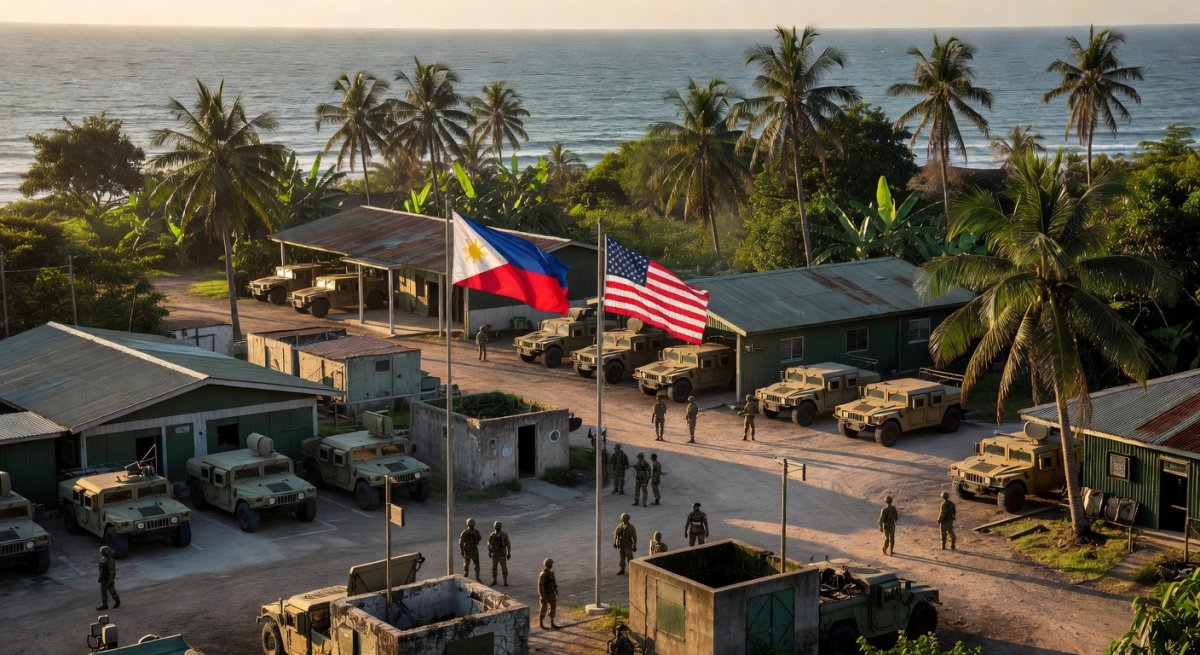
In a recent CGTN report, an American expert contends that United States military bases in the Philippines increase rather than diminish Manila's vulnerability to external threats. The analysis frames these installations as magnets for potential conflict, particularly amid rising tensions in the South China Sea, and urges their phased removal to restore Philippine strategic autonomy.
This perspective aligns with longstanding debates over forward-deployed forces and their deterrent value versus provocation risks. The expert highlights how such bases could draw the Philippines into great-power rivalries without sufficient safeguards for local sovereignty or regional stability.
The EDCA Framework and Its Evolution
The Enhanced Defense Cooperation Agreement, signed in 2014 and expanded in 2023, designates nine sites for rotational United States access. These include locations such as Camp Aguinaldo in Metro Manila, Basa Air Base in Pampanga, Lal-lo Airport in Cagayan, and additional facilities in Palawan and other northern provinces. The 2023 additions broadened the geographic scope, emphasizing air and maritime domains near the Luzon Strait.
Under the agreement, United States forces rotate through these sites for training and prepositioning of equipment, without establishing permanent bases. Philippine officials have emphasized that EDCA remains consistent with the 1947 Military Bases Agreement's successor frameworks while addressing modern capability gaps. Expansions have proceeded through bilateral consultations involving the Department of National Defense and United States Indo-Pacific Command, with implementation timelines extending into subsequent years.
Critics note that the agreement's evolution reflects Washington's desire to distribute assets across the first island chain. Philippine participation grants access to American funding for infrastructure upgrades at these sites, yet operational control stays with Manila. Historical context from the post-1991 withdrawal of permanent United States bases illustrates how EDCA revives selective access arrangements without full-scale reoccupation.
China's Strategic Calculus on Periphery Security
China's Ministry of Foreign Affairs has consistently described United States military activities in the Philippines as external interference that heightens regional tensions. Statements by Foreign Minister Wang Yi have underscored Beijing's preference for direct bilateral dialogue with Manila on maritime issues, framing EDCA expansions as contrary to the spirit of the 2002 Declaration on the Conduct of Parties in the South China Sea.
Chinese naval modernization, including advancements in surface combatants and submarine capabilities, forms part of a broader periphery security strategy aimed at safeguarding sea lanes and disputed features. Reports of maritime militia presence near Scarborough Shoal and Second Thomas Shoal illustrate gray-zone tactics that avoid direct escalation while asserting administrative control. These measures support Beijing's Dual Circulation strategy by protecting trade routes critical to domestic economic resilience.
From China's viewpoint, United States rotational presence under EDCA complicates efforts to manage disputes through ASEAN mechanisms. Officials in Beijing argue that such arrangements risk militarizing the region and undermining the principle of non-interference central to China's regional diplomacy.
Philippine Hedging Strategy Under Marcos Jr.
Under President Ferdinand Marcos Jr., Manila has pursued a calibrated approach that reinforces the 1951 Mutual Defense Treaty with the United States while sustaining economic engagement with China. Bilateral trade volumes have continued to grow, with infrastructure projects under the Belt and Road Initiative advancing in select sectors despite occasional frictions over maritime incidents.
Marcos Jr. has authorized EDCA site expansions yet maintained high-level visits to Beijing to discuss investment pipelines and agricultural exports. Philippine statistics show China remaining a top trading partner, with cooperation extending to rail and port developments outside defense-related zones. This hedging reflects domestic political calculations that balance alliance commitments against the need for diversified economic partnerships.
Manila's strategy also incorporates capacity-building measures through the Armed Forces of the Philippines modernization program, seeking to reduce reliance on any single external actor. Historical oscillations between closer United States alignment and pragmatic China engagement illustrate the continuity of this approach across administrations.
ASEAN's Middle Path
ASEAN member states have responded to EDCA developments with measured statements that avoid direct endorsement or condemnation. Indonesia has reiterated support for the ASEAN Outlook on the Indo-Pacific, emphasizing inclusive dialogue and economic connectivity over military alignments. Vietnam has accelerated its own defense modernization while engaging both Washington and Beijing through separate channels.
Malaysia and Singapore have focused on maintaining freedom of navigation without expanding foreign base access on their territories. The collective ASEAN position continues to prioritize the 2002 declaration and ongoing code-of-conduct negotiations as the primary vehicle for managing South China Sea disputes. These stances reflect a shared interest in preventing binary great-power polarization within the region.
Second-order effects include strengthened intra-ASEAN defense dialogues and diversified supply-chain initiatives that lessen dependence on any single external security guarantor. The Outlook on the Indo-Pacific serves as a doctrinal framework for preserving strategic autonomy amid external pressures.
Broader Geopolitical Implications
EDCA expansions carry implications for the Taiwan Strait by enhancing United States logistical reach across northern Philippine islands. This positioning could influence contingency planning on both sides of the strait, affecting calculations in Tokyo, Seoul, and Canberra. Supply-chain resilience efforts across the Global South may accelerate as countries seek to mitigate risks associated with potential disruptions in the South China Sea.
For ASEAN economies, sustained hedging strategies could foster greater multilateral institution-building, including expanded roles for the Regional Comprehensive Economic Partnership. China's pursuit of technological self-sufficiency gains added relevance as regional actors weigh alignment costs against long-term economic interdependence. The United States, meanwhile, seeks to distribute deterrence burdens while preserving access arrangements that avoid the political liabilities of permanent basing.
Overall, the interplay between EDCA implementation and Chinese periphery security measures will shape whether the Philippines emerges as a stabilizing buffer or an inadvertent flashpoint. Careful management of alliance commitments alongside economic pragmatism remains essential for all parties seeking durable regional equilibrium.
By Prof. Marcus Chen, Staff WriterThis article was produced with AI-assisted research and editorial support. Reporting is based on sources cited in the article.
What's Your Reaction?
 Like
0
Like
0
 Dislike
0
Dislike
0
 Love
0
Love
0
 Funny
0
Funny
0
 Wow
0
Wow
0
 Sad
0
Sad
0
 Angry
0
Angry
0

World Politics Analyst at Global1.News. Based in Beijing, covering US-China relations, global trade, and geopolitical strategy. Brings deep analytical perspective to the power dynamics shaping international affairs.












Comments (0)