
US Strikes Iran for Sixth Night as Tehran Condemns Attack Near Children's Hospital, Warns War Will Spread
The US strikes Iran for a sixth consecutive night, hitting civilian infrastructure in the south. Iran condemns a "barbaric" attack near a children's cancer hospital in Ahvaz, evacuating 211 chemo patients. The interim peace deal falters as both sides harden positions amid regional spillover.
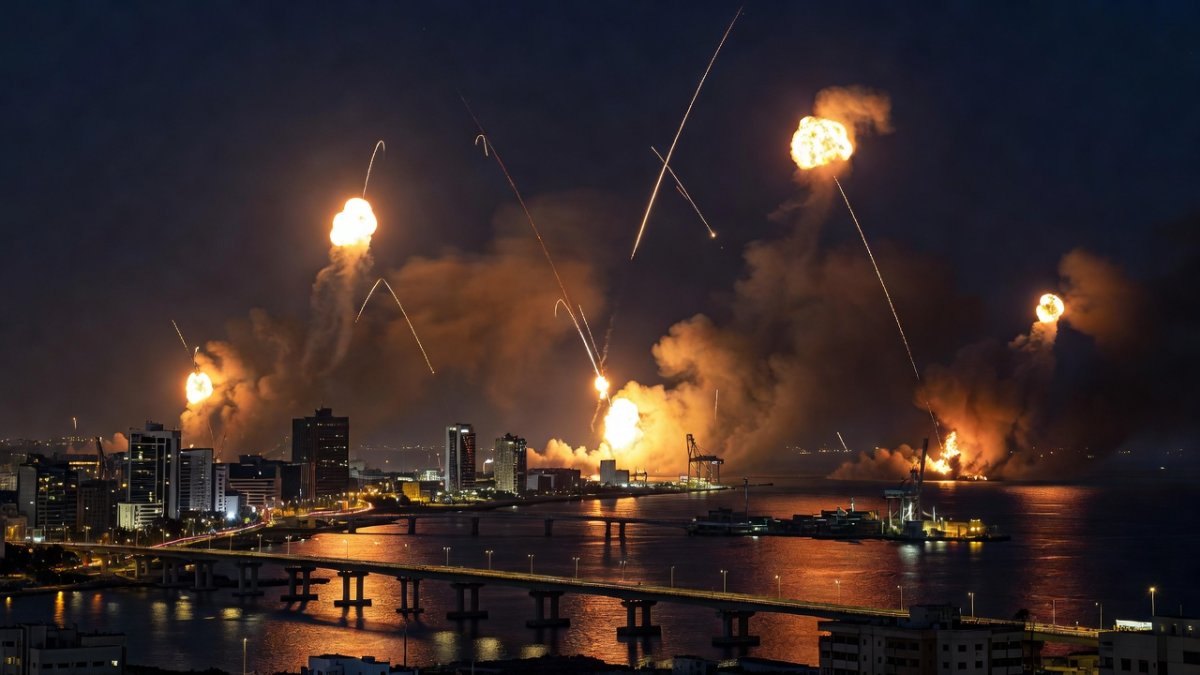
US Strikes Iran for Sixth Night as Tehran Condemns Attack Near Children's Hospital, Warns War Will Spread
US Launches Sixth Night of Strikes
US Central Command conducted operations beginning at 18:00 GMT on Thursday, marking the sixth consecutive night of strikes on Iranian territory. The stated objective was to further degrade Iranian military capabilities. Iranian media reported seven deaths across Qeshm Island, Bandar Abbas, Chabahar, Iranshahr, and Bandar-e Khamir. Casualties were also feared in the Bandar Abbas and Bandar-e Khamir areas, where transport infrastructure including the Kehvarstan Bridge and a railway station came under attack.
Analysts at the International Crisis Group have drawn parallels to the 1980s Tanker War, when Iranian and Iraqi forces targeted oil shipping in the Gulf, disrupting 15 percent of global crude flows and driving insurance premiums up by 400 percent. Carnegie Middle East experts note that the Kehvarstan Bridge serves as a critical artery linking Bandar Abbas port to inland refineries, much like the infrastructure targeted during the 1991 Gulf War coalition campaign against Iraqi logistics. Current US naval interdictions have already rerouted an estimated 2.1 million barrels per day away from the Strait of Hormuz, which normally carries 21 percent of seaborne oil trade.
Chatham House researchers highlight how these strikes echo the 2003 Iraq invasion's initial focus on command nodes, yet risk broader economic fallout as oil prices hover near $118 per barrel. Military budgets across the region reflect the strain: Saudi Arabia's $75 billion defense allocation for 2026 includes expanded Patriot batteries, while the UAE has increased spending by 12 percent to counter potential proxy retaliation.
Targeting of Civilian Infrastructure Raises Concerns
The latest wave of US operations has focused on southern Iranian locations, including transport links vital for regional movement. Both Washington and Tehran have accused each other of violating the interim peace deal memorandum of understanding signed in June 2026. US forces also redirected three commercial vessels attempting to bypass the Gulf of Oman blockade, disabling one and boarding another. These actions occur against the backdrop of President Trump's earlier threats to target Iranian infrastructure if talks do not resume.
Enforcement of the blockade relies on a combination of Aegis-equipped destroyers and Coast Guard boarding teams operating under Combined Maritime Forces protocols, a mechanism refined after the 2019 Abqaiq attacks exposed Gulf energy vulnerabilities. Second-order effects include a reported 280 percent spike in war-risk insurance premiums for vessels transiting the Gulf of Oman, prompting several European shipping lines to suspend services. The International Crisis Group warns that such measures could fracture GCC unity, as Oman and Kuwait seek to preserve neutral transit rights established during the 1991 conflict.
Iran's Condemnation of Hospital Vicinity Strike
Iran's Foreign Ministry spokesperson Esmaeil Baghaei described a strike near Shahid Baghaei Specialised Hospital in Ahvaz as a cowardly war crime. Hospital director Dr Majid Bou'azar confirmed that 211 patients undergoing chemotherapy were forced to relocate, with some requiring oxygen and ventilators. The facility was placed out of service as a result. Iranian officials drew parallels to reported targeting of healthcare facilities in Gaza, while the US offered no comment on this specific incident. Over 30 civilians have been killed in US strikes according to Iranian government figures since the conflict began around February 2026.
Among the evacuated patients were twelve children under the age of ten whose treatment regimens for leukemia were interrupted mid-cycle, forcing families to travel over 300 kilometers to alternative facilities in Shiraz. Carnegie Middle East analysts compare the incident to the 1979 revolutionary period's disruption of medical supply chains, noting that sanctions already limit access to specialized pharmaceuticals. The International Crisis Group has documented similar patterns of infrastructure strain during the 2003 Iraq War, when civilian health systems absorbed secondary shocks from targeted strikes on nearby dual-use sites.
Regional Spillover: Fires in Kuwait and Qatar Interception
Falling debris from intercepted Iranian projectiles sparked fires and thick smoke in a border area between Kuwait and Iraq. Qatar's Ministry of Defense separately intercepted a missile attack aimed at its territory. Iran stated that it had targeted US military sites in Jordan and Kuwait. Qatar rejected Israeli media reports suggesting any Qatari agreement to participate in military action against Iran. These incidents illustrate how the confrontation is producing immediate effects beyond Iranian borders.
These cross-border incidents revive memories of the 1991 Gulf War Scud exchanges that forced mass evacuations in Saudi Arabia and Israel. Chatham House reports that Qatar's independent air-defense posture, bolstered by a $2.3 billion investment in THAAD systems since 2022, reflects a deliberate distancing from Saudi-led coordination seen during the 2017-2021 GCC crisis. Second-order alliance dynamics now include accelerated Turkish-Qatari security consultations, potentially shifting Iran's proxy calculations in Iraq and Syria.
Energy Security at Stake in the Strait of Hormuz
The International Energy Agency executive director warned that global energy security faces risk without increased oil shipments through the Strait of Hormuz. Iranian warnings that it would respond by targeting civilian infrastructure in neighboring Gulf countries add pressure on energy routes. Gulf states have responded by strengthening air defenses around critical infrastructure amid the prevailing uncertainty. The situation directly affects OPEC+ diplomacy and the stability of global oil markets.
Oil market analysts at Carnegie Middle East project that sustained closure threats could push Brent crude above $140, replicating the 1979 revolution's supply shock that doubled prices within months. Shipping volumes through Hormuz have already fallen 18 percent month-over-month, raising global refining margins and prompting China to draw down strategic reserves at a rate of 1.2 million barrels daily. The International Crisis Group notes that any Iranian mining of the strait would echo the 1980s Tanker War's asymmetric tactics, forcing Gulf monarchies to weigh energy revenues against domestic stability.
The Faltering Interim Peace Deal
The interim US-Iran peace deal signed in June 2026 is faltering, with mutual accusations of violations dominating statements from both sides. President Trump threatened to strike Iranian power plants and bridges next week if Tehran does not return to talks, while claiming in a primetime address that the US is winning big in Iran and that the fruits of that labor would appear very shortly. Iran has warned that the war will spread if attacks continue.
Chatham House scholars observe that the June 2026 memorandum mirrors the fragile 2015 JCPOA framework, undermined by domestic political cycles in both capitals. Carnegie Middle East analysts point to the 2003 Iraq precedent, where interim security arrangements collapsed under mutual recriminations, leading to prolonged proxy conflict. Iranian officials have privately signaled to European intermediaries that further strikes on power infrastructure could trigger activation of dormant Houthi and Iraqi militia networks.
Gulf States' Defensive Posture and Broader Dynamics
Gulf Cooperation Council members are prioritizing protection of vital installations as the conflict extends into its fifth month. Iran's proxy networks and the nuclear program's status remain central factors shaping regional calculations. Great power competition involving the United States, China, and Russia adds layers of complexity, as each actor assesses leverage in energy markets and security arrangements. Qatar's independent stance on reported military cooperation further highlights divisions within Gulf alignments.
Beijing's mediation attempts, building on its 2023 Saudi-Iran rapprochement role, now face tests as Chinese oil imports from the Gulf drop 9 percent. Moscow has increased arms deliveries to Tehran, valued at $1.8 billion this quarter, altering proxy balances in Lebanon and Yemen. The International Crisis Group warns that these great-power undercurrents risk transforming a bilateral confrontation into a wider regional realignment unseen since the 1991 post-war security architecture.
Regional Implications for the Gulf and Beyond
The escalation carries profound consequences for GCC cohesion and global energy governance. Heightened insurance costs and rerouted tankers have already added an estimated $4 billion in monthly logistics expenses for Asian importers, prompting renewed interest in overland pipelines from Iraq and the UAE. Historical precedents from the 1991 and 2003 conflicts demonstrate that sustained Gulf instability tends to accelerate diversification away from Hormuz-dependent routes, a trend now visible in Saudi and Emirati investments in Indian Ocean ports.
Proxy network shifts are equally significant: Iranian-backed groups in Iraq have increased rocket attacks on US facilities by 40 percent since February, while Hezbollah's Lebanese front remains largely contained due to economic pressures. Chatham House analysts caution that any widening of the conflict could fracture the Abraham Accords framework, as Gulf states weigh normalization benefits against domestic security risks. Meanwhile, the International Energy Agency projects that prolonged disruption could shave 0.8 percent off global GDP growth in 2027, with developing economies bearing the brunt through elevated food and transport costs.
What This Means
The sixth night of US strikes demonstrates Washington's willingness to sustain pressure on Iranian military assets while risking escalation through proximity to civilian sites. Tehran's accusations and threats of reciprocal targeting of Gulf infrastructure reflect a strategy aimed at raising costs for US allies in the region. The involvement of Kuwait and Qatar through debris incidents and interceptions shows how quickly localized actions can affect multiple states. Energy security concerns voiced by the IEA underscore the leverage Iran retains via the Strait of Hormuz, even as US naval actions seek to enforce restrictions. The breakdown of the June 2026 memorandum of understanding illustrates the difficulty of maintaining interim arrangements amid ongoing military operations. For Gulf states, the priority remains shielding economic assets while navigating relations with both Washington and Tehran. Second-order effects include heightened risks to global oil flows and potential realignments among regional actors seeking to limit spillover. The strategic calculus for each side centers on demonstrating resolve without triggering uncontrolled expansion of the conflict that began around February 2026.
By Malik Hassan, Staff WriterThis article was produced with AI-assisted research and editorial support. Reporting is based on sources cited in the article.
What's Your Reaction?
 Like
0
Like
0
 Dislike
0
Dislike
0
 Love
0
Love
0
 Funny
0
Funny
0
 Wow
0
Wow
0
 Sad
0
Sad
0
 Angry
0
Angry
0
Middle East Correspondent at Global1.News. Based in Beirut, covering politics, conflict, energy, and society across the Middle East. Brings context and depth to a region often reduced to headlines.










Comments (0)